On this page
Think of the heavy roller a groundsman drags across a cricket pitch. Hold its handle at the same angle and pull from the front, or push from behind: pulling feels lighter. The reason is the vertical part of your force, and it is a classic school physics exam question.
Why is it easier to pull a lawn roller than push it?
Resistance to motion depends on how hard the two surfaces are pressed together. HyperPhysics puts it plainly: frictional resistance is usually proportional to the force pressing the surfaces together, written f = μN.
OpenStax University Physics gives the same rule: kinetic friction is f = μN, where N is the normal force, and static friction can be at most μN.
A roller rolls rather than slides, but its rolling resistance follows the same pattern: it is modelled as a dimensionless coefficient times the normal force, F = C_rr × N (Rolling resistance, Wikipedia).
So anything that changes N changes the drag. Your force F along the handle, at angle θ above the ground, splits into F cos θ along the ground, which moves the roller, and F sin θ, which acts vertically.
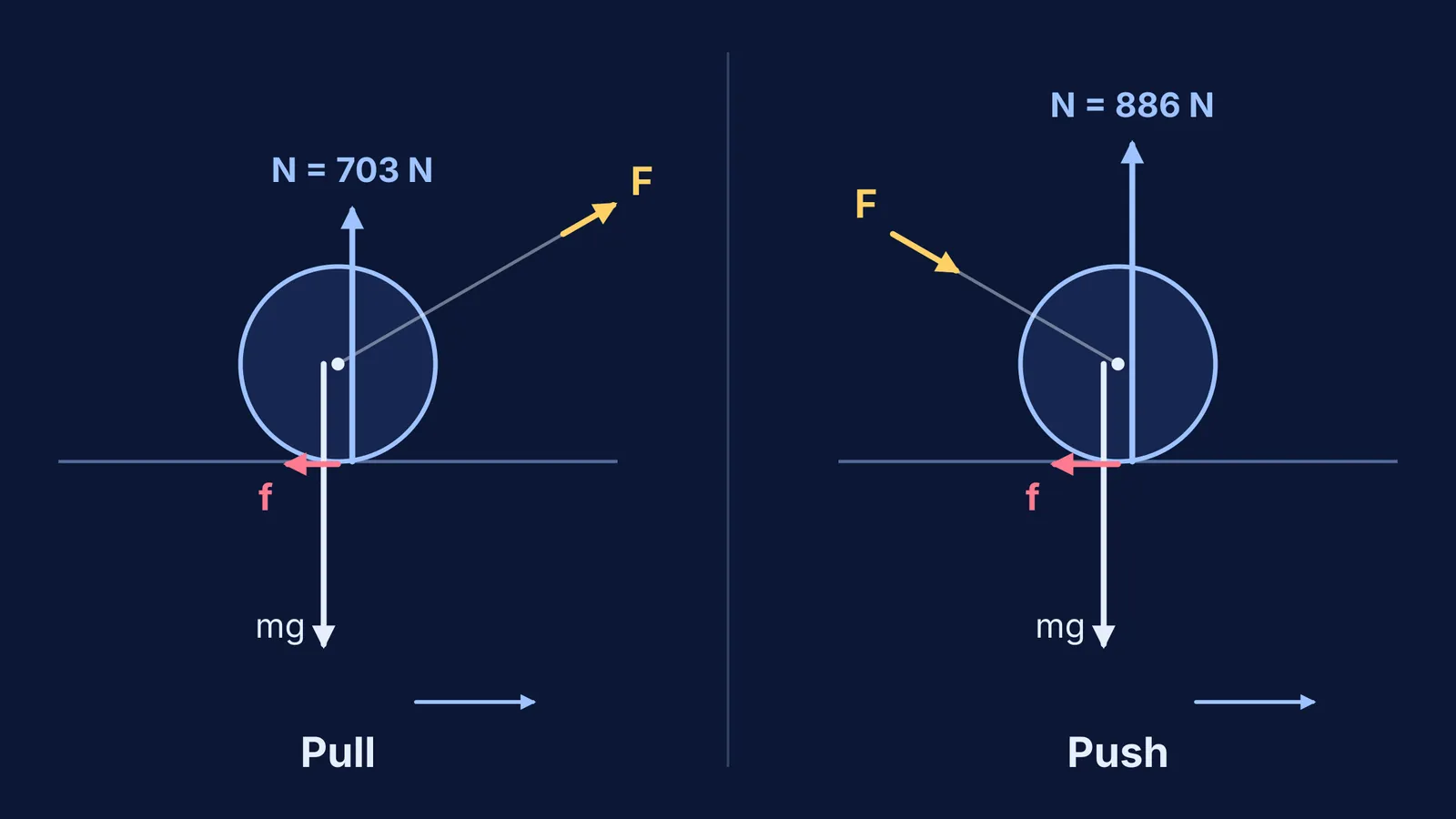
Pulling: your hands are above and ahead of the roller, so F sin θ points up and carries part of the weight. N = mg − F sin θ.
Pushing: you press down and forward along the handle, so F sin θ points down and adds to the weight. N = mg + F sin θ.
Less N means less resistance. More N means more resistance, which needs a bigger push, which raises N again. Pulling turns the loop in your favour: a harder pull lifts more of the weight. The same idea on a slope is worked through in normal force on an incline when you push horizontally.
How much easier is pulling? A worked example
Take an 80 kg roller, g = 9.8 m/s², the handle at 30° and a resistance coefficient μ = 0.2. That μ is a round number chosen for the example; a real one depends on the soil, the grass and the roller. Assume steady speed, so the horizontal forces balance.
Weight: mg = 80 × 9.8 = 784 N, so μmg = 156.8 N. Use cos 30° = 0.866 and sin 30° = 0.5.
Pulling: F cos θ = μ(mg − F sin θ), so F = μmg / (cos θ + μ sin θ) = 156.8 / 0.966 ≈ 162 N. The normal force is 784 − 81 = 703 N.
Pushing: F cos θ = μ(mg + F sin θ), so F = μmg / (cos θ − μ sin θ) = 156.8 / 0.766 ≈ 205 N. The normal force is 784 + 102 = 886 N.
Same roller, same angle, and pushing takes roughly a quarter more force.
Can pushing ever become impossible?
In this model, yes. The push formula breaks down when cos θ − μ sin θ falls to zero, that is when tan θ = 1/μ. For μ = 0.2 that happens at about 79°. At that angle, pushing harder only drives the roller into the ground: the extra friction cancels the extra forward force.
What is the best angle to pull at?
Pulling force is least when cos θ + μ sin θ is largest, which happens when tan θ = μ. For μ = 0.2 that is about 11°, and the force drops to μmg / √(1 + μ²) ≈ 154 N. Pulling flat needs μmg = 157 N, and our 30° pull needed 162 N. A slight upward pull beats a flat one; a steep pull wastes force because less of it points forward.
How do you write this answer in an exam?
Give the reason, not just the fact:
Draw the free-body diagram: mg down, N up, F along the handle at θ, friction opposite to motion.
Resolve F into F cos θ (horizontal) and F sin θ (vertical).
Write the vertical balance for each case: N = mg − F sin θ for pulling, N = mg + F sin θ for pushing.
Use f = μN to compare friction.
Conclude in one line: "In pulling, the vertical component of the applied force acts upward and reduces the normal reaction, so friction is less; in pushing, it acts downward and increases the normal reaction, so friction is more."
A common slip is writing N = mg in both cases. Another is assuming friction equals μN before the roller moves; static friction only grows as large as needed, as our explainer on why static friction is not always μN shows. A related trap is thinking contact area belongs in f = μN; see why friction does not depend on area of contact.
If a variation trips you up, such as a roller on a slope, the Fermi Problem Library has worked problems with a step-by-step solver that explains the reasoning rather than printing an answer. To revisit normal reaction and friction from the start, each has its own lesson in the Fermi Concept Library.