

On this page
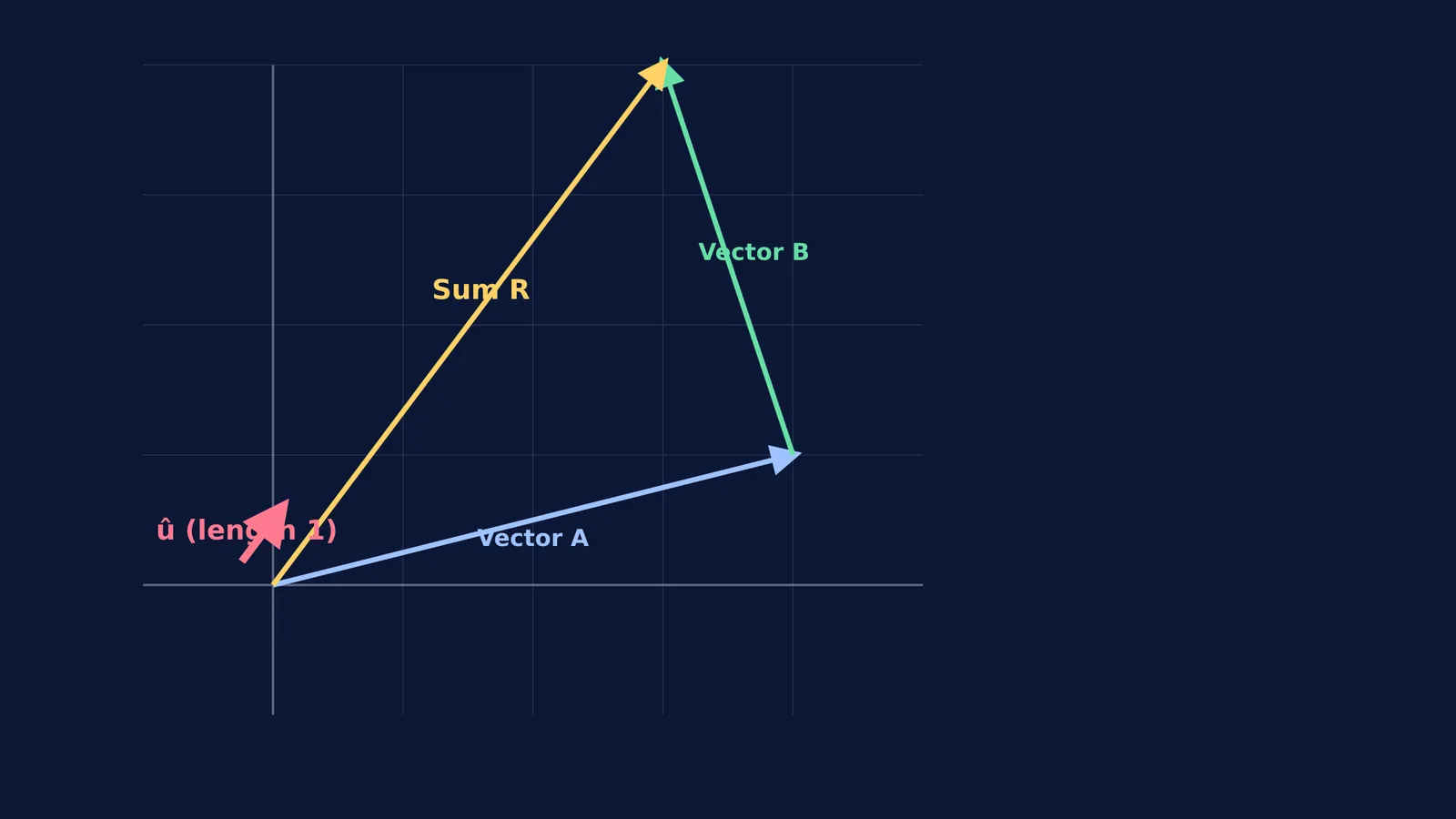
To find the unit vector in the direction of the sum of two vectors, you add their components to find the sum vector, calculate its magnitude, and then divide the sum vector by that magnitude.
What is a unit vector?
A unit vector "has a magnitude of one and does not have any physical unit" (OpenStax, University Physics Volume 1). Its only job is to specify a direction.
When you add two forces, velocities, or displacements together, you often want to know exactly which direction the total (or resultant) points, without worrying about its size. This is where you need the unit vector of their sum. Because the magnitude of a unit vector is exactly 1, you can multiply it by any scalar value later to create a new vector pointing in the same direction.
How do you find the unit vector in direction of sum of two vectors?
Finding this direction takes three steps: adding the components, measuring the total length, and scaling it down to 1.
Add the vectors to find the sum. Vectors are added component by component. You add the î (x-axis) components together, the ĵ (y-axis) components together, and the k̂ (z-axis) components together. This gives you the sum vector, often called the resultant vector (R).
Find the magnitude of the sum. The magnitude (or length) of the sum vector is found using the 3D Pythagorean theorem. If your sum vector is R = xî + yĵ + zk̂, the magnitude |R| is √(x² + y² + z²).
Divide by the magnitude. To get the unit vector (often written as R̂ or û), divide each component of your sum vector by the magnitude you just calculated.
A step-by-step worked example
Let us find the unit vector in the direction of the sum of two 3D vectors: Vector A = 3î + 2ĵ + 4k̂ Vector B = -1î + 1ĵ + 2k̂
Step 1: Find the sum vector (R) We add the matching components of A and B: x-component: 3 + (-1) = 2 y-component: 2 + 1 = 3 z-component: 4 + 2 = 6
So, the sum vector is R = 2î + 3ĵ + 6k̂.
Step 2: Calculate the magnitude (|R|) We square each component, add them, and take the square root: |R| = √(2² + 3² + 6²) |R| = √(4 + 9 + 36) |R| = √49 |R| = 7
The length of the sum vector is 7 units. (If you want to see this addition happen visually before calculating, you can test it in a vector addition simulation.)
Step 3: Divide to find the unit vector We divide each component of the sum vector by its magnitude of 7.
Unit vector û = (2/7)î + (3/7)ĵ + (6/7)k̂
The magnitude check Let us prove this vector has a length of 1: Magnitude = √((2/7)² + (3/7)² + (6/7)²) Magnitude = √(4/49 + 9/49 + 36/49) Magnitude = √(49/49) Magnitude = √1 = 1.
The length is exactly 1, confirming our unit vector is correct.
What happens if the vectors have negative components?
Negative signs are the most common source of error when adding vectors. A negative component simply means the vector points in the opposite direction along that axis. For example, if you have a component of -4ĵ, the vector points downwards on the y-axis. When you add components, you must carry these signs over exactly as they are written.
If Vector C = 5î - 8ĵ and Vector D = 2î + 12ĵ, the y-component of the sum is (-8) + 12 = +4. Treating a negative component as positive will change both the direction of your resultant and the final unit vector. Always write the signs out clearly before starting your arithmetic.
What if I make a mistake adding vector components?
When dealing with complex mechanics problems, losing track of your components is a common wrong-method mistake, especially if you also need to resolve vectors along non-perpendicular axes. If you find yourself stuck, you can use the Fermi Problem Library. Its step-by-step solver explains the reasoning behind each component breakdown, helping you find where your arithmetic went off track rather than just printing the final answer.
Sometimes, vectors can completely cancel each other out. If you are adding multiple vectors and checking your sum, you might want to review the condition for three vectors to have a zero resultant.


