

On this page
When you study vectors in introductory physics, you quickly encounter a classic question: given three vectors with fixed lengths, is it possible to orient them so that their resultant is zero? The short answer is yes, but only if their lengths satisfy a strict geometric rule known as the triangle inequality.
Can three vectors add to zero?
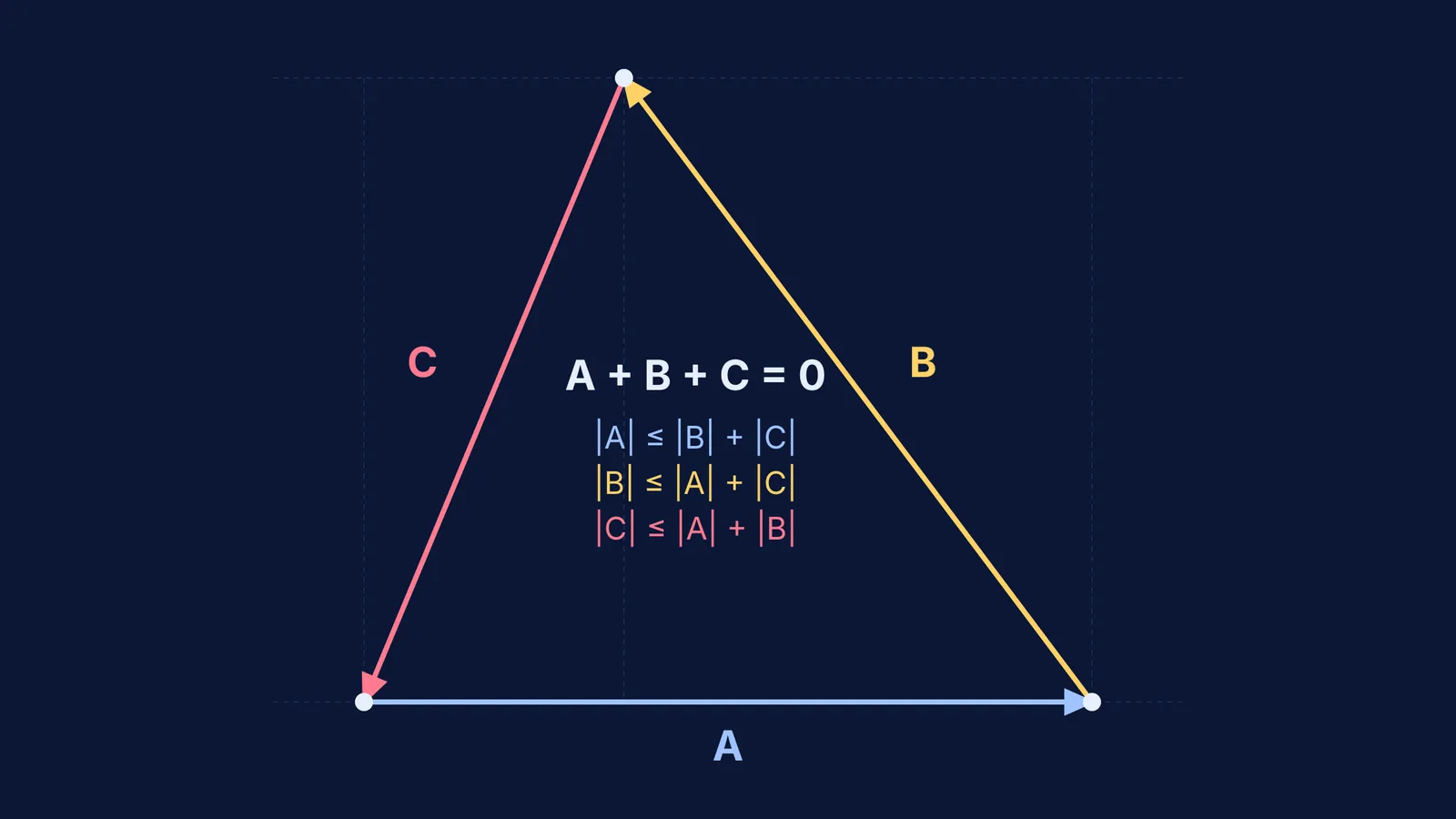
Three vectors can add to zero if and only if they are coplanar and can be arranged to form a closed triangle. According to OpenStax University Physics Volume 1, the vector sum of individual vectors equals the null vector when the head of the final vector returns exactly to the tail of the first.
This geometric rule imposes a strict limit on their magnitudes. If you label the three vector lengths as a, b, and c, with c being the largest magnitude, the vectors can add to zero if and only if c ≤ a + b.
The maximum possible resultant of two vectors occurs when they point in the exact same direction, yielding an effective magnitude of a + b. If the third vector c is longer than this combined reach, even placing a and b in direct opposition cannot cancel c out. The minimum resultant magnitude would still be c − (a + b), which remains strictly greater than zero.
Why must three vectors form a closed triangle?
Vector addition represents sequential displacements. If you walk along vector A, continue along vector B, and then follow vector C, your net displacement is zero only if you end up back at your starting point. As explained in the Class 11 physics curriculum published by NCERT, the polygon law of vector addition states that when vectors taken in sequence form a closed perimeter, their resultant is the zero vector.
In mechanics, this geometry describes static equilibrium. When three concurrent forces act on a stationary particle, Newton's second law requires their vector sum to equal zero. This balance is often analysed using Lami's theorem for concurrent forces, where each force magnitude is proportional to the sine of the angle between the other two forces.
Why do students struggle with graphical vector addition?
Visualising vector addition as a closed geometric shape sounds simple, but empirical research shows it is a frequent stumbling block. In a study of over 2,000 introductory physics students published in the American Journal of Physics, researchers evaluated student understanding of vector operations using graphical diagnostic tests (ERIC EJ679757).
The authors found that more than 25% of students beginning second-semester calculus-based physics and more than 50% of students in algebra-based physics could not correctly perform two-dimensional vector addition graphically (ERIC EJ679757). Instead of placing vectors head to tail, students frequently connected arrows tip to tip or guessed a resultant direction without checking geometric constraints.
Understanding why three vectors must form a closed loop helps prevent these common vector errors in physics. When you view equilibrium as a closed geometric circuit, spotting impossible combinations becomes second nature.
How can you test any three magnitudes step by step?
According to the vector addition rules in OpenStax University Physics Volume 1, you can test whether any three positive numbers can represent vectors with a zero resultant using a simple three-step method:
Identify the largest magnitude: Sort your three lengths so that a ≤ b ≤ c, where c is the largest value.
Sum the two smaller values: Calculate the sum a + b.
Compare the sum to the largest value:
If a + b > c, the three vectors can form a non-degenerate triangle and can add to zero.
If a + b = c, the vectors can add to zero only as collinear vectors along a single line.
If a + b < c, the three vectors cannot add to zero under any orientation.
Consider a few worked examples:
Magnitudes 3 N, 4 N, and 5 N: The largest is 5 N. The sum of the shorter two is 3 N + 4 N = 7 N. Since 7 N > 5 N, these vectors can form a closed right-angled triangle and sum to zero.
Magnitudes 2 N, 5 N, and 9 N: The largest is 9 N. The sum of the shorter two is 2 N + 5 N = 7 N. Because 7 N < 9 N, they cannot close the loop, so their resultant can never be zero.
Magnitudes 4 N, 6 N, and 10 N: The largest is 10 N. Here, 4 N + 6 N = 10 N. They can add to zero only if the 4 N and 6 N forces act in the same direction and directly oppose the 10 N force.
Magnitudes 8 N, 8 N, and 8 N: Three equal vectors can add to zero because 8 N + 8 N = 16 N > 8 N. They form an equilateral triangle when oriented at 120° relative to one another.
How to build confidence with vector reasoning?
Mastering vector addition requires active practice rather than passive memorisation. Drawing vectors on grid paper, breaking them into horizontal and vertical components, and checking whether the components independently sum to zero builds durable intuition.
The Fermi Problem Library has worked problems with a step-by-step solver that explains the reasoning rather than printing an answer. For geometric concepts, the Fermi Simulation Lab provides interactive simulations for ideas that are easier to see than to read. When working through challenging physics topics, Fermi's AI tutor can work out what you already know and build a plan for the session, drawing figures and checking understanding as you go.


