

On this page
A vector addition simulation lets you drag arrows about. The trap is to drag first and think later. Write down a prediction, then move the arrows to check it. Here are six predictions, with numbers you can check by hand.
The rules come from the free OpenStax textbook. In the tail-to-head method, you place the tail of the second vector on the head of the first, and the resultant runs from the tail of the first to the head of the last. Vectors that point the same way are parallel; vectors 180 degrees apart are antiparallel. The same page warns that the size of the resultant generally cannot be written as a simple sum or difference of the two sizes. That is exactly what the simulation lets you see.
How do you add vectors tip to tail in a simulation?
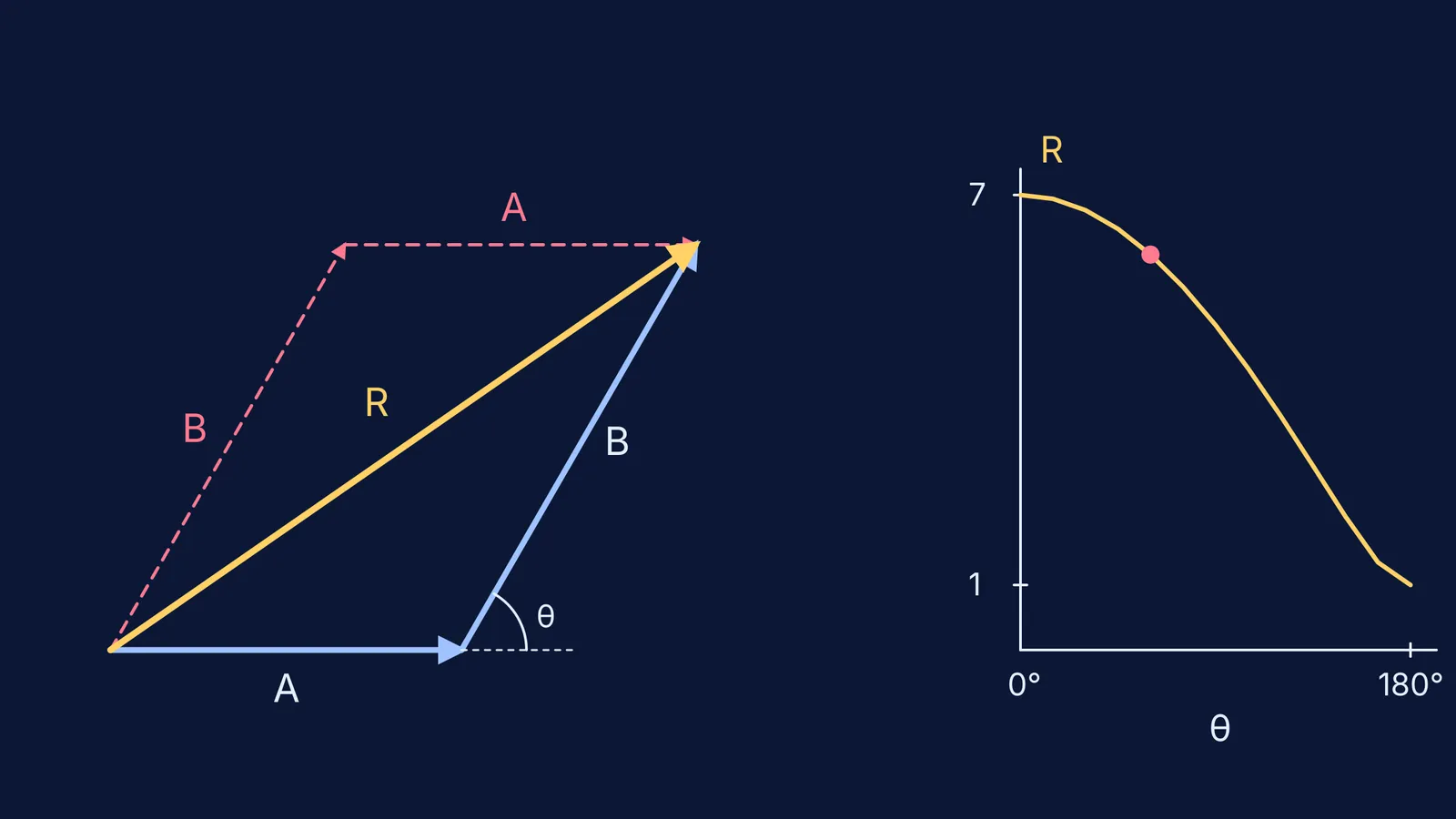
Set up two vectors: A of length 3 units and B of length 4 units. Drag B so its tail sits on A's tip. Many simulations then draw the resultant R for you, from A's tail to B's tip. Before you touch anything else, write down your answers to these six predictions.
At what angle between A and B is R longest, and how long is it?
At what angle is R shortest, and how long is it?
Can these two vectors ever give R = 0? If not, what would?
When the angle is 90 degrees, what are R's x and y parts?
If you add B first and then A, does R change?
As you sweep the angle from 0 to 180 degrees, does R shrink steadily or in jumps?
When is the resultant largest, smallest and zero?
Point A and B the same way and R is 3 + 4 = 7 units, the most it can ever be. Turn B round to face the other way and R falls to 4 − 3 = 1 unit, pointing along B, the longer vector. Every other angle gives something between 1 and 7. The resultant cannot reach zero here, because 4 units of B always outlast 3 units of A.
For two vectors to cancel, they must be equal in size and opposite in direction. OpenStax calls the result the null vector, which has no length and no direction. With three vectors, zero is easier: lengths 3, 4 and 5 arranged tip to tail into a closed triangle bring you back to where you started. That is why balanced forces on a knot form a closed triangle.
How do the components of vectors add?
OpenStax adds vectors component by component: the x-component of R is the sum of the x-components, and the same for y. Turn on the component display and test prediction 4.
Put A along x, so A = (3, 0). Set B at 90 degrees, so B = (0, 4). Then R = (3 + 0, 0 + 4) = (3, 4). Its length is the square root of 9 + 16, which is 5 units, and its angle above A is the inverse tangent of 4/3, about 53 degrees.
Now set B at 60 degrees. Its parts are 4 cos 60 = 2 and 4 sin 60 = 3.46, so R = (5, 3.46) and its length is about 6.08 units. At 120 degrees, B = (−2, 3.46), R = (1, 3.46) and the length drops to about 3.61. Components can be negative as well as positive, and that minus sign is what pulls R shorter once the angle passes 90 degrees. Put together, the length is R² = A² + B² + 2AB cos θ, which answers prediction 6: R shrinks smoothly, with no jumps.
Why does the order of addition not matter?
Drag B to the origin first, then hang A on its tip. The path is different, but the tip lands on the same point. Together the two paths form a parallelogram, and R is its diagonal. OpenStax states this as A + B = B + A, and notes that vector addition is commutative and associative, so with three or more vectors you can group them in any order too.
A checklist for your session
Write all six predictions before dragging anything.
Test the extremes first: 0 and 180 degrees.
Read the components and add them in your notebook, then compare with the screen.
Swap the order and confirm the tip does not move.
Try three vectors and make R exactly zero.
This is the same predict-then-test routine as in our post on learning projectile motion with a simulation, and the research behind it is in what PhET studies say interactive simulations are good for. Once the picture is clear, check the slips that cost marks in common vector errors in JEE physics.
If you want to drag the arrows yourself, the Fermi Simulation Lab has interactive simulations for ideas that are easier to see than to read. Predict first, then see how many survive.


