

On this page
Why does standard right-angle resolution fail on oblique axes?
Most students learn vector resolution as a reflex: multiply the magnitude by cos θ for the horizontal component and by sin θ for the vertical component. This shortcut works only because standard Cartesian axes meet at 90°, where dropping a perpendicular from the vector tip onto an axis coincides with completing a rectangle. When forces act along non-perpendicular lines—such as structural members in engineering statics or inclined planes with tilted reference lines—applying cos θ and sin θ fails.
In a benchmark study in the American Journal of Physics, Ngoc-Loan Nguyen and David E. Meltzer (2003) found that more than 25% of students beginning the second semester of calculus-based physics and 50% in algebra-based courses could not successfully perform two-dimensional vector operations or identify vector components graphically. When axes are not orthogonal, students frequently drop perpendiculars to each axis. This mistake confuses orthogonal projection with true vector resolution, as examined in our guide to common vector errors in JEE physics. Adding two orthogonal projections on non-perpendicular axes never reconstructs the original vector.
How do you use the parallelogram law and sine rule to resolve a vector?
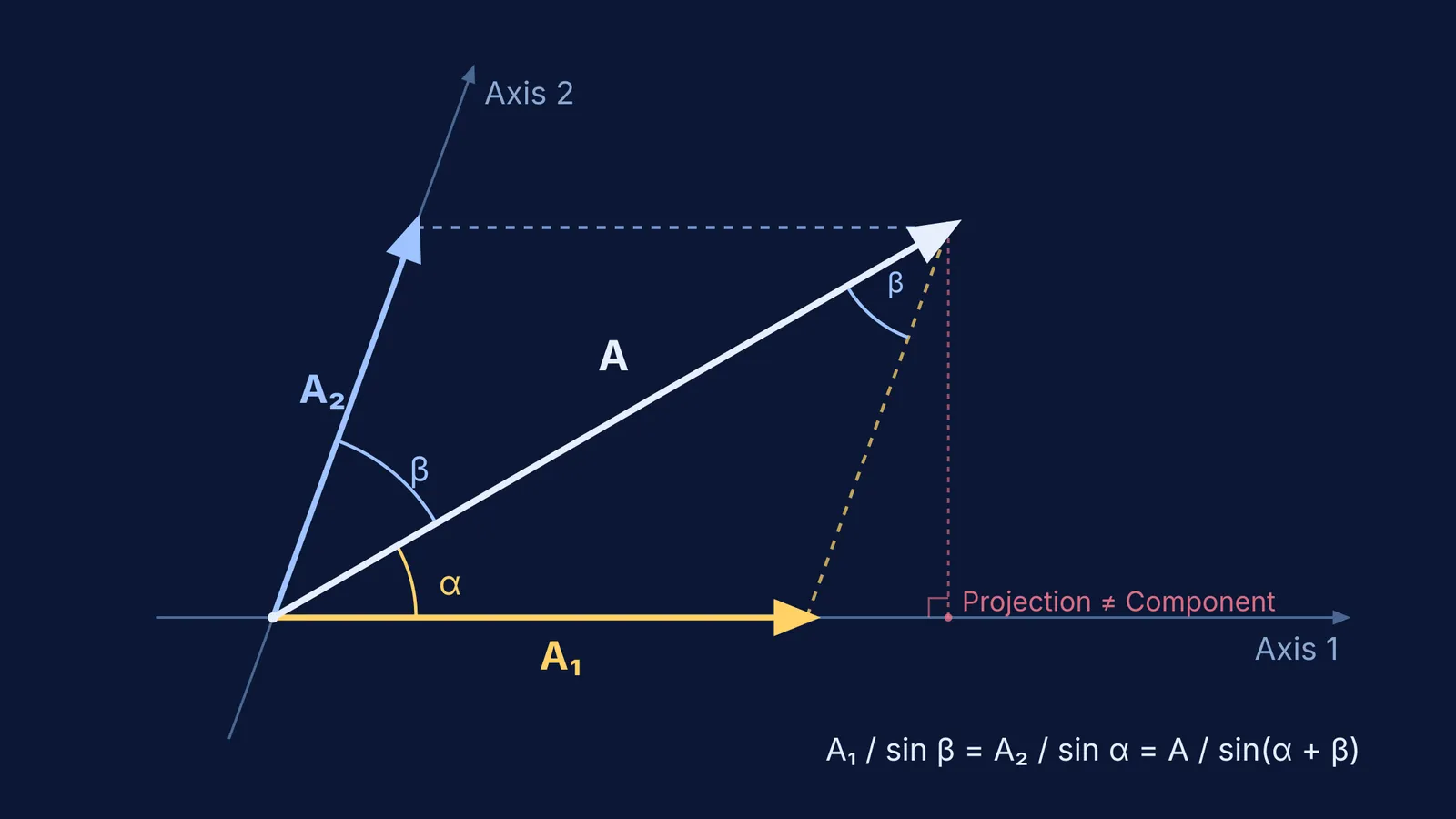
Vector resolution does not require perpendicular axes. According to NCERT Class 11 Physics Chapter 3, any vector A in a plane can be uniquely resolved along two non-parallel coplanar vectors a and b as A = λa + μb, where λ and μ are real scalars. To resolve A along two given axes, you complete a parallelogram with A as its main diagonal and sides lying along the axes.
From the tip of vector A, draw a line parallel to Axis 2 to intersect Axis 1 at component A₁, and a line parallel to Axis 1 to intersect Axis 2 at component A₂. This constructs a triangle with sides A₁, A₂, and A. Let α be the angle between A and Axis 1, and β be the angle between A and Axis 2. When A lies between the axes, the total angle between them is θ = α + β.
By alternate interior angles, the angle opposite side A₁ in the triangle is β, and that opposite A₂ is α. The angle opposite resultant A is 180° − (α + β) = 180° − θ. Applying the Sine Rule (Law of Sines) to this triangle yields: A₁ / sin β = A₂ / sin α = A / sin(α + β)
This yields the component magnitudes:
A₁ = A sin β / sin(α + β)
A₂ = A sin α / sin(α + β)
When axes are perpendicular (θ = 90°), sin 90° = 1 and sin β = sin(90° − α) = cos α, retrieving A₁ = A cos α and A₂ = A sin α.
What does a worked example look like step by step?
In engineering mechanics problems, such as those catalogued in Russell C. Hibbeler's Engineering Mechanics: Statics, forces frequently act along non-orthogonal structural members. Suppose a force F = 100 N must be resolved along two axes where Axis 1 is 30° below F (α = 30°) and Axis 2 is 45° above F (β = 45°).
Identify angles: α = 30°, β = 45°, and the total angle between axes is θ = 30° + 45° = 75°.
Calculate component F₁ along Axis 1: F₁ = 100 N × sin 45° / sin 75° ≈ 100 × (0.7071 / 0.9659) ≈ 73.21 N.
Calculate component F₂ along Axis 2: F₂ = 100 N × sin 30° / sin 75° ≈ 100 × (0.5000 / 0.9659) ≈ 51.76 N.
Verify by Cartesian addition: With F along the positive x-axis, Axis 1 points at −30° and Axis 2 at +45°. The x-sum is 73.21 cos(−30°) + 51.76 cos(45°) = 63.40 + 36.60 = 100.00 N. The y-sum is 73.21 sin(−30°) + 51.76 sin(45°) = −36.60 + 36.60 = 0.00 N.
If you instead dropped perpendiculars, you would get 100 cos 30° = 86.60 N and 100 cos 45° = 70.71 N. Adding these orthogonal projections vectorially yields a resultant of 125.18 N, creating an error of 25.18 N over the true 100 N force. Accurate decomposition is vital when studying plane motion from position vectors or analyzing torque with position and force vectors.
Why is projection not the same as resolution?
The root misconception lies in confusing orthogonal projection with vector decomposition. Research by Joel Van Deventer and Michael C. Wittmann (2007) showed that students develop an orthogonal bias from standard problems, struggling whenever coordinate axes are tilted or non-orthogonal. Investigations by Pablo Barniol and Genaro Zavala (2014) and Barniol and Zavala (2015) documented how introductory students rely on rote trigonometric formulas rather than geometric reasoning, often evaluating the orthogonal projection A cos α onto an axis rather than finding true oblique components.
Orthogonal projection measures the shadow of A onto an axis by dropping a perpendicular line, giving the scalar length A cos α.
Vector resolution finds two directed components along the given axes that add together via the parallelogram law to reconstruct A.
On perpendicular axes, the shadow and the component coincide. On oblique axes, resolution requires lines parallel to the opposite axis, forming a triangle solved by the sine rule.
How can students practice and master non-perpendicular vectors?
To master non-orthogonal vectors, apply three checks on every problem:
Draw lines from the vector head parallel to each axis, never perpendicular.
Verify that substituting α + β = 90° returns standard cosine and sine components.
Check that the components vectorially sum back to the original magnitude and direction.
When practicing complex mechanics problems, the Fermi Problem Library offers worked problems with a step-by-step solver that explains the reasoning rather than printing an answer. To explore how coordinate systems and vector geometry connect across physics, the Fermi Concept Library maps every concept in physics, chemistry, biology, mathematics and computing, each with its own lesson and its place in the map.


