

On this page
Almost every mechanics chapter has a block on a slope: friction, pulleys, wedges, a car climbing a hill. The physics is rarely the hard part. The marks go missing in one line, where a student writes mg cos θ for the force down the slope. Here is how to set up the axes, why each component is what it is, and a quick check that catches the swap.
Why tilt the axes along the slope?
You can choose any pair of perpendicular axes, so choose the pair that lines up with the most forces. OpenStax College Physics 2e puts it directly: the most convenient coordinate system for motion on an incline has one axis parallel to the slope and one perpendicular to it.
The block moves along the slope, so its acceleration has only one component.
Friction acts along the slope, so it needs no splitting.
The normal force acts perpendicular to the slope, so it needs no splitting either.
Only the weight, which points straight down, sits at an angle to both axes.
With horizontal and vertical axes you would have to split the normal force, the friction and the acceleration instead of just the weight.
What are mg sin θ and mg cos θ?
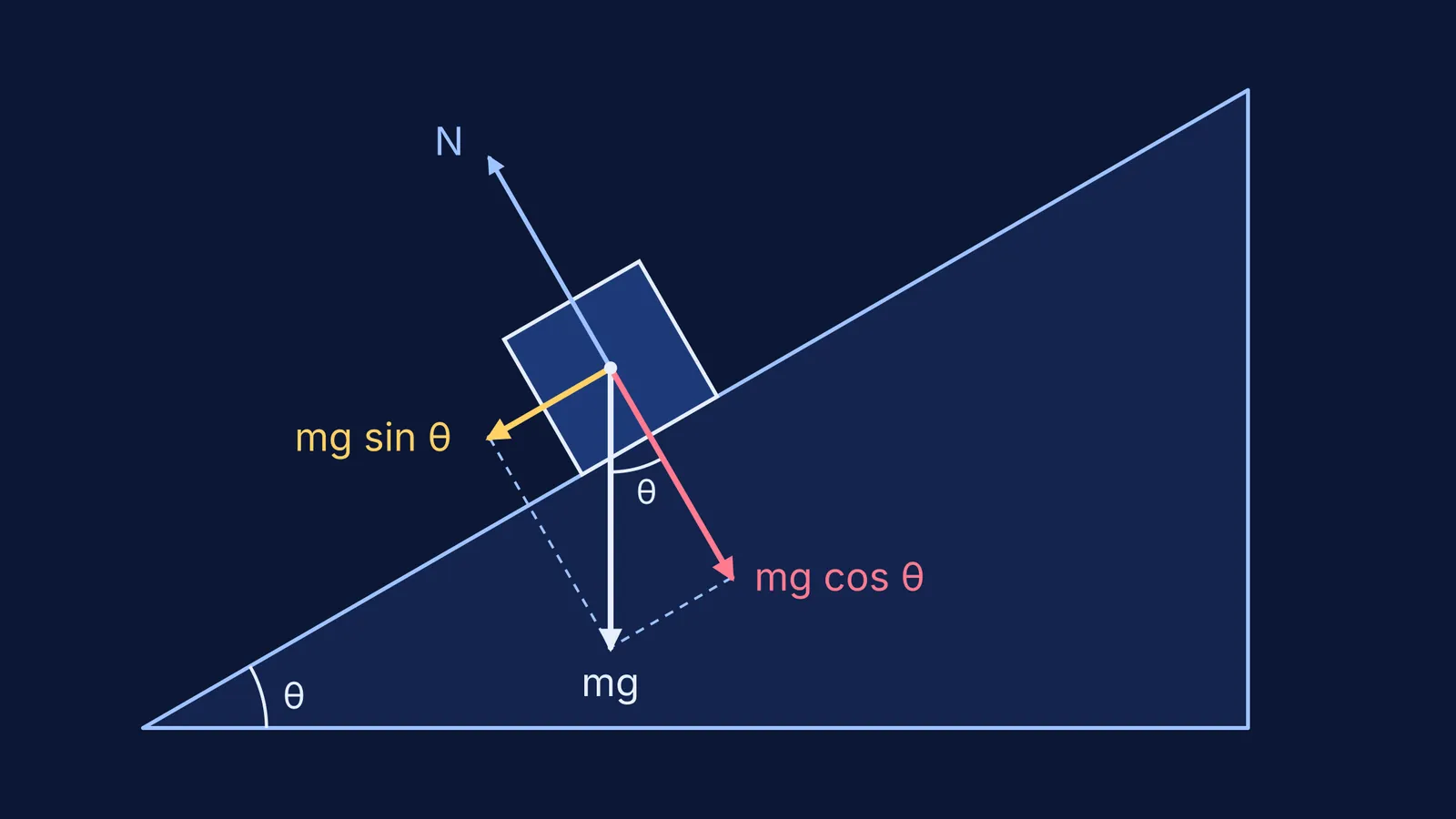
The weight mg breaks into two perpendicular parts. The part along the slope is mg sin θ and the part perpendicular to the slope is mg cos θ, where θ is the angle of the incline with the horizontal (OpenStax).
mg sin θ pulls the block down the slope; mg cos θ presses it into the surface. If nothing else pushes perpendicular to the slope, the normal force balances that part, so N = mg cos θ. The same OpenStax section works through a 60.0 kg skier on a 25° slope and gets an acceleration of 4.14 m/s² without friction, which is just g sin 25°.
Why does the incline angle show up next to the weight?
Skipping this geometry is what causes the swap. OpenStax notes that the angle θ of the incline is the same as the angle between the weight and its perpendicular component.
Here is why. The weight is perpendicular to the horizontal ground. The perpendicular axis is perpendicular to the slope. When you turn two lines through the same 90°, the angle between them doesn't change. So the angle between the ground and the slope (θ) equals the angle between the weight and the perpendicular axis (also θ).
That puts θ next to the perpendicular axis. The side next to an angle takes cos, so the perpendicular part is mg cos θ. The side opposite the angle takes sin, so the part along the slope is mg sin θ.
How do you catch the sin-cos swap in 10 seconds?
In an exam, test the line you just wrote:
Flatten the slope. Imagine θ = 0. A block on flat ground has no downhill pull, so the along-slope part must be zero. sin 0 = 0, cos 0 = 1. If your along-slope term has cos in it, swap.
Make it a wall. Imagine θ = 90°. The block falls freely and nothing presses it into the surface, so the perpendicular part must be zero. cos 90° = 0.
Compare sizes. Below 45°, sin θ is smaller than cos θ, so on a gentle slope the downhill part should be the smaller one.
Check the answer. On a smooth incline, a = g sin θ, which can never be bigger than g.
A worked example: a 5 kg block on a 30° slope
Take a 5 kg block on a 30° incline, with g = 9.8 m/s², using the components from OpenStax.
Weight: mg = 5 × 9.8 = 49 N.
Along the slope: 49 × sin 30° = 49 × 0.5 = 24.5 N.
Perpendicular: 49 × cos 30° ≈ 49 × 0.866 ≈ 42.4 N, so N ≈ 42.4 N.
Smooth slope: a = 24.5 ÷ 5 = 4.9 m/s² down the slope.
With kinetic friction coefficient 0.2: friction = 0.2 × 42.4 ≈ 8.5 N up the slope, net force ≈ 24.5 − 8.5 = 16.0 N, so a ≈ 3.2 m/s².
Swap the components and you get 42.4 N along the slope and a smooth-slope acceleration of about 8.5 m/s². Check 3 catches it at once: at 30° the downhill part must be the smaller one.
When the axes can't be perpendicular, the rules change; see how to resolve a vector along non-perpendicular axes. For harder setups, try two blocks on an incline with different friction, and learn how to check a free-body diagram an AI draws for you.
If the setup still trips you up, try inclined-plane problems in the Fermi Problem Library. Its step-by-step solver explains the reasoning rather than printing an answer, so you can see the line where your method went wrong. To go over vector resolution itself, the Fermi Concept Library gives each physics concept its own lesson.


