

On this page
Large language models do not experience gravity, contact, or friction. Because they predict tokens rather than reasoning spatially, general chatbots often produce plausible-sounding mechanics solutions while visualizing forces incorrectly or hallucinating interactions that do not exist.
In a benchmark study published in *Physical Review Physics Education Research*, researcher Gerd Kortemeyer tested ChatGPT across a calculus-based introductory physics curriculum. The model scored only 48% on homework problems involving trajectory motion and friction, and achieved 47% on the mechanics final exam. On the Force Concept Inventory, it scored 60% (18 out of 30), barely touching the entry threshold for Newtonian thinking while exhibiting persistent novice misconceptions such as inventing motion forces. The AI repeatedly made spatial errors, dropped geometric constraints, and failed basic physical plausibility checks.
Relying on a flawed sketch is worse than using no diagram. An investigation by David Rosengrant, Alan Van Heuvelen, and Eugenia Etkina in *Physical Review Special Topics - Physics Education Research* tracked introductory physics students over two years. Students who drew a correct free-body diagram reached an 85% success rate on exam problems, compared to 49% for students who drew no diagram. But students with an incorrect diagram dropped to a 38% success rate. A faulty free-body diagram misleads your vector equations before you write the first line of algebra. As we noted in our guide to checking when AI gets physics wrong, catching spatial errors early is vital before accepting an automated answer.
What is the two-step rule for checking every force?
To audit an AI free-body diagram, you need two physical checks: the Agent Test and the Isolation Test.
First, apply the Agent Test. In Newtonian mechanics, every force is a mutual interaction between two identifiable physical bodies. For every arrow the AI proposes, demand two specifics:
The agent (the physical body in the surroundings exerting the force).
The receiver (the target body being analyzed).
If the AI cannot identify a tangible body—such as the Earth, a cable, or a contact surface—the force is imaginary.
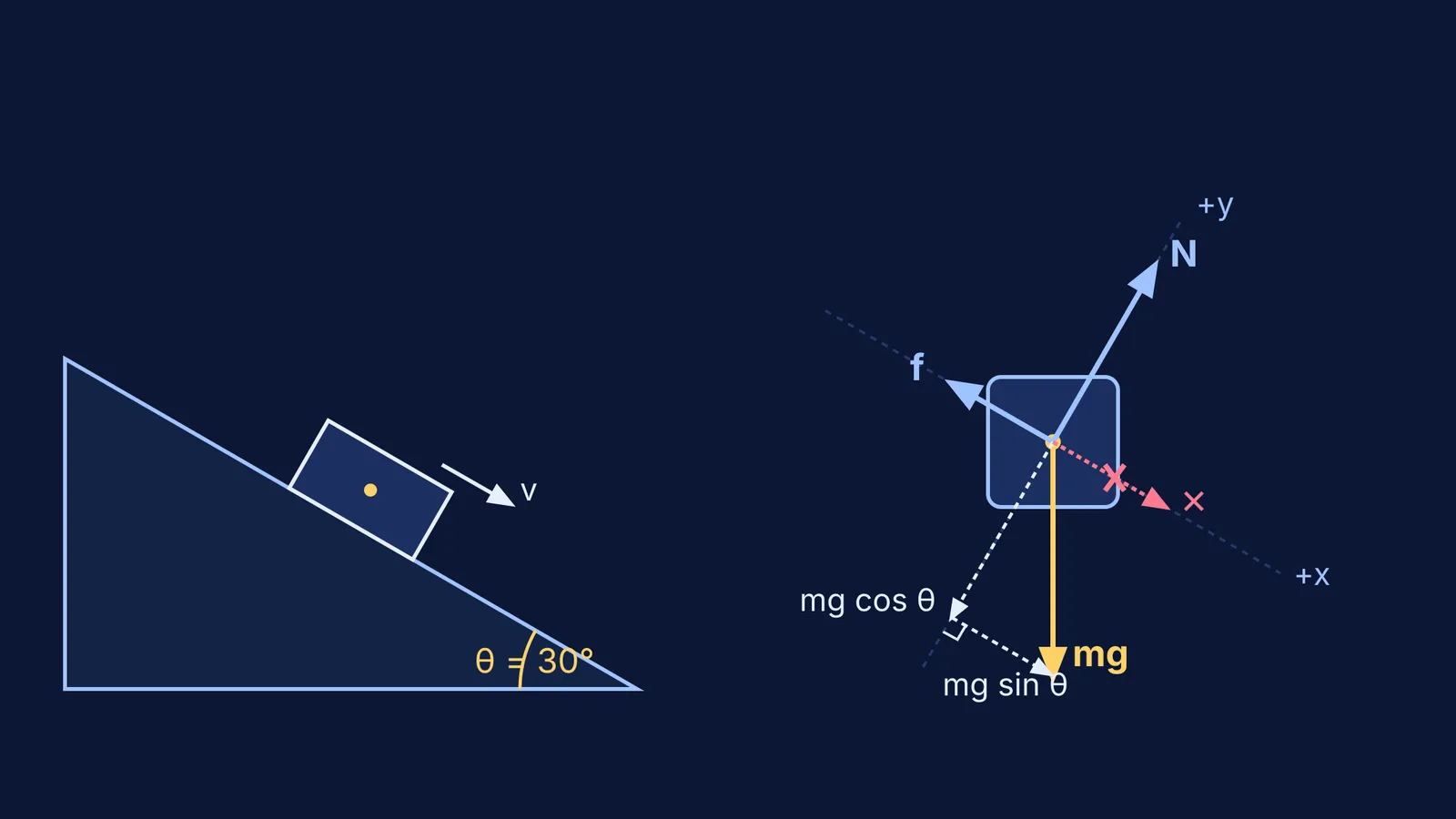
Second, apply the Isolation Test to ensure nothing is double counted. Check whether the AI drew both a true force and its resolved components on the same diagram. For a block on an incline, the Earth exerts one downward force, mg. Resolving that force into components parallel (mg sin θ) and perpendicular (mg cos θ) to the surface is a mathematical substitution, not two additional physical forces. Showing both the parent vector and its components counts gravity twice.
How do phantom forces and double counting sneak in?
AI models frequently mirror the misconceptions of human novices. Decades ago, David Hestenes, Malcolm Wells, and Gregg Swackhamer documented in *The Physics Teacher* that intuitive reasoning often invents a forward "force of motion" in the direction of velocity. Chatbots make this mistake routinely:
The phantom forward push: On an object in free flight or sliding freely across a surface, AI outputs often add an arrow labeled "forward force" or "motion force," even when no body touches it from behind.
Centripetal force drawn as a separate arrow: When an object rounds a curve, an AI may draw friction inward and then add another arrow labeled "centripetal force." But centripetal force is simply the net inward resultant (mv²/r), not an extra physical interaction.
Double-counting action-reaction pairs: In multi-block problems, an AI might draw both the force of block A on block B and the reaction force of block B on block A on a single diagram. For multi-body problems, follow our guide on finding the contact force between blocks pushed together, where each body gets its own isolated boundary.
When practicing mechanics, Fermi's AI tutor teaches rather than simply printing an answer. It holds a line of reasoning across a session, draws the figure, and checks understanding as it goes by requiring you to name the source of each force. In the Fermi Problem Library, worked problems use a step-by-step solver that explains the reasoning rather than jumping straight to numerical answers.
What prompt forces an AI to verify its own diagram?
You can prevent mechanics hallucinations by forcing the model into a structured audit before it writes equations.
Prompt the AI with this verification script: "For this mechanics problem, do not solve the equations yet. First, list every force acting on [Object] in a three-column list:
Force name and symbol.
The specific physical object exerting it (the agent).
Contact type (field force or direct contact surface).
Then confirm that no net resultant (such as centripetal force) and no component (such as mg cos θ) is included alongside primary forces."
Once the AI generates this table, check three rules:
Does every contact force match an actual surface touching the body?
Is gravity the only non-contact field force present?
Are all vector components kept out of the free-body diagram?
If any arrow fails these checks, discard it before applying ΣF = ma. Pair this auditing habit with getting AI feedback on your solutions to keep your mechanics grounded in first principles.


