

On this page
When you put two blocks on an inclined plane, they slide down under gravity. If their surfaces have the exact same roughness, they accelerate at the same rate and stay side by side. But exam problems often give them different coefficients of friction. What happens then?
The answer depends entirely on which block has more friction. This one detail decides whether they push against each other, move as one system, or separate completely as they slide.
Do they move together or separate?
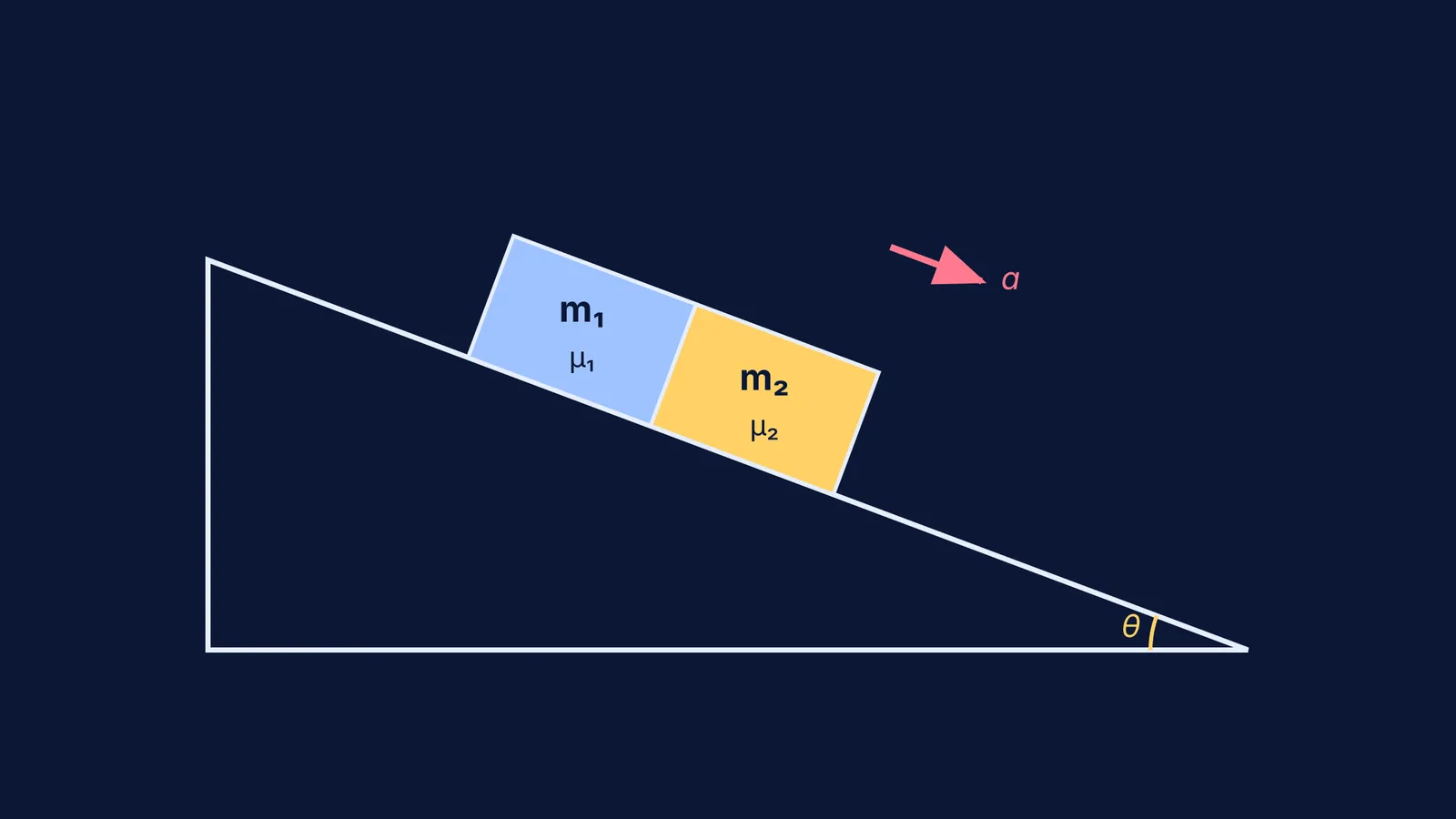
Imagine Block A is resting higher up the slope than Block B, and they are touching. According to OpenStax *University Physics*, the friction force on any sliding block is f = μmg cos θ. This friction opposes the component of gravity pulling it down the slope, which is mg sin θ.
If the blocks were not touching, they would each have an acceleration of a = g(sin θ − μ cos θ). Notice that the mass cancels out: a block's independent acceleration depends only on the slope angle and its coefficient of friction, μ.
Because they are placed touching each other, we have to look at those independent accelerations to see what they will actually do:
If the upper block has less friction (μ₁ < μ₂): The upper block "wants" to accelerate faster than the lower one. Because the slower block is in the way, the upper block pushes into it. They end up moving together with a shared acceleration, and a contact force exists between them.
If the upper block has more friction (μ₁ > μ₂): The lower block wants to accelerate faster. It pulls away from the upper block. They slide completely independently, and the contact force between them is exactly zero.
If the two blocks are connected by a string instead of just touching, the logic flips. If the lower block is faster, it pulls the string taut, creating tension. If the upper block is faster, it catches up and the string goes slack.
How do you find the common acceleration?
When the upper block has less friction (μ₁ < μ₂), they move as a single combined mass. To find their acceleration, treat both blocks as one system, an approach detailed by The Physics Classroom.
The total downward force from gravity is (m₁ + m₂)g sin θ. The total opposing friction is the sum of the friction on each block: μ₁m₁g cos θ + μ₂m₂g cos θ.
Using Newton's second law (F_net = ma), the common acceleration a is: a = g sin θ − [(μ₁m₁ + μ₂m₂) / (m₁ + m₂)] g cos θ
Notice the term in the brackets. It is the effective coefficient of friction for the system—a weighted average of μ₁ and μ₂ based on their masses.
What is the contact force between the blocks?
Once you know the system is moving together, finding the contact force (often called Fc or N′) requires looking at just one block on its own.
Let's isolate the lower block (m₂). The forces acting on it parallel to the incline are gravity pulling it down, friction holding it back, and the contact force from the upper block pushing it down the slope.
Set up the equation for the lower block: m₂a = m₂g sin θ − μ₂m₂g cos θ + Fc
Since you already calculated the shared acceleration a in the previous step, you can plug it in here and solve for Fc. If you ever get stuck setting up these equations, the Fermi Problem Library has worked problems with a step-by-step solver that explains the reasoning rather than printing an answer.
How do you solve a worked example?
Let's test this with numbers typical of a University Physics problem.
You place a 2 kg block (μ₁ = 0.1) on an incline of 37°, directly above a 3 kg block (μ₂ = 0.3). Do they move together, and what is the contact force? Use g = 10 m/s².
Check the condition: The upper block has less friction (0.1 < 0.3). It will push into the lower block. They move together. (This relates closely to the concepts in Contact force between blocks pushed together on a smooth floor).
Find the common acceleration: For a 37° angle, sin 37° = 0.6 and cos 37° = 0.8.
The effective friction is (2 × 0.1 + 3 × 0.3) / (2 + 3) = (0.2 + 0.9) / 5 = 1.1 / 5 = 0.22. a = 10 × (0.6 − 0.22 × 0.8) = 10 × (0.6 − 0.176) = 10 × 0.424 = 4.24 m/s².
Find the contact force: Look at the 3 kg lower block.
m₂a = 3 × 4.24 = 12.72 N. The gravity component is 3 × 10 × 0.6 = 18 N. The friction is 0.3 × 3 × 10 × 0.8 = 7.2 N. 12.72 = 18 − 7.2 + Fc 12.72 = 10.8 + Fc Fc = 1.92 N.
The upper block exerts a contact force of 1.92 N on the lower block as they slide down together. (If you want to practice finding the sliding duration once you know the acceleration, see Time for a block to slide down a rough incline: worked example; for understanding when an object starts to slip, look at Angle of repose and angle of friction: the tan θ = μ result).


