

On this page
Many meiosis questions turn on one distinction: the two copies of a chromosome are not the two members of a pair. Get that straight, and anaphase and counting questions fall into place.
What is the difference between sister chromatids and homologous chromosomes?
A chromatid is one of the two identical halves of a chromosome that has been copied before cell division, and the two sister chromatids are joined at the centromere, according to the NHGRI genetics glossary.
Homologous chromosomes are "matched pairs containing the same genes in identical locations along their lengths", in the words of OpenStax Biology 2e. One member of each pair comes from each parent, so they are a pair, not copies of each other.
Here is the quick way to keep them apart:
Where they come from: sisters come from copying DNA in S phase; homologues come from two different parents.
What holds them together: sisters are held at the centromere; homologues pair up (synapsis) only in meiosis I, from prophase I until they separate in anaphase I.
How alike they are: sisters start out identical; homologues have the same genes in the same order but came from different parents.
When they part: homologues separate in anaphase I; sisters separate in anaphase II (and in mitotic anaphase).
For the three terms side by side, see our explainer on chromatin, chromosomes and chromatids.
What separates in anaphase I and anaphase II?
The NCERT Class 11 Biology chapter on cell cycle and cell division says that in anaphase I "the homologous chromosomes separate, while sister chromatids remain associated at their centromeres." In anaphase II, the same chapter says, the centromere of each chromosome splits, letting the sister chromatids move to opposite poles.
So meiosis I pulls the pairs apart, and meiosis II pulls the copies apart. That is why NCERT calls meiosis the division that reduces chromosome number by half: each pole in anaphase I receives half the parent cell's chromosomes, but each one still has both its chromatids.
One detail examiners like: during pachytene, crossing over happens between non-sister chromatids of homologous chromosomes, as the NCERT chapter describes. After that, sister chromatids are no longer perfect copies along their whole length.
How do you count chromosomes and chromatids at each stage?
NCERT notes that in S phase DNA content goes from 2C to 4C but the chromosome number stays 2n, because the copies stay joined at one centromere (NCERT, section 10.1.1). Now work through the human case. Humans have 23 chromosome pairs, so 2n = 46 (OpenStax).
G1 (before replication): 46 chromosomes, each a single DNA molecule; DNA content 2C.
After S phase and in prophase I: still 46 chromosomes, but 92 chromatids; 4C. The homologues pair up into 23 bivalents (tetrads).
Metaphase I: the 23 bivalents line up at the equator.
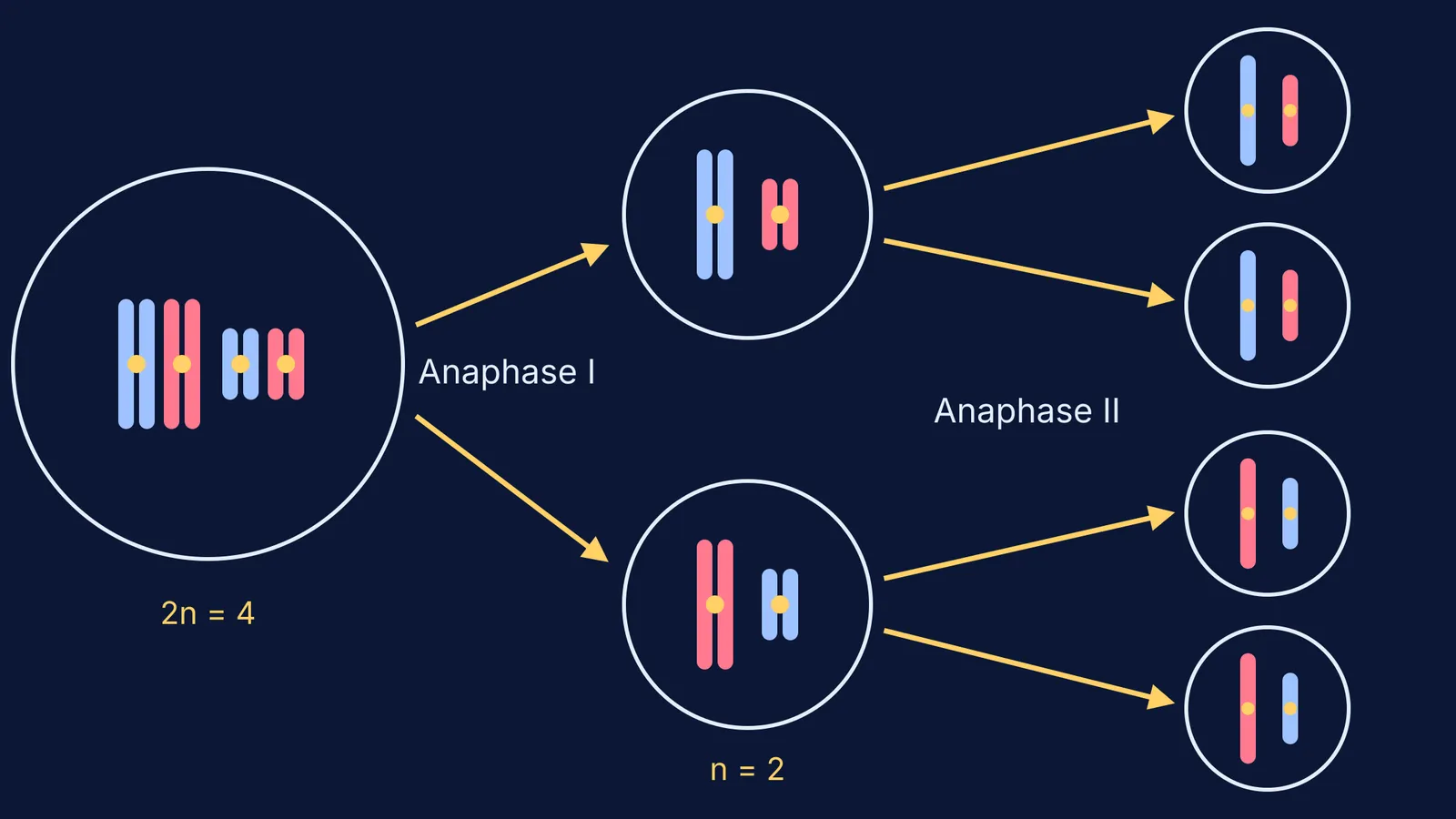
Anaphase I: the homologues of each pair go to opposite poles, so 23 chromosomes go to each pole, each still with 2 chromatids.
After telophase I, each cell: 23 chromosomes, 46 chromatids, 2C. The cell is now haploid, though each chromosome is still double.
Anaphase II: centromeres split. For a moment each cell has 46 separate chromosomes, 23 moving to each pole.
After telophase II, each of the four cells: 23 chromosomes, 23 chromatids, 1C.
The hero diagram shows the same steps for a cell with 2n = 4. NCERT also says there is no DNA replication in interkinesis, between the two divisions; we explain why in interkinesis and the missing S phase. To compare these counts with mitosis, see chromosome counts at each stage of mitosis.
How do you tell them apart in a diagram question?
Ask three questions about any two strands in the figure:
Are they joined at one centromere? If yes, they are sister chromatids.
Do they have separate centromeres but the same length and centromere position, lying side by side? They are homologues. In a bivalent you see four chromatids around two centromeres.
Is the cell in meiosis II or in mitosis? Then homologues are not paired, and any split you see is between sisters.
A tempting wrong answer says chromosome number halves in anaphase II. It does not. Number halves in meiosis I, the reduction division in the NCERT chapter; meiosis II halves the chromatids per chromosome and the DNA content.
If the counting still slips, the Fermi Concept Library has a lesson for each idea in biology, so you can go back to replication or synapsis on its own. When you want to test the method on exam-style questions, the Fermi Problem Library has worked problems with a step-by-step solver that explains the reasoning rather than printing an answer.
Tonight, draw one bivalent with two colours, label each sister and each homologue, and write the counts beside every stage.


