

On this page
Interkinesis is a critical checkpoint in cell division. When a cell undergoes meiosis to produce gametes (like sperm or egg cells), it divides twice. The gap between these two divisions is called interkinesis.
What is interkinesis between meiosis I and II?
Interkinesis, sometimes called interphase II, is the stage that occurs between the end of meiosis I (telophase I) and the beginning of meiosis II (prophase II) (NCERT). After the first division separates the homologous chromosomes into a dyad of two cells, interkinesis provides a brief transition period.
Unlike a typical mitotic interphase, the chromosomes do not fully decondense. They may spread out slightly, but they never reach the extremely extended chromatin state seen in a resting nucleus (NCERT).
Why is there no DNA replication during interkinesis?
The defining rule of this stage is that no DNA replication occurs during interkinesis (NCERT).
Before meiosis I even began, the parent cell went through a full interphase, including an S-phase where all its DNA was copied. At the start of interkinesis, each chromosome in the two new cells still consists of two sister chromatids. If the DNA were to replicate again, the cell would double its genetic material, defeating the entire purpose of a reduction division. By skipping the S-phase in interkinesis, meiosis II can simply pull those existing sister chromatids apart, leaving the final four gametes haploid with half the original DNA.
Tracking DNA content across these stages is a common stumbling block in exams like NEET-UG. If you find yourself confused by questions asking whether a cell has a 2C or 4C DNA level, the Fermi Concept Library has every concept in physics, chemistry, biology, mathematics and computing, each with its own lesson and its place in the map.
How long does interkinesis last?
Interkinesis is generally short-lived (NCERT). Because it skips the time-consuming process of copying the genome, the cell does not need to linger.
The exact duration depends heavily on the species and the type of cell:
In fission yeast, the gap can be as short as 10 to 15 minutes.
In many plant cells, the transition is almost immediate, and the cell rushes straight from meiosis I into meiosis II.
What happens during interkinesis?
While the DNA remains untouched, the cell is not entirely dormant. Several key preparations take place:
Centriole duplication: In animal cells, the centrosome and its centrioles replicate to form the poles for the upcoming meiotic spindle.
Protein synthesis: The cell manufactures the specific RNA and proteins required to drive meiosis II.
No crossing over: Since the homologous chromosomes have already separated, no further genetic recombination happens here.
Once these quick preparations are complete, the cell enters prophase II. This next phase is much simpler than prophase I (NCERT), acting much like a standard mitotic division to finish the job.
How to track DNA content through interkinesis?
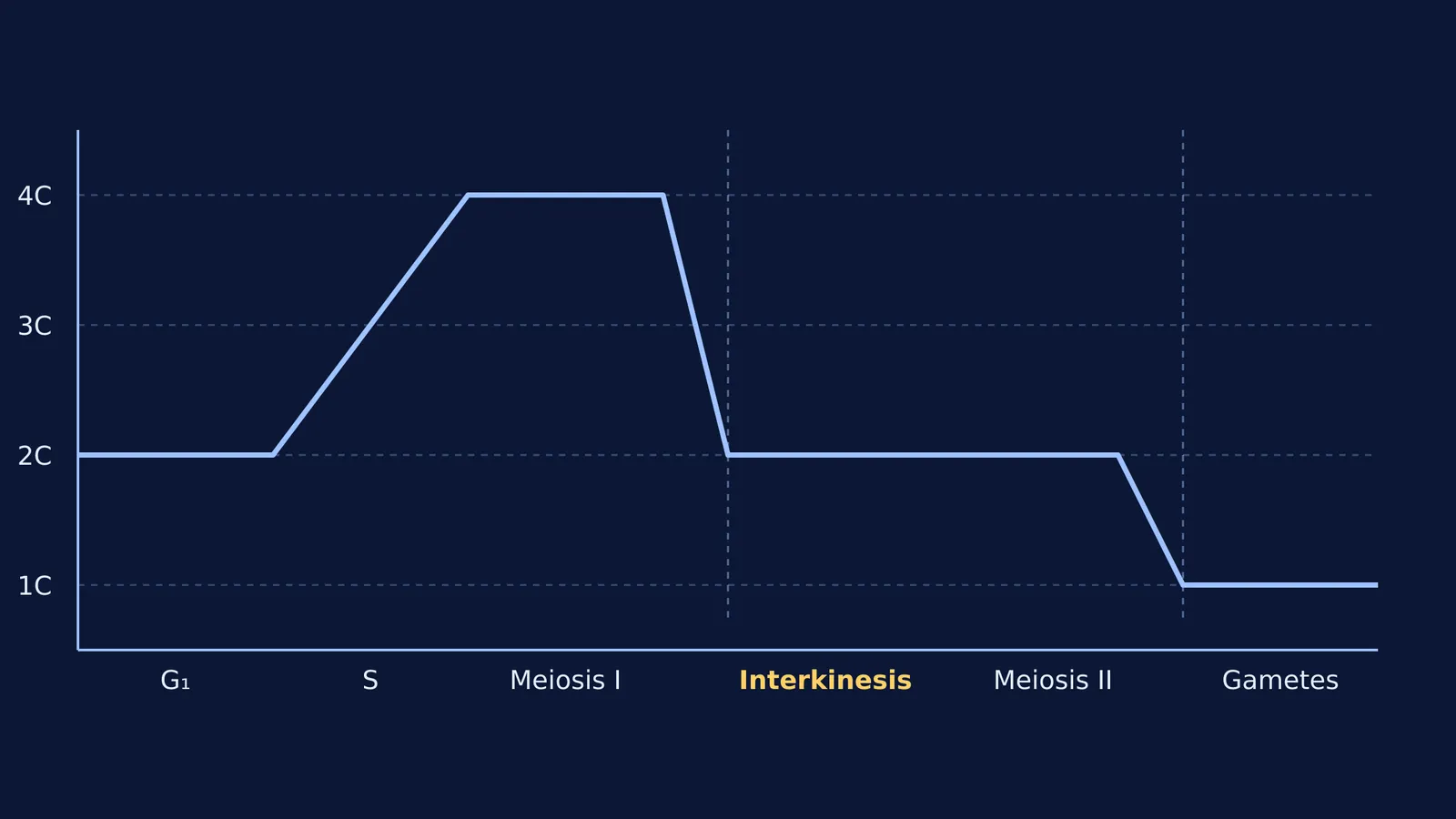
A classic way to test this concept is by tracking the "C-value" (the amount of DNA) and the "n-value" (the number of chromosomes) through the cell cycle (NCERT).
G1 phase: The cell starts diploid (2n) with a baseline DNA content of 2C.
S phase: DNA replicates. The chromosome number stays the same (2n), but the DNA doubles to 4C.
Meiosis I: The homologous chromosomes are pulled into separate cells. Each new cell now has half the chromosomes (n), but because the sister chromatids are still attached, the DNA content is 2C.
Interkinesis: The cell rests. The values remain at n and 2C because there is no S-phase.
Meiosis II: The sister chromatids are finally pulled apart. The resulting gametes are haploid (n) with a DNA content of 1C.
This mathematical tracking is why the brief pause of interkinesis is so important. Without it, or if a rogue S-phase were to happen, the gametes would end up with a 2C DNA content, leading to a 4C zygote upon fertilisation—a fatal chromosomal error for most species.
If you want to practice calculating DNA content and chromosome numbers, the Fermi Problem Library has worked problems with a step-by-step solver that explains the reasoning rather than printing an answer. You can also explore related topics like Microsporogenesis and the structure of a pollen grain or Chromosome types by centromere position: metacentric to telocentric to see how these divisions build plant life and shape our genetics.


