On this page
NCERT's Class 11 Biology gives erythroblastosis foetalis one paragraph. It is a story in four steps: an antigen, a leak, a memory and a second baby.
What is the Rh factor?
The Rh factor is an antigen on the surface of red blood cells, named after a similar antigen in Rhesus monkeys, and nearly 80 per cent of humans have it (NCERT Class 11 Biology, Body Fluids and Circulation). People who have it are Rh positive; people who lack it are Rh negative. In clinical terms, Rh-negative means the D antigen is absent, which is why the injection that prevents the disease is called anti-D (ICOG–FOGSI recommendations on anti-D).
How Rh status passes from parents to children is worked through in our post on how Rh positive and Rh negative inheritance works.
Why is the second Rh-positive baby at risk and not the first?
Erythroblastosis foetalis is the destruction of an Rh-positive foetus's red blood cells by anti-Rh antibodies from its Rh-negative mother, which can cause severe anaemia and jaundice or be fatal to the foetus (NCERT). NCERT describes it in this order:
First pregnancy. The foetus is Rh positive and the mother Rh negative, but the placenta keeps the two bloods well separated, so the foetus's Rh antigens do not reach her blood.
First delivery. Small amounts of the baby's Rh-positive blood can reach her circulation. Small really means small: 99.3% of women have a fetomaternal haemorrhage (foetal blood entering the mother's circulation) of less than 4 ml at delivery (ICOG–FOGSI).
Sensitisation. She starts making antibodies against the Rh antigen. The first baby, already born, escapes.
Next Rh-positive pregnancy. Her anti-Rh antibodies leak into the foetus's blood and destroy its red blood cells.
MedlinePlus, from the US National Library of Medicine, puts step 4 the same way: the mother's antibodies "can cross the placenta and cause very severe anemia in the baby" (MedlinePlus: haemolytic disease of the newborn). For the antibody classes, see our guide to IgA, IgM, IgE and IgG.
The ICOG–FOGSI guidance puts numbers on step 3: without prophylaxis, an Rh-negative woman who delivers an Rh-positive, ABO-compatible baby has a 16% chance of becoming immunised (ICOG–FOGSI). Of that 16%, 2% are immunised by the time of delivery, 7% have anti-D antibody by six months after it, and 7% are "sensibilized", making antibodies too faintly to detect until early in the next pregnancy. That last group is why the danger can stay invisible until the second baby. So NCERT's "well separated" is a simplification: a few mothers are sensitised before the first birth.
How does an anti-Rh injection after delivery prevent it?
NCERT's answer: give anti-Rh antibodies to the mother immediately after the delivery of the first child (NCERT). The antibodies are ready-made and injected rather than made by her own body, which is passive immunity; our active vs passive immunity explainer covers the difference. The aim is to stop her immune system from becoming sensitised, so she never starts producing her own anti-Rh antibodies.
The Indian guidance from ICOG and FOGSI is specific (ICOG–FOGSI):
Every Rh-negative mother who delivers an Rh-positive baby, by normal delivery or caesarean, should receive 300 mcg of anti-D within 72 hours.
If the 72 hours are missed, it should still be given as early as possible, as it may still give some protection.
A 300 mcg dose covers about 30 ml of foetal blood.
Antenatal doses are recommended too: 100 mcg at 28 and 34 weeks, or a single 300 mcg dose at 28 weeks.
Women who are already sensitised should not be given anti-D.
Worked example: what happens to 1,000 Rh-negative mothers?
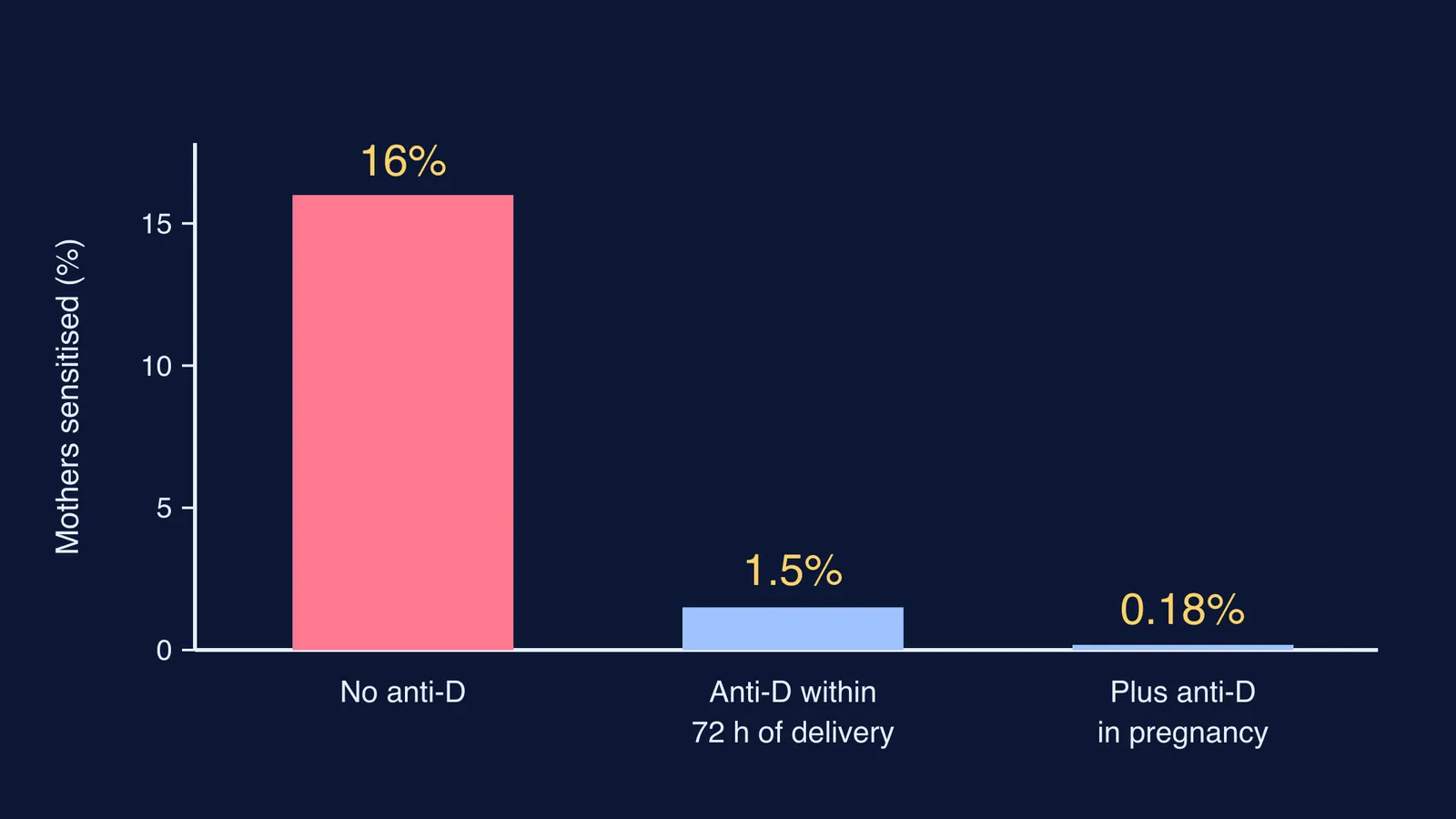
Take 1,000 Rh-negative mothers who each deliver an Rh-positive baby, and apply the ICOG–FOGSI figures (ICOG–FOGSI):
No anti-D: 16% means about 160 become sensitised.
Anti-D after delivery: the risk falls to 1.5%, about 15 mothers.
Antenatal anti-D as well: the risk can fall to 0.18%, about 2 mothers.
The same guidance cites an analysis by K S Joseph of CMC Vellore that expected India to need about 8,03,000 post-delivery doses a year by 2000, while about 1,15,000 units were sold in 2000.
What are the common exam traps on erythroblastosis foetalis?
Only an Rh-negative mother carrying an Rh-positive foetus sets this up. An Rh-positive mother with an Rh-negative foetus does not.
The anti-Rh injection goes to the mother, not the baby.
It is given after the delivery, within 72 hours per ICOG–FOGSI, not at the start of the second pregnancy.
The first baby is usually spared because the placenta keeps the bloods apart, not because it lacks the antigen.
If the antigen–antibody–placenta chain feels loose, the Fermi Concept Library has every biology concept with its own lesson and its place in the map. For practice, the Fermi Problem Library has worked problems with a step-by-step solver that explains the reasoning rather than printing an answer.