On this page
Both your parents are Rh positive, yet a cousin in a similar family is Rh negative. Rh positive is the dominant trait, and two Rh positive parents can each carry a hidden Rh negative allele. Here is the genetics, a real Indian number to work with, and six crosses to practise for your board exam or NEET-UG.
Is Rh positive dominant or recessive?
Rh positive is dominant. The Rh blood group antigens come from two genes, RHD and RHCE, on chromosome 1 (Wagner and Flegel, Blood, 2000). The same paper reports that in white populations, a haplotype with a deletion of the whole RHD gene occurs with a frequency of about 40%.
That explains the dominance. For many people, the textbook allele "d" is not a different version of the gene but a missing gene. One working copy of RHD is enough to put the D antigen on red blood cells, so a single D allele makes you Rh positive.
DD: Rh positive
Dd: Rh positive, carrying a hidden d
dd: Rh negative
An Indian donor study in Cureus states the same rule: Rh positive people are DD or Dd, and Rh negative people are dd (Sigamani and Gajulapalli, 2022).
Why can two Rh positive parents have an Rh negative child?
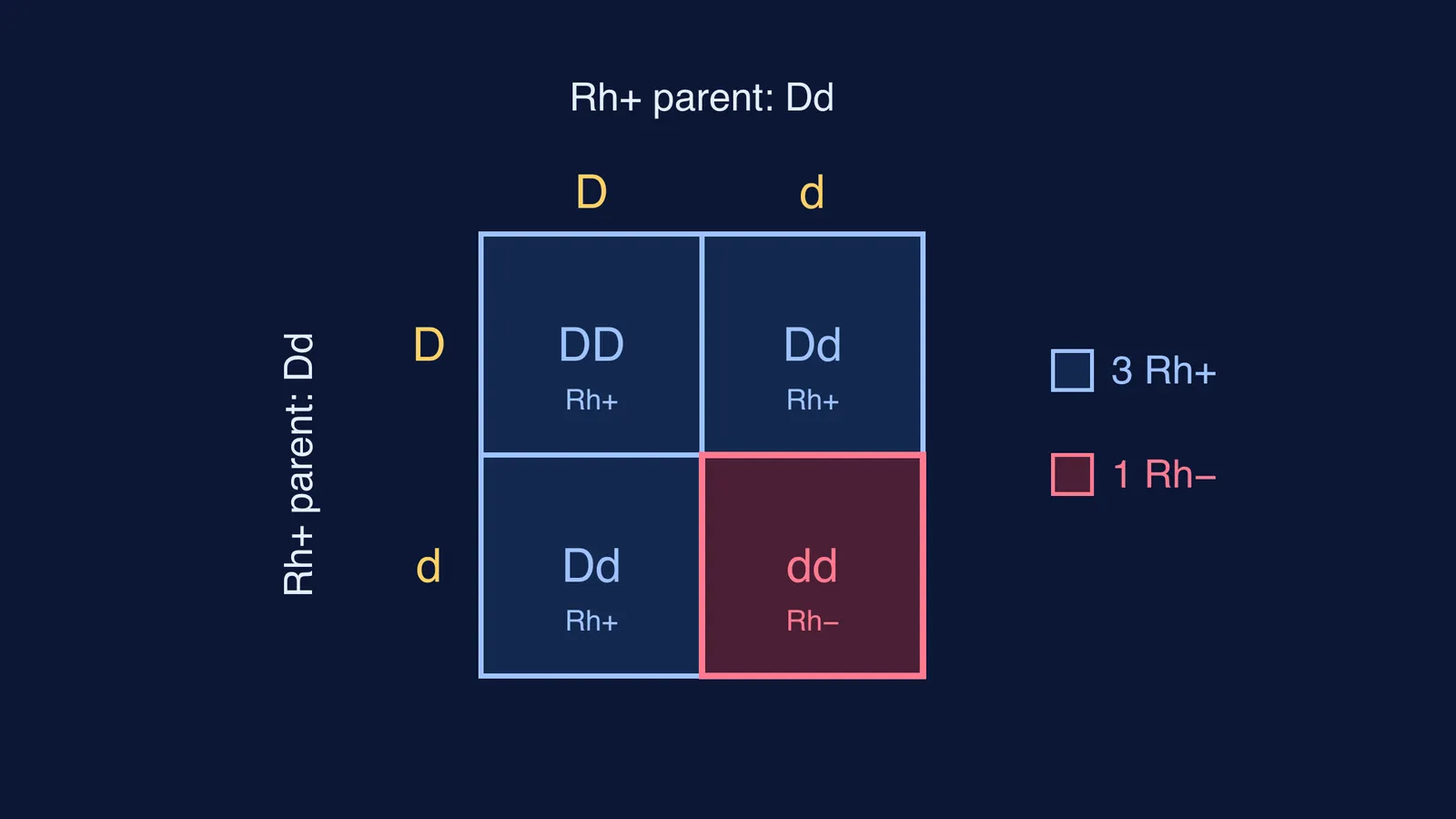
Because both parents can be Dd. Each Dd parent passes on D or d with equal chance, so the Punnett square has four equally likely boxes:
D from both parents: DD, Rh positive
D from the mother, d from the father: Dd, Rh positive
d from the mother, D from the father: Dd, Rh positive
d from both parents: dd, Rh negative
The genotype ratio is 1 DD : 2 Dd : 1 dd, and the phenotype ratio is 3 Rh positive : 1 Rh negative. The same logic shows up in ABO, where two A parents can have an O child; our post on ABO blood groups and multiple alleles works through those crosses.
How common is Rh negative in India?
The prevalence of the RhD negative blood group in the Indian blood donor population is 5% to 6% (Negi and colleagues, Asian Journal of Transfusion Science, 2024). In the Cureus study of 7,598 donors in Chengalpattu district, Tamil Nadu, 4.04% were Rh negative and the frequency of the d allele was 0.2009 (Sigamani and Gajulapalli, 2022).
Here the dominant trait is also the common one, but that is a fact about these populations, not about dominance. Our post on why dominant does not mean more common explains the difference.
How many Rh positive people carry a hidden d?
Take the Chengalpattu allele frequencies from the Cureus donor study, D = 0.7991 and d = 0.2009, and assume random mating (the Hardy-Weinberg model from Class 12).
Carriers (Dd) = 2 x 0.7991 x 0.2009 = about 0.321 of people.
All Rh positive people (DD + Dd) = 1 - 0.2009 x 0.2009 = about 0.960.
So about 0.321 / 0.960, or roughly 1 in 3, Rh positive people in that sample carry a hidden d.
For two Rh positive parents picked at random: 1/3 x 1/3 x 1/4 = about 1 in 36 chance of an Rh negative child.
This is a classroom estimate for one region's donors, not a figure for any real family.
Six Rh crosses to practise
Write the gametes first, then the square. Cover the answers below.
DD x dd
Dd x dd
Dd x Dd
dd x dd
Two Rh positive parents have an Rh negative first child. What is the chance the second child is Rh negative?
An Rh positive woman whose father is Rh negative marries an Rh negative man. What is the chance their child is Rh negative?
Answers:
All Dd, all Rh positive.
1/2 Dd (positive), 1/2 dd (negative).
3/4 Rh positive, 1/4 Rh negative.
All dd, all Rh negative in the textbook model.
The first child proves both parents are Dd, so 1/4.
She got d from her father, so she is Dd. Dd x dd gives 1/2.
For more pedigree reasoning, our guide to carrier probability in pedigrees takes it further. If you get a different answer, the Fermi Problem Library has worked problems with a step-by-step solver that explains the reasoning rather than printing an answer. To revise alleles and genotypes first, try the Fermi Concept Library.
What does Rh status mean in pregnancy?
Rh incompatibility develops when a pregnant woman has Rh negative blood and the baby has Rh positive blood, and it is almost completely preventable with care during pregnancy, according to MedlinePlus from the US National Library of Medicine. Whether a family needs that care is a question for their doctor, not for a Punnett square.
Try the six crosses again tomorrow without looking.