

On this page
Pedigree questions follow one routine: decide the inheritance pattern, write a genotype under every person you can, give a probability to everyone you can't, then multiply. The step students most often skip is the 2/3 carrier step.
A pedigree is "a chart that diagrams the inheritance of a trait or health condition through generations of a family", in the words of the NHGRI genetics glossary. Squares are males, circles are females, filled shapes are affected people, and a horizontal line joins parents.
How do you tell if a pedigree is autosomal recessive?
Look for two unaffected parents with an affected child: both parents must carry a hidden allele, so the trait is recessive. The NHS Genomics Education Programme lists the usual signs: males and females are affected in roughly equal numbers, affected people are usually siblings in one generation, and the condition is more common when the parents are related by blood.
Dominant traits behave differently. According to MedlinePlus Genetics, a person with an autosomal dominant disorder has a 50 percent chance of passing the altered gene to each child. So in a dominant pedigree, an affected child usually has an affected parent; MedlinePlus notes the exception, a new (de novo) variant, where the parents are unaffected.
How do you assign genotypes in a pedigree?
Use A for the normal allele and a for the recessive one. Then work through the chart in this order.
Every affected person is aa. No doubt there.
Every unaffected parent of an affected child is Aa. They passed on an a, and they are not affected, so they must also have an A. These are "obligate carriers".
Every unaffected child of an affected parent is Aa, for the same reason in reverse.
Anyone left who is unaffected gets a probability, not a fixed genotype. This is where the 2/3 comes in.
Why is the carrier chance 2/3 and not 1/2?
Cross two carriers, Aa × Aa. The four equally likely outcomes are AA, Aa, aA and aa. MedlinePlus Genetics puts it plainly: two carriers have a 25 percent chance with each pregnancy of having an affected child.
Now suppose you are told the child is unaffected. That rules out aa. Three outcomes remain, AA, Aa and aA, and two of them are carriers. So the chance is 2/3. A GeneTests guide to autosomal recessive inheritance states the same rule: of the children of two carriers who are unaffected, 2/3 will be carriers.
What is the probability that a child is affected?
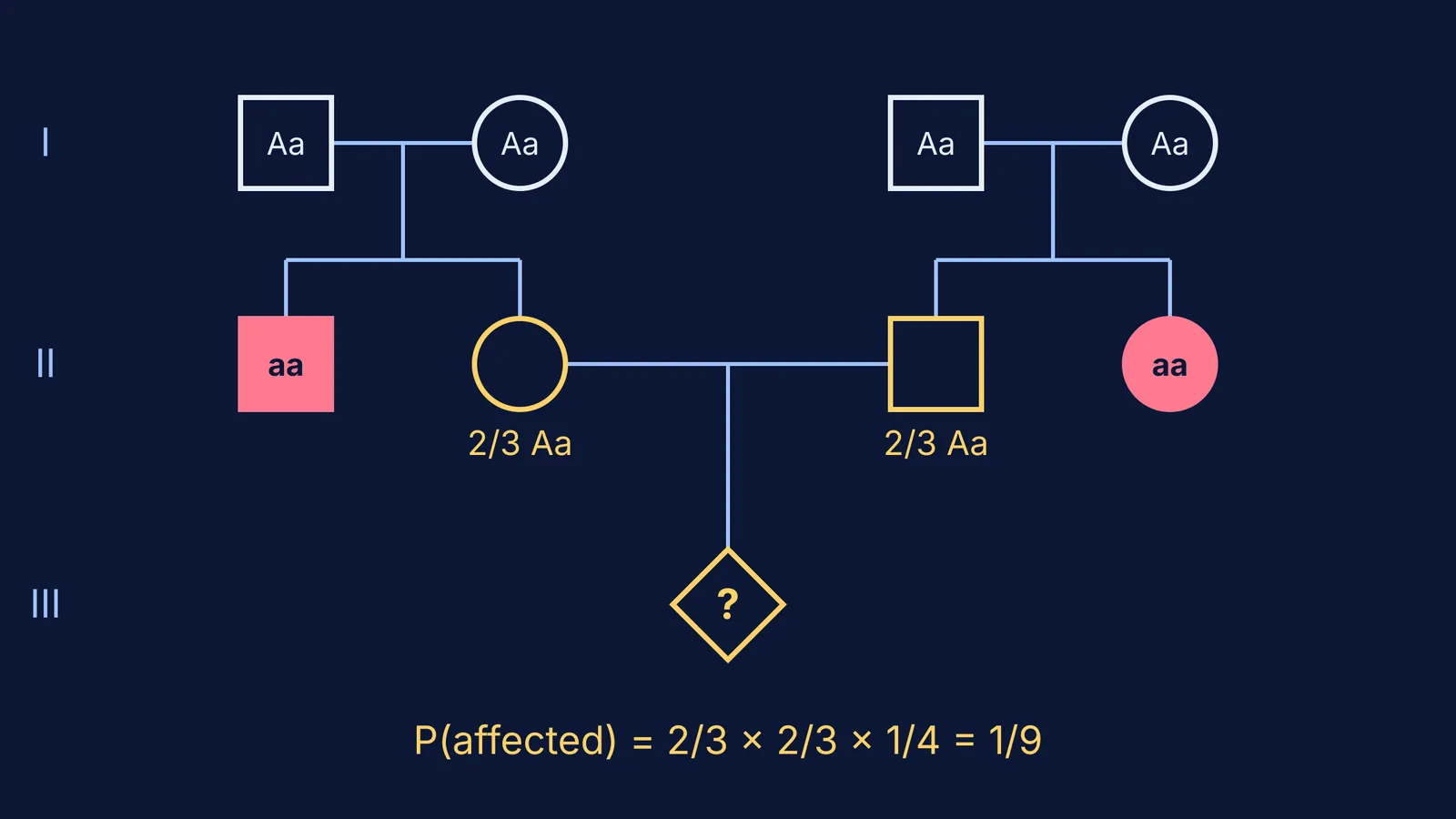
Here is a typical exam question. Priya and her parents are unaffected, but her brother has an autosomal recessive condition. Rahul and his parents are unaffected, but his sister has the same condition. Priya and Rahul plan a child. What is the chance the child is affected? What is the chance the child is a carrier?
Step 1: Parents of each affected sibling. All four grandparents are unaffected and have an affected child, so all four are Aa.
Step 2: Priya and Rahul. Each is an unaffected child of Aa × Aa, so each is a carrier with probability 2/3.
Step 3: Chance the child is affected. The child is aa only if both Priya and Rahul are carriers and both pass on a. That is 2/3 × 2/3 × 1/4 = 1/9.
Step 4: Chance the child is a carrier. Think allele by allele. Priya passes on a with probability 2/3 × 1/2 = 1/3, and so does Rahul. The child is a carrier if exactly one of them passes a: 1/3 × 2/3 + 2/3 × 1/3 = 4/9.
Check: affected 1/9 plus carrier 4/9 leaves 4/9 for AA, and the three add up to 1.
Change one fact and the answer changes. If Rahul's father were affected instead of his sister, Rahul would be an obligate carrier (probability 1). The chance of an affected child would then be 2/3 × 1 × 1/4 = 1/6.
What mistakes cost marks on pedigree questions?
Using 1/2 instead of 2/3 for an unaffected sibling of an affected person.
Forgetting the final 1/4 after working out the parents' carrier chances.
Treating each birth as dependent on earlier ones. MedlinePlus Genetics notes the chance applies equally to each pregnancy, so an earlier affected child does not change the next child's 1/4.
Answering "chance of a carrier child" with the chance of an unaffected child. Read which one the question wants.
If a step in your own working goes wrong, the Fermi Problem Library has worked problems with a step-by-step solver that explains the reasoning rather than printing an answer, so you can follow each multiplication. If the gap is earlier, in alleles, Punnett squares or conditional probability, the Fermi Concept Library gives each concept its own lesson.
Tomorrow, redo the worked example without looking, then change one relative and recompute.


