

On this page
Mendel's original experiments on pea plants suggested that a trait is controlled by two alternate forms of a gene—one dominant and one recessive. However, in the human population, a gene can exist in more than two forms. This is known as multiple allelism.
The classic example of multiple alleles in human genetics is the ABO blood group system NCBI Gene. The blood group is controlled by a single gene called the I gene, located on chromosome 9 at locus 9q34.2. In the human population, the I gene has three distinct alleles: I^A, I^B, and i.
What does multiple alleles mean in genetics?
In genetics, "multiple alleles" means that there are three or more variants of a specific gene existing within a population. A single human can only carry two of them at a time, but across the entire species, the gene has a wider variety of forms.
Unlike mistakes during cell division, such as nondisjunction in meiosis that create extra chromosomes, these alleles are stable natural variations. The I gene is responsible for producing an enzyme that modifies the surface of your red blood cells. Depending on which alleles you inherit, your body manufactures different sugars, or antigens.
What are the six genotypes of the ABO blood group?
The three alleles of the I gene instruct the cell to build antigens differently:
The I^A allele codes for an enzyme that adds a sugar called N-acetylgalactosamine, creating the A antigen.
The I^B allele codes for an enzyme that adds D-galactose, creating the B antigen.
The i allele (sometimes written as I^O) has a small genetic mutation—typically a deletion of a guanine base—that makes its enzyme non-functional NCBI Gene. This means no new sugar is added.
Because you inherit one allele from each parent, these three alleles combine mathematically into exactly six possible pairs, or genotypes ABO blood group system. These six genotypes produce the four observable blood groups, or phenotypes:
Blood Group A: Genotypes I^A I^A or I^A i
Blood Group B: Genotypes I^B I^B or I^B i
Blood Group AB: Genotype I^A I^B
Blood Group O: Genotype ii
Why are IA and IB codominant over i?
The ABO system perfectly illustrates two different inheritance rules working at the same time: complete dominance and codominance.
Both the I^A and I^B alleles are completely dominant over the i allele. If you inherit an I^A from one parent and an i from the other, your red blood cells will only display the A antigen. The non-functional i allele simply steps aside, producing no conflicting sugars.
However, if you inherit an I^A allele from your mother and an I^B allele from your father, neither allele overpowers the other. Instead, they are codominant. Both enzymes are actively manufactured in the cell, and both add their respective sugars to the red blood cells. As a result, your blood type is AB, and your cells express both A and B antigens equally. This is distinctly different from incomplete dominance in snapdragons, where two alleles blend to create an intermediate trait.
When testing yourself on these principles, the Fermi Concept Library holds every concept in physics, chemistry, biology, mathematics and computing, each with its own lesson and its place in the map.
How do you predict a child's blood group?
Parent-to-child prediction problems are a staple of biology exams. You can solve them by mapping the parents' alleles on a Punnett square to find the probability of each outcome.
Imagine a father with Blood Group A and a mother with Blood Group B. Can they have a child with Blood Group O?
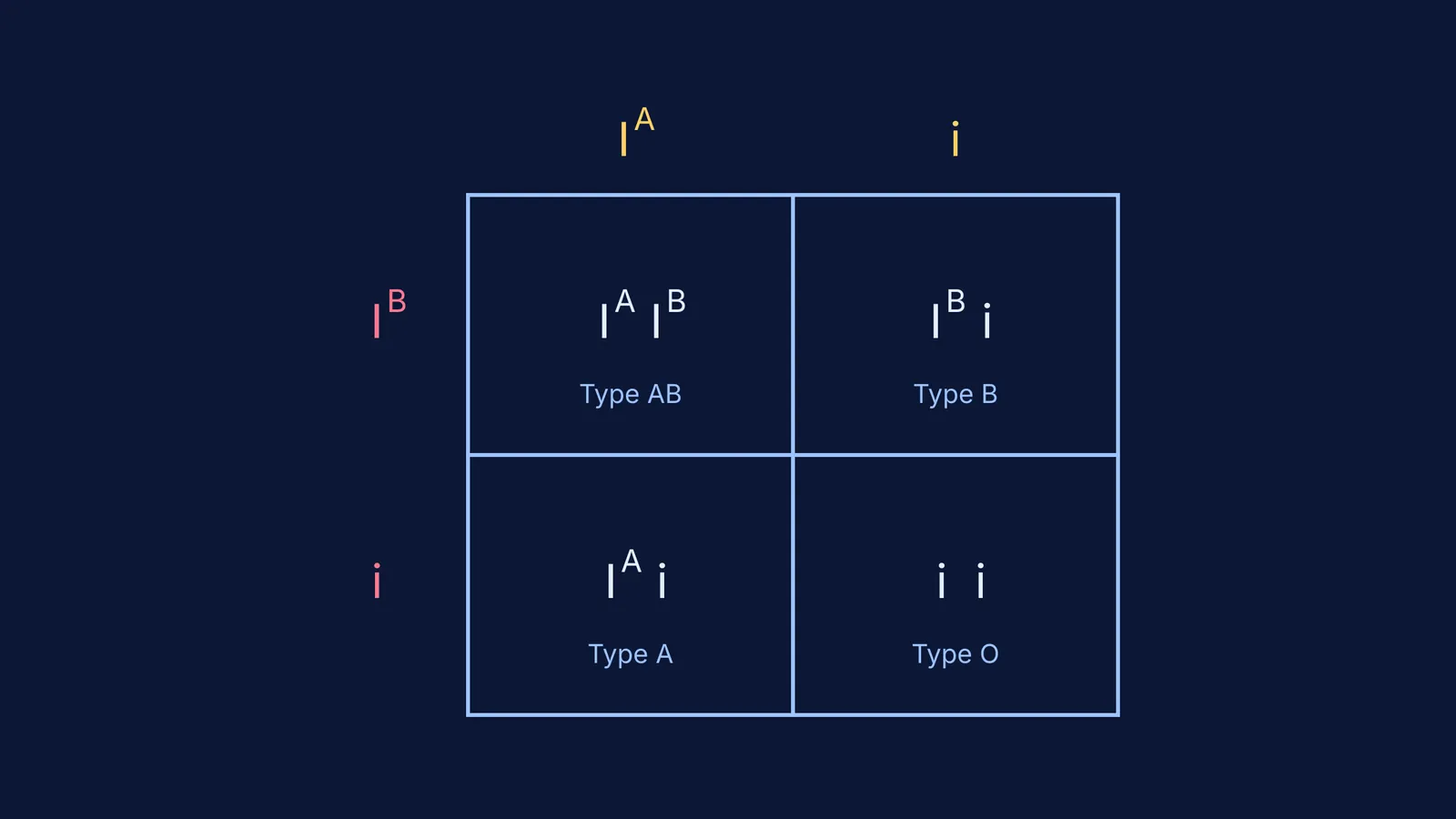
If the parents are homozygous (I^A I^A and I^B I^B), 100% of their children will inherit the I^A I^B genotype and have Blood Group AB ABO blood group system. However, if both parents are heterozygous (the father is I^A i and the mother is I^B i), the genetic cross looks different, yielding Punnett square ratios that include every blood type:
25% chance of inheriting I^A and I^B (Type AB)
25% chance of inheriting I^A and i (Type A)
25% chance of inheriting I^B and i (Type B)
25% chance of inheriting i and i (Type O)
In this scenario, two parents with A and B blood can have a biological child of any of the four blood groups. This demonstrates why knowing a parent's phenotype is not always enough to know their exact genotype.
If you struggle with setting up crosses or tracing alleles through a family tree, the Fermi Problem Library has worked problems with a step-by-step solver that explains the reasoning rather than printing an answer.


