

On this page
Cell division usually follows a strict sorting rule: each new cell must receive exactly half of the parent cell's genetic material. This guarantees that when a sperm and an egg combine, the resulting embryo has a complete and balanced set of instructions. But biological processes are not perfectly mechanical. Sometimes, a pair of chromosomes sticks together and travels to the same pole of the dividing cell.
This error is known as nondisjunction. It breaks the sorting rule, leaving one new cell with an extra chromosome and the other with one too few. When those cells go on to become gametes (sperm or egg cells), the mistake becomes permanent.
If a gamete with an extra chromosome joins a normal gamete during fertilisation, the resulting embryo will have three copies of that chromosome instead of the usual two. This condition is called a trisomy.
What is nondisjunction in meiosis?
Meiosis is the specialised cell division that creates sperm and egg cells. It happens in two stages: Meiosis I and Meiosis II. In a normal division, homologous chromosomes pair up and separate in Meiosis I, and then sister chromatids split in Meiosis II.
Nondisjunction is the failure of these chromosomes or chromatids to separate. It can happen in either stage:
Meiosis I nondisjunction: A homologous pair fails to separate. Both chromosomes travel to one daughter cell.
Meiosis II nondisjunction: Sister chromatids fail to separate. Both chromatids are pulled into one gamete.
When a chromosome pair fails to separate, the error cascades down to the final gametes. This is fundamentally different from a mutation in a single gene, such as those that cause Mendelian disorders: sickle-cell anaemia, thalassemia and PKU. Nondisjunction affects the entire chromosome, which carries hundreds or thousands of genes.
How does an extra chromosome cause trisomy?
Humans normally have 46 chromosomes in every cell, arranged in 23 pairs. One chromosome in each pair comes from the mother, and the other from the father.
If nondisjunction occurs in an egg cell, it might end up with two copies of a specific chromosome instead of one. When a normal sperm (carrying one copy) fertilises this egg, the embryo receives three copies in total.
Trisomy 21, the presence of three copies of chromosome 21, is the primary cause of Down syndrome. According to the Centers for Disease Control and Prevention, Down syndrome occurs in approximately 1 in 700 live births in the United States. The CDC also notes that 95% of these cases are caused by meiotic nondisjunction, while the remaining cases involve structural rearrangements or errors in mitosis after fertilisation.
The risk of nondisjunction is strongly linked to maternal age. Because egg cells are held in an arrested state of meiosis for decades before they mature, the biological machinery that pulls chromosomes apart becomes more prone to sticking as a woman gets older. Most maternal nondisjunction errors occur specifically during Meiosis I, the stage where homologous chromosomes are separated.
How do you predict the gametes after nondisjunction?
Exam questions often ask you to trace the consequences of a nondisjunction event. Instead of memorising the outcomes, it is easier to draw the cells and count the chromosomes.
The Fermi Simulation Lab has interactive simulations for the ideas that are easier to see than to read. You can run cell division step by step, forcing a nondisjunction event to watch where the chromosomes go. If you are practising on paper, Fermi's AI tutor works out what you already know and builds a plan for the session, checking your understanding as it goes until the chromosome counts make sense.
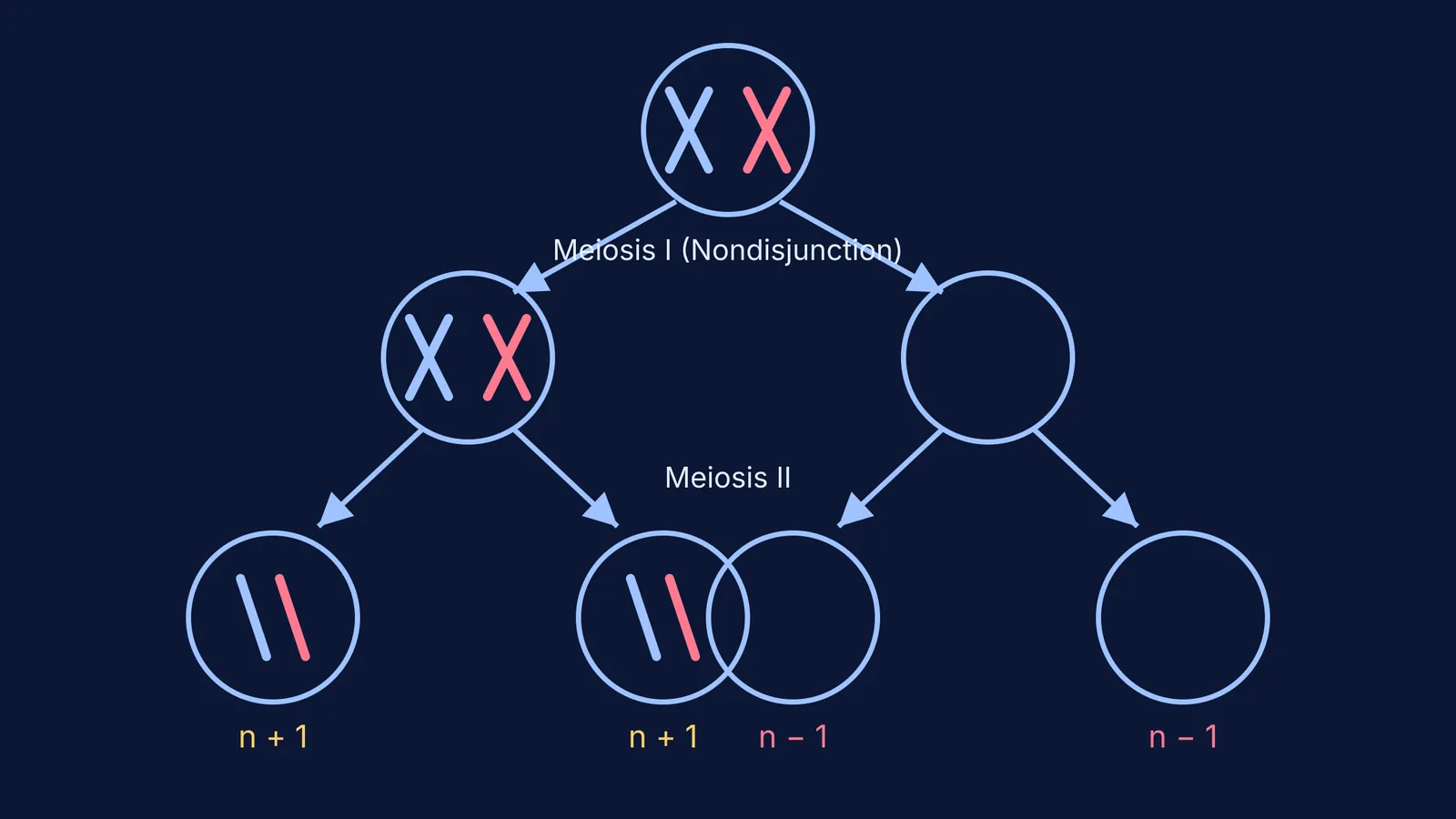
If nondisjunction occurs in Meiosis I:
The homologous pair travels together to one pole.
At the end of Meiosis I, one cell has an extra chromosome, and the other cell is missing it.
Both cells undergo a normal Meiosis II.
Result: All four gametes are abnormal. Two gametes are *n + 1* (they have an extra chromosome), and two gametes are *n - 1* (they are missing a chromosome).
If nondisjunction occurs in Meiosis II:
Meiosis I proceeds normally. Both intermediate cells have the correct number of chromosomes.
In one of those cells, sister chromatids fail to separate during Meiosis II.
Result: Two of the four gametes are normal (*n*). One gamete is *n + 1*, and one gamete is *n - 1*.
If an *n - 1* gamete is involved in fertilisation, the resulting embryo has only one copy of that chromosome, a condition called monosomy. Most autosomal monosomies are not viable in humans, but an extra chromosome (trisomy) can sometimes be tolerated by the developing embryo.
Understanding how chromosomes are pulled apart explains why the shape of the chromosome itself matters. Chromosomes are classified by where their centromeres are located, which affects how they look when the spindle fibres drag them to the poles. You can read more about chromosome types by centromere position: metacentric to telocentric to see how this works in a normal division.
By tracing the mechanics of the spindle fibres and the chromosomes, you can move away from rote memorisation. Nondisjunction is simply what happens when the mechanical pulling of meiosis misses a step.


