On this page
You draw a Punnett square for two pea plants that each carry one round and one wrinkled allele, and the boxes say three in four offspring will be round. Then a question tells you two heterozygous parents had four children and none showed the recessive trait. The square was not wrong. It predicts probabilities, and probabilities only settle into neat ratios when you count a lot of offspring.
What ratios does a Punnett square predict?
A Punnett square, devised by the British geneticist Reginald Punnett, applies the rules of probability to predict the possible outcomes of a cross and how often each is expected (OpenStax Biology 2e). These are the three ratios you need:
Monohybrid cross, Aa x Aa, phenotypes: 3 dominant : 1 recessive.
The same cross, genotypes: 1 AA : 2 Aa : 1 aa.
Dihybrid cross, AaBb x AaBb: a 4 x 4 square gives 16 equally likely combinations and a phenotype ratio of 9 : 3 : 3 : 1 (OpenStax Biology 2e, laws of inheritance).
The 9:3:3:1 assumes the two genes sort into gametes independently. Some genes are not inherited independently of each other, and their crosses break the pattern (same OpenStax chapter).
If you still find the allele sorting hard to follow, our guide to Mendelian genetics for NEET works through the squares and the common traps.
Did Mendel's own peas give exactly 3:1?
Close, but not exactly, and Mendel noted the scatter himself. In his pea paper (read in 1865, published in 1866) he reported 5,474 round and 1,850 wrinkled seeds from 253 hybrid plants, a ratio of 2.96:1, and 6,022 yellow to 2,001 green seeds, a ratio of 3.01:1 (Mendel, Experiments in Plant Hybridization, English translation). His dihybrid cross gave 315 round yellow, 101 wrinkled yellow, 108 round green and 32 wrinkled green seeds out of 556. A perfect 9:3:3:1 split of 556 would be about 313, 104, 104 and 35.
Single plants swung much more. Among his first ten plants, one gave 19 round and 10 wrinkled seeds, and another gave 26 round and 6 wrinkled. At the extremes, one plant gave 43 round and only 2 wrinkled seeds, and another gave 14 round and 15 wrinkled (same paper). Mendel wrote that with a smaller number of experimental plants "very considerable fluctuations may occur."
Read how Gregor Mendel found the laws of inheritance for how he set up the crosses.
Why don't small families match the textbook ratio?
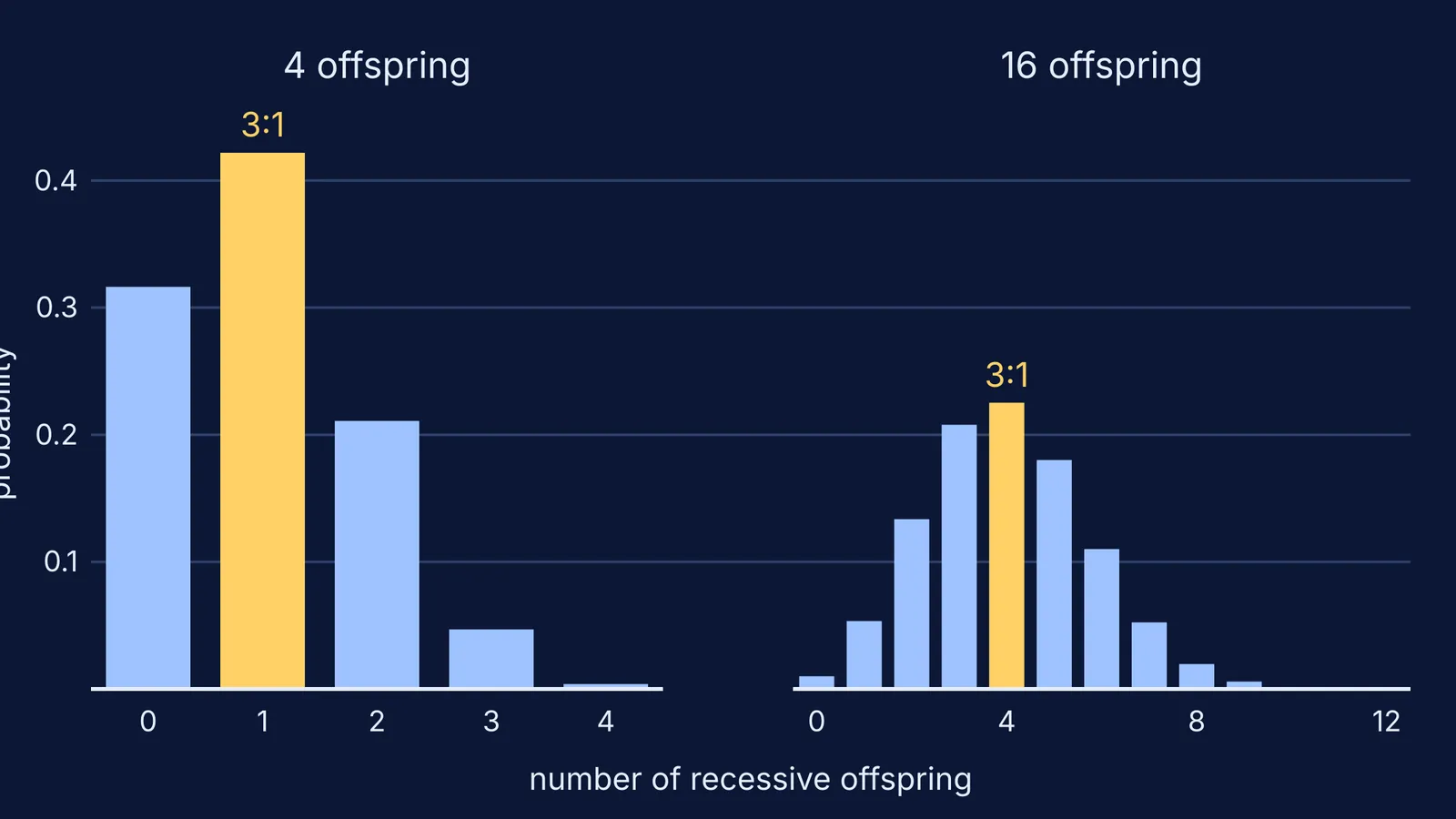
Each offspring is a separate draw. In Aa x Aa, every child has a 1 in 4 chance of being aa, whatever its siblings turned out to be. So the number of recessive offspring in a family of n follows the binomial distribution, P(k) = C(n, k) p^k (1 - p)^(n - k) (NIST/SEMATECH e-Handbook of Statistical Methods).
Worked example, a family of four, p = 1/4:
Exactly one recessive child, a perfect 3:1: 4 x (3/4)^3 x (1/4) = 108/256, about 42%.
No recessive child at all: (3/4)^4 = 81/256, about 32%.
Exactly 1 AA : 2 Aa : 1 aa: 12 x (1/4) x (1/2)^2 x (1/4) = 12/64, about 19%.
So a perfect 3:1 is the single most likely result for four offspring, and it still happens less than half the time. With 16 offspring from a dihybrid cross, the same counting extended to four classes gives roughly a 2.5% chance of landing on exactly 9, 3, 3 and 1.
The binomial standard deviation is the square root of np(1 - p) (NIST, same page). Turned into a share of offspring, the recessive fraction typically wobbles by about 22 percentage points for 4 offspring, about 4 points for 100, and about half a point for Mendel's 7,324 seeds. That is why his 25.3% wrinkled sat so close to 25%. The same chance effect, across generations of a whole population, is what biologists call genetic drift; see Sewall Wright and genetic drift.
How do you run your own cross simulator?
Coins are enough to start:
Predict first. Write the expected ratio, then guess what a family of 4, of 16 and of 100 will show.
Use two coins per offspring, one for each Aa parent: heads gives A, tails gives a. Record 4 offspring, then 16. For a dihybrid cross, use four coins, two per gene.
Pool results with classmates until you pass 100 offspring, and work out the recessive share at each stage.
Compare. Your families of 4 will scatter widely; the pooled share should move towards 25%.
Explain the difference in one sentence that uses the word independent.
For other ideas that are hard to picture, the Fermi Simulation Lab has interactive simulations for the ideas that are easier to see than to read. If the probability arithmetic is where you slip, the Fermi Problem Library has worked problems with a step-by-step solver that explains the reasoning rather than printing an answer.
The next time a small family seems to break Mendel's ratio, count the offspring before you doubt the square.