

On this page
When you first learn about genetics, the word "dominant" sounds powerful. It is easy to assume that a dominant trait will eventually take over a population, outcompeting the "weaker" recessive traits. But in genetics, dominance has nothing to do with how common a trait is.
So, does dominant mean more common in a population? The short answer is no. A dominant allele simply masks a recessive one when both are present in a single individual. Whether that trait becomes common across thousands of people depends on evolution, not dominance.
Here is how to separate the two ideas, and why some of the most common human traits are actually recessive.
What does dominance actually mean?
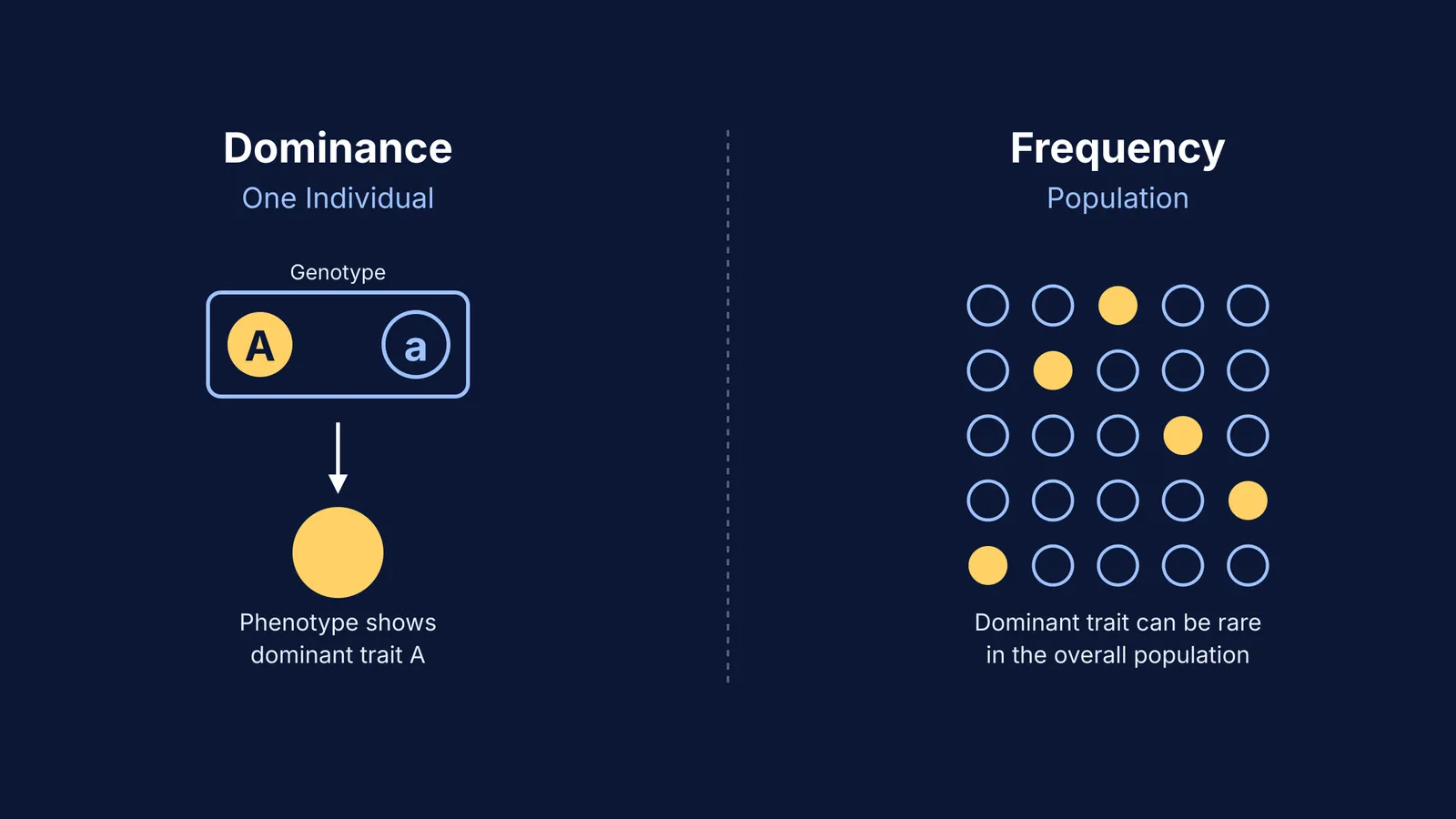
Dominance describes a relationship between two alleles (versions of a gene) in one person's DNA.
If you inherit one dominant allele and one recessive allele for a trait, you are heterozygous. The dominant allele "wins" by expressing its physical trait, masking the recessive one. According to the National Library of Medicine, a dominant trait is expressed even if an individual has only one copy of that allele.
This interaction happens entirely at the microscopic level inside your cells. It does not give the allele any special ability to spread to other people or survive in the wild. When Gregor Mendel first studied pea plants, he noted that the allele for purple flowers was dominant over the allele for white flowers. However, in a real meadow, the number of purple flowers ultimately depends on which colour local bees prefer to pollinate, not just on the plant's internal genetic rules.
Why are some dominant traits so rare?
Whether a trait is common or rare depends on its allele frequency: how often that specific DNA sequence appears in the overall gene pool. Frequency is driven by natural selection, mutation rates, and genetic drift.
If a dominant trait causes a severe disadvantage, natural selection will filter it out, keeping its frequency very low. A classic example is achondroplasia, the most common form of short-limbed dwarfism. It is an autosomal dominant condition, meaning only one copy of the mutated gene is needed to cause it. Yet, achondroplasia is rare, occurring in 1 in 15,000 to 40,000 newborns. The vast majority of the human population carries two copies of the recessive "average height" allele.
Similarly, Huntington's disease is a severe neurological disorder caused by a dominant allele. Despite being dominant, it affects only 3 to 7 per 100,000 people of European ancestry. The dominant allele remains rare because it does not offer a survival advantage.
Even harmless dominant traits can be rare. Polydactyly—having extra fingers or toes—is often inherited as a dominant trait. Despite this, the vast majority of humans have five digits because the recessive allele for five digits is overwhelmingly more frequent in the gene pool. The dominant allele simply never became widespread in our ancestral populations.
Can a recessive trait be the most common?
Yes. If a recessive allele is neutral or beneficial, it can easily become the most frequent trait in a population.
Blood types are a perfect example. The allele for Type O blood is recessive to both Type A and Type B. To have Type O blood, you must inherit two copies of the recessive O allele. However, Type O is the most common blood group. The American Red Cross notes that O positive and O negative blood types together make up roughly 45% of the U.S. population. The dominance of the A and B alleles does not reduce the frequency of the O allele across the population.
Another example is eye colour in isolated populations. In parts of Northern Europe, the recessive allele for blue eyes is extremely common, while the dominant brown eye allele is much rarer. This demonstrates how geographic isolation and genetic drift can easily make a recessive trait the majority.
A practical framework for exam prep
When studying for board exams or competitive tests, students often mix up individual inheritance with population genetics. You can avoid this trap by keeping the concepts in separate boxes:
Dominance (The Mechanism): This is about how alleles interact in one individual. You study this using Punnett squares to predict the outcome of a single cross between parents.
Frequency (The Population): This is about how many people carry the allele in a large group. You study this using the Hardy-Weinberg principle to see how the whole population's genetics remain stable or change over time.
If you are stuck on why a dominant trait doesn't take over, Fermi's AI tutor can work out what you already know and build a plan for the session, teaching you the mathematical difference between Mendelian crosses and population shifts. You can also explore the complete map of these ideas in the Fermi Concept Library.
For more practice on how alleles interact, you can read our guide to Heredity in Class 10: Mendel's experiments and sex determination or dive deeper into Mendelian genetics for NEET: Punnett squares, ratios and traps. If you are studying human genetics, our overview of Mendelian disorders: sickle-cell anaemia, thalassemia and PKU covers how these specific conditions are inherited.


