

On this page
In biology, immunity is categorised by how your body acquires its defensive antibodies. When studying for exams, you can trace how these defenses work using the map in the Concept Library, where every concept in physics, chemistry, biology, mathematics and computing has its own lesson and its place in the map.
The core difference between active and passive immunity comes down to whether your immune system did the work to produce the defense.
What is active immunity?
Active immunity means your own immune system produces antibodies and memory cells after being exposed to an antigen.
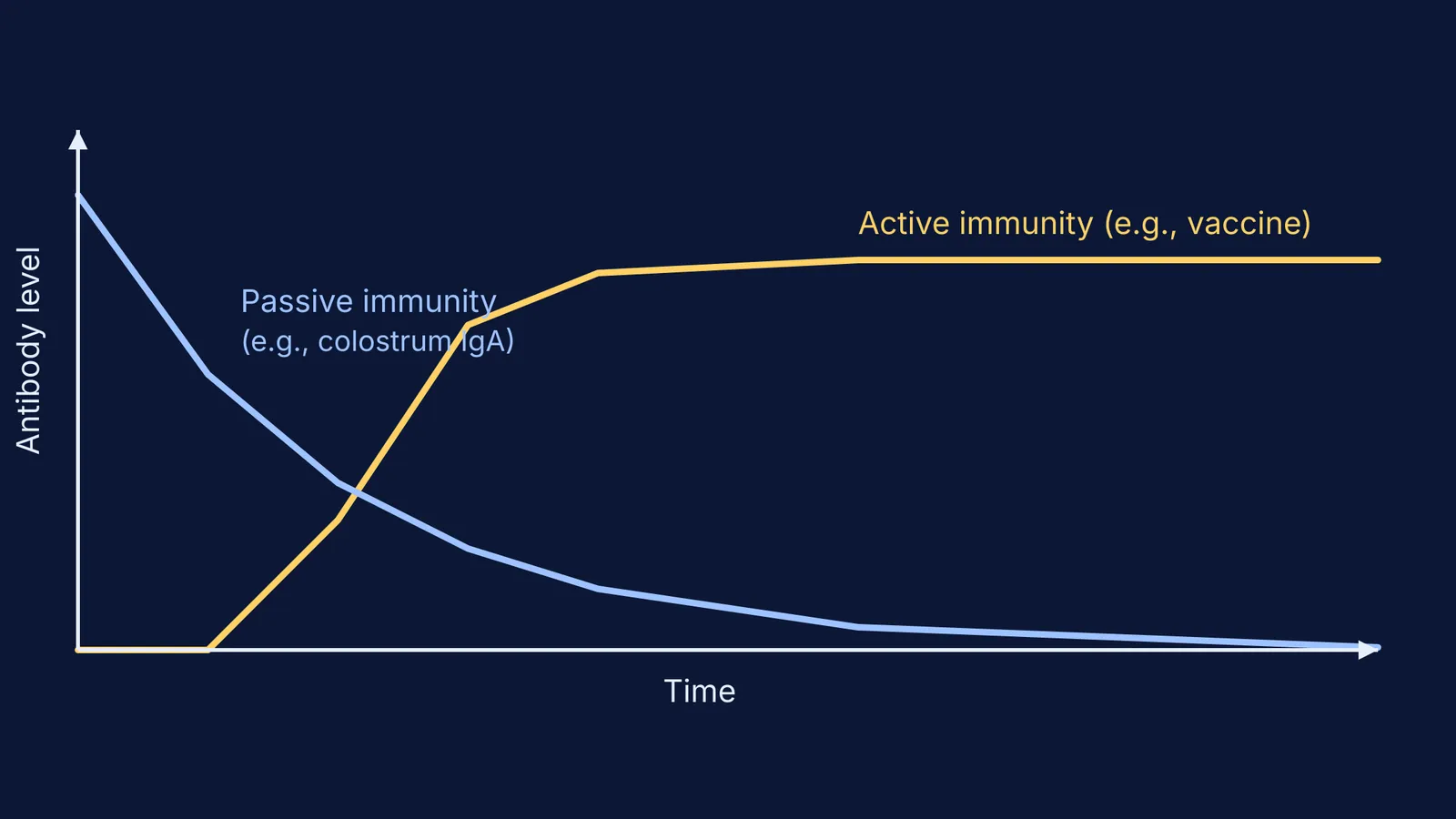
When you first encounter an antigen—say, the chickenpox virus—your immune system mounts a primary response. This is why active immunity is slow to start. It takes time for antigen-presenting cells to find the right T cells, which then activate B cells to produce targeted antibodies. Once the infection is cleared, memory B and T cells remain in your bloodstream. If the same virus enters your body later, these memory cells trigger a rapid and overwhelming secondary response. This is why you typically do not get sick from the same pathogen twice. This long-lasting defense is the hallmark of natural active immunity.
If you receive a polio vaccine, you are given a weakened or dead form of the virus. Your body still does the work of making antibodies and memory cells, but without you getting the disease. This is artificial active immunity.
What is passive immunity?
Passive immunity means you receive pre-made antibodies from another source. Because your own immune system did not manufacture these antibodies, it does not learn how to make more.
The imported antibodies circulate in your system and do their job by binding to antigens. However, like all proteins, antibodies have a limited lifespan. As they naturally break down and are cleared from your body, the level of protection drops. Since there are no memory cells left behind to replenish the supply, passive immunity is inherently short-lived.
A common example of artificial passive immunity is receiving an antivenom injection after a snake bite. The antivenom contains ready-made antibodies that neutralise the toxin instantly, but it will not protect you if you are bitten again.
Natural passive immunity occurs when antibodies are transferred naturally from mother to child. During pregnancy, IgG antibodies cross the placenta. After birth, a different antibody takes over, primarily delivered through milk.
Why is IgA in colostrum an example of passive immunity?
The World Health Organization recommends initiating breastfeeding within the first hour of life (World Health Organization). Colostrum, the thick "first milk" produced by a mother, is often called the first natural vaccine because it is uniquely packed with immunoglobulins and immune cells.
The dominant antibody in human colostrum is Secretory IgA (sIgA). Colostrum is exceptionally rich in sIgA, with concentrations significantly higher than the trace amounts found in mature breast milk.
This setup is a perfect example of natural passive immunity tailored for a newborn. A baby's immune system is immature and cannot yet produce enough of its own antibodies. Instead, the mother's pre-made IgA antibodies are swallowed by the infant. Unlike the nutrients in milk that are broken down for energy, these secretory IgA molecules have a special structural component that resists being digested by the harsh stomach acid and intestinal enzymes.
Rather than being absorbed into the infant's bloodstream, sIgA remains in the digestive tract. It coats the mucosal surfaces of the baby's gastrointestinal and respiratory systems. This creates a defensive varnish that binds to and neutralises pathogens and diseases before they can attach to the gut wall. Once the infant stops receiving breast milk, this external supply of antibodies stops, and the passive protection wanes as the infant's own active immunity begins to take over.
How to remember the difference for exams
If you are struggling to keep these concepts straight while studying, rely on this analytical framework instead of rote memorisation:
Source of antibodies: Did the person's own body make the antibodies? (Yes = Active, No = Passive).
Speed of action: Did the protection take effect immediately? (Yes = Passive, No = Active).
Immunological memory: Are memory cells left behind for future protection? (Yes = Active, No = Passive).
When you encounter a multiple-choice question about a specific treatment, look at what is actually in the syringe or the substance. A vaccine contains an antigen (like a dead virus), forcing your body to react. That means it provides active immunity. An antivenom or an antitoxin contains pre-made antibodies, providing an immediate but temporary shield. That means it provides passive immunity.
Knowing these precise definitions helps you grasp the broader mechanics of human immunity, just as knowing the formed elements of blood helps you understand the transport of oxygen and nutrients.
If you are stuck on these distinctions, Fermi's AI tutor can work out what you already know and build a plan for the session, checking your understanding of antigens and antibodies as it goes. For numericals or tricky conceptual questions, you can also use the Problem Library, a step-by-step solver that explains the reasoning rather than printing an answer, to practice identifying different immunological scenarios.


