

On this page
NEET questions on blood cells are rarely hard, but they are exact. One gives you "agranulocyte, 6 to 8 per cent, phagocytic" and expects one word back. Another hands you a lab report and asks which count is off. This post takes the three formed elements one at a time with NCERT's numbers, then works a sample blood report so the percentages turn into counts you can reason with.
Where is this in the syllabus?
The NEET (UG) 2026 syllabus lists "Composition of blood, blood groups, coagulation of blood" under body fluids and circulation. The material is section 15.1.2 of the NCERT Class 11 chapter Body Fluids and Circulation (2026-27 reprint), and the chapter is also in the CBSE Class XI biology curriculum for 2026-27. Check the syllabus for your exam year when it is notified.
NCERT calls erythrocytes, leucocytes and platelets together the formed elements. They make up nearly 45 per cent of blood; plasma is the other 55 per cent.
What makes an RBC different from other blood cells?
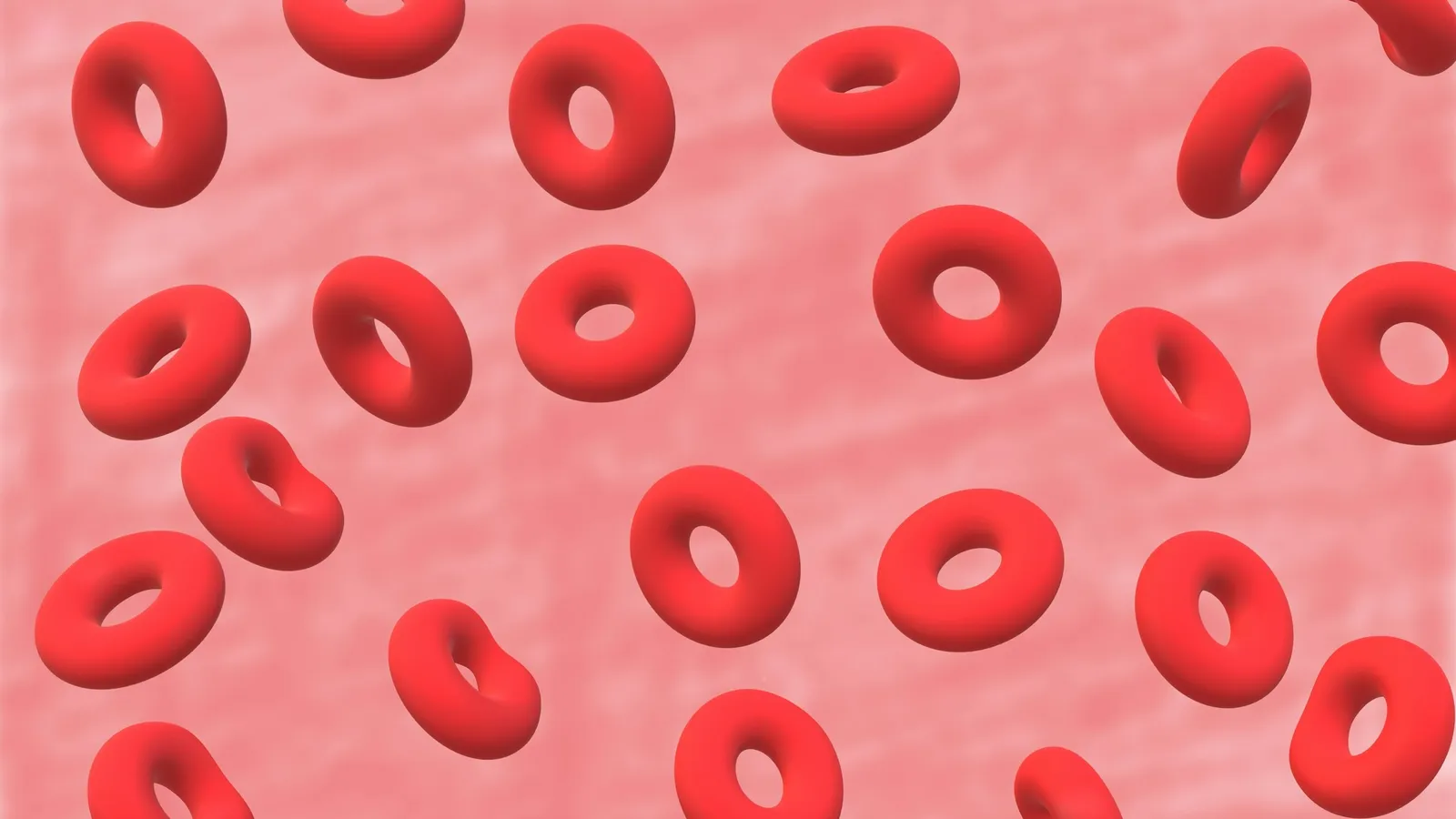
Most abundant cell: 5 million to 5.5 million per mm³ in a healthy adult man.
Made in the red bone marrow in adults.
No nucleus in most mammals, and biconcave in shape.
Carries haemoglobin, an iron-containing protein: 12 to 16 g in every 100 mL of blood.
Lives about 120 days, then is destroyed in the spleen, which NCERT calls the "graveyard of RBCs".
Two words in that list are tested more than the rest: "most" mammals, not all, and spleen, not liver.
How do you tell the five WBC types apart?
Leucocytes are colourless because they lack haemoglobin. They are nucleated, generally short-lived and number 6000 to 8000 per mm³. NCERT splits them into two groups.
Granulocytes:
Neutrophils, 60 to 65 per cent, the most abundant WBC. Phagocytic: they destroy foreign organisms that enter the body.
Eosinophils, 2 to 3 per cent. They resist infections and are associated with allergic reactions.
Basophils, 0.5 to 1 per cent, the fewest. They secrete histamine, serotonin and heparin and take part in inflammatory reactions.
Agranulocytes:
Lymphocytes, 20 to 25 per cent, in B and T forms. Both are responsible for the body's immune responses.
Monocytes, 6 to 8 per cent. Phagocytic, like neutrophils.
The Class 12 chapter Human Health and Disease adds the immunity side. Neutrophils (which it calls PMNL), monocytes and natural killer cells in blood, plus macrophages in tissues, can phagocytose microbes. B-lymphocytes produce antibodies; T-lymphocytes do not secrete antibodies but help B cells and mediate cell-mediated immunity. Our post on human health and immunity covers that chapter.
Where do platelets come from?
Platelets, or thrombocytes, are not whole cells. They are cell fragments produced from megakaryocytes, special cells in the bone marrow. Blood normally holds 1.5 lakh to 3.5 lakh platelets per mm³, that is 150,000 to 350,000. NCERT prints the range as "1,500,00-3,500,00", which is easy to misread, so write it out in full in your notes. Platelets release substances mostly involved in clotting, and a fall in their number can lead to clotting disorders and heavy blood loss.
Worked example: turning a differential count into numbers
The figures here are sample numbers for practice, not a real patient. A report gives a total WBC count of 7500 per mm³ and this differential count: neutrophils 64 per cent, lymphocytes 24, monocytes 8, eosinophils 3, basophils 1. All five sit inside NCERT's ranges and they add to 100.
Absolute counts. Multiply each percentage by 7500: neutrophils 4800, lymphocytes 1800, monocytes 600, eosinophils 225, basophils 75 per mm³. These add back to 7500.
Granulocytes against agranulocytes. Granulocytes are 64 + 3 + 1 = 68 per cent, or 5100 per mm³. Agranulocytes are 24 + 8 = 32 per cent, or 2400.
Phagocytes. Neutrophils plus monocytes are 72 per cent, or 5400 per mm³.
Red cells per white cell. With 5 million RBCs per mm³, 5,000,000 ÷ 7500 ≈ 667. Across NCERT's ranges the ratio runs from 625 (5 million ÷ 8000) to about 917 (5.5 million ÷ 6000).
Step 4 is why NCERT can call RBCs the most abundant cells in blood: they outnumber WBCs by hundreds to one.
Which mistakes cost marks?
Calling monocytes granulocytes. Monocytes and lymphocytes are the two agranulocytes.
Listing lymphocytes as the phagocytes in a Class 11 question. NCERT's phagocytic pair in this chapter is neutrophils and monocytes.
Saying RBCs are destroyed in the liver. NCERT says the spleen.
Calling platelets cells. They are fragments of megakaryocytes.
Giving histamine and heparin to eosinophils. Basophils, the rarest WBC, secrete them.
A practice routine
Recall works better than rereading, and the schedule matters too. In Rawson and Dunlosky (2011), 533 students learned concepts by retrieval practice across three experiments. The authors' advice was to recall each concept correctly three times in a first session, then relearn it three times at widely spaced intervals.
Make one card per formed element and per WBC type: name on the front; number, origin, life span or role on the back.
Practise until you get each card right three times, then come back after two days, a week and three weeks.
Work two more sample differential counts with totals of 6000 and 8000 per mm³.
Write one line linking each WBC type to its job in immunity, using the Class 12 chapter.
If the numbers still feel like a list with no logic behind them, Fermi's AI tutor can work out what you already know and build a plan for the session, so you spend time on the cells you keep mixing up. For the rest of the chapter, including the cardiac cycle and blood groups, read our guide to body fluids and circulation.
Today, write the five WBC types in order of abundance with their NCERT percentages, then check them against the textbook.


