

On this page
The adjoint method for a 3x3 inverse has no hard idea in it. What goes wrong is bookkeeping: one sign flipped, a transpose forgotten, one entry not divided. This guide fixes the order of every step, works one example, and ends with a check that catches those slips.
What is the formula for the inverse of a 3x3 matrix?
The method comes from Chapter 4 (Determinants) of the NCERT Class 12 Mathematics textbook, Part I: cofactors are defined in Section 4.4, the adjoint and inverse in Section 4.5.
Cofactor: A_ij = (−1)^(i+j) × M_ij, where M_ij is the minor you get by deleting row i and column j.
Adjoint: NCERT defines adj A as the transpose of the matrix of cofactors [A_ij] (Definition 3). Outside India it is often called the adjugate or classical adjoint (Wikipedia: Adjugate matrix).
Key identity: A(adj A) = (adj A)A = |A| I, where I is the identity matrix (NCERT, Theorem 1).
Inverse: A square matrix is invertible if and only if |A| ≠ 0, and then A⁻¹ = (1/|A|) adj A (NCERT, Theorem 4).
If you need a refresher on why a zero determinant kills the inverse, read what a singular matrix means.
How do you find the inverse of a 3x3 matrix step by step?
Cofactors, in a fixed order. Go row by row: A11, A12, A13, then A21, A22, A23, then A31, A32, A33. The signs follow the checkerboard + − + / − + − / + − +. Write the sign before you compute the 2x2 minor, not after. Our guide to minors and cofactors of a 3x3 matrix covers this step in detail.
Determinant from row 1. You already have A11, A12 and A13, so |A| = a11·A11 + a12·A12 + a13·A13 costs three multiplications. If |A| = 0, stop: there is no inverse.
Transpose. Row 1 of the cofactor matrix becomes column 1 of adj A, and so on.
Divide. Write A⁻¹ = (1/|A|) adj A and keep the fraction outside the matrix until the very end.
Check. Multiply A by adj A and confirm you get |A| on the diagonal and 0 everywhere else.
Worked example: a 3x3 inverse with determinant 5
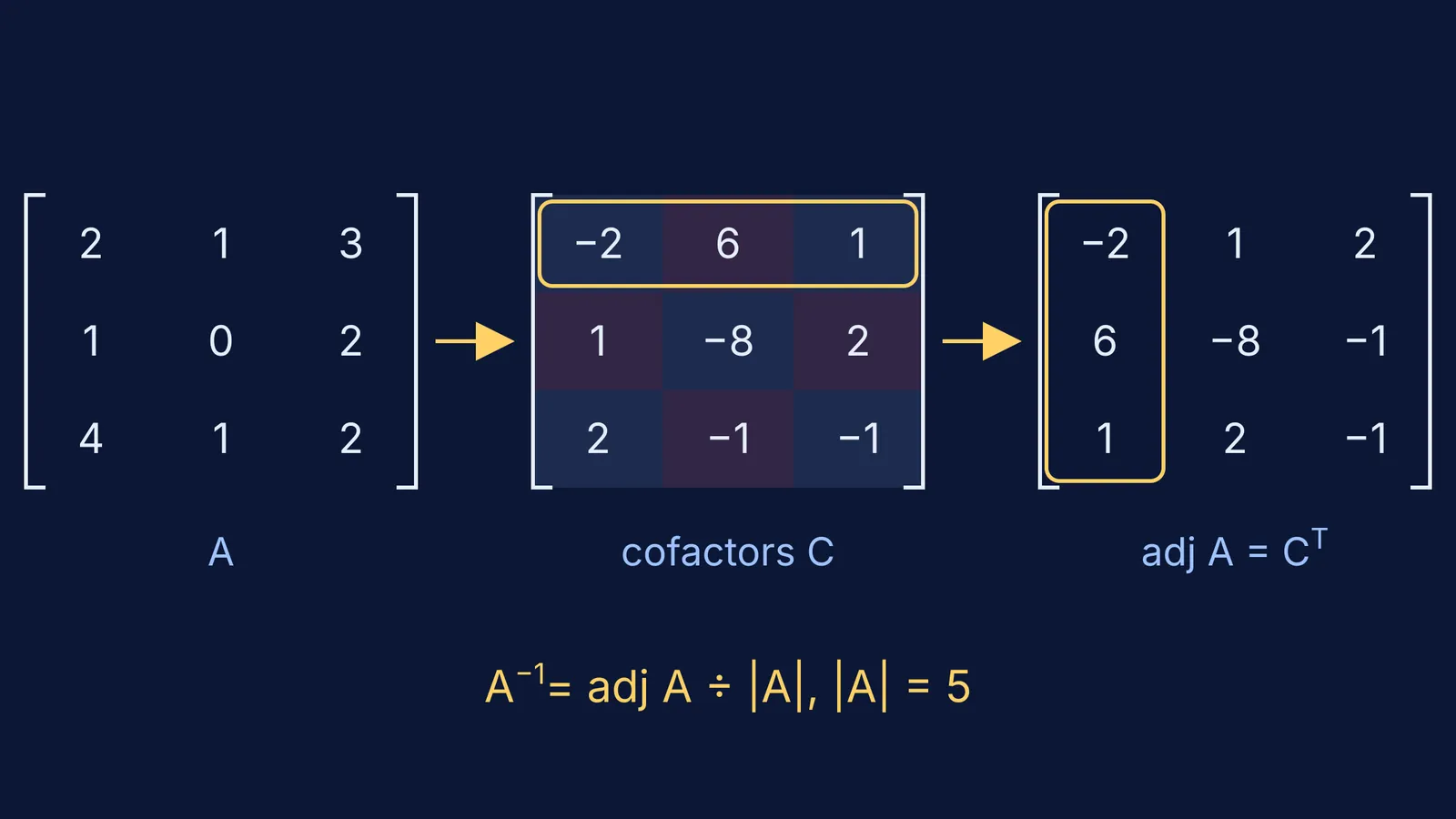
Take A with rows (2, 1, 3), (1, 0, 2) and (4, 1, 2).
Step 1, the cofactors, row by row:
A11 = +(0·2 − 2·1) = −2, A12 = −(1·2 − 2·4) = 6, A13 = +(1·1 − 0·4) = 1
A21 = −(1·2 − 3·1) = 1, A22 = +(2·2 − 3·4) = −8, A23 = −(2·1 − 1·4) = 2
A31 = +(1·2 − 3·0) = 2, A32 = −(2·2 − 3·1) = −1, A33 = +(2·0 − 1·1) = −1
Step 2, the determinant: |A| = 2(−2) + 1(6) + 3(1) = 5. It is not zero, so the inverse exists.
Step 3, the transpose: the cofactor rows were (−2, 6, 1), (1, −8, 2) and (2, −1, −1). They become the columns, so adj A has rows (−2, 1, 2), (6, −8, −1) and (1, 2, −1).
Step 4, the division: A⁻¹ = (1/5) × adj A, which has rows (−2/5, 1/5, 2/5), (6/5, −8/5, −1/5) and (1/5, 2/5, −1/5).
Step 5, the check: row 1 of A times column 1 of adj A is 2(−2) + 1(6) + 3(1) = 5. Row 1 times column 2 is 2(1) + 1(−8) + 3(2) = 0. All nine products together give 5I. So A·A⁻¹ = I.
How do you check your answer quickly?
The check works because, as NCERT notes in Sections 4.4 and 4.5, the sum of the products of a row's elements with their own cofactors is |A|, and with another row's cofactors it is zero (NCERT Class 12 Mathematics, Chapter 4).
It also catches a forgotten transpose. In the example, row 1 of A times column 1 of the untransposed cofactor matrix gives 2(−2) + 1(1) + 3(2) = 3, not 5.
A second check: for a 3x3 matrix, |adj A| = |A|², because NCERT states |adj A| = |A|^(n−1) for a square matrix of order n. Here det(adj A) = 25 = 5².
Which slips cost marks?
Using minors where cofactors are needed, which drops the signs.
Transposing twice, or not at all.
Dividing only some entries by |A|.
Finding adj A for a matrix whose determinant is 0.
For a 2x2 matrix, use the swap-and-negate shortcut for a 2x2 inverse instead.
If your adj A keeps disagreeing with the answer key, the Fermi Problem Library has worked problems with a step-by-step solver that explains the reasoning rather than printing an answer, so you can find the exact cofactor that went wrong. If minors and determinants themselves feel shaky, the mathematics lessons in the Fermi Concept Library take each idea on its own.
Next, try the 3x3 questions in NCERT Exercise 4.4 (Questions 7 to 11) using the five steps and the row-1 test.


