On this page
In June 1798 Henry Cavendish reported the experiment in his paper Experiments to determine the density of the Earth, in the Philosophical Transactions of the Royal Society. He was after the Earth's density, and reported it as 5.48 times the density of water. Today the same experiment is how physics courses introduce the gravitational constant G, and it suits JEE and board questions because one equation ties torque, oscillations and gravitation together.
What did the Cavendish torsion balance look like?
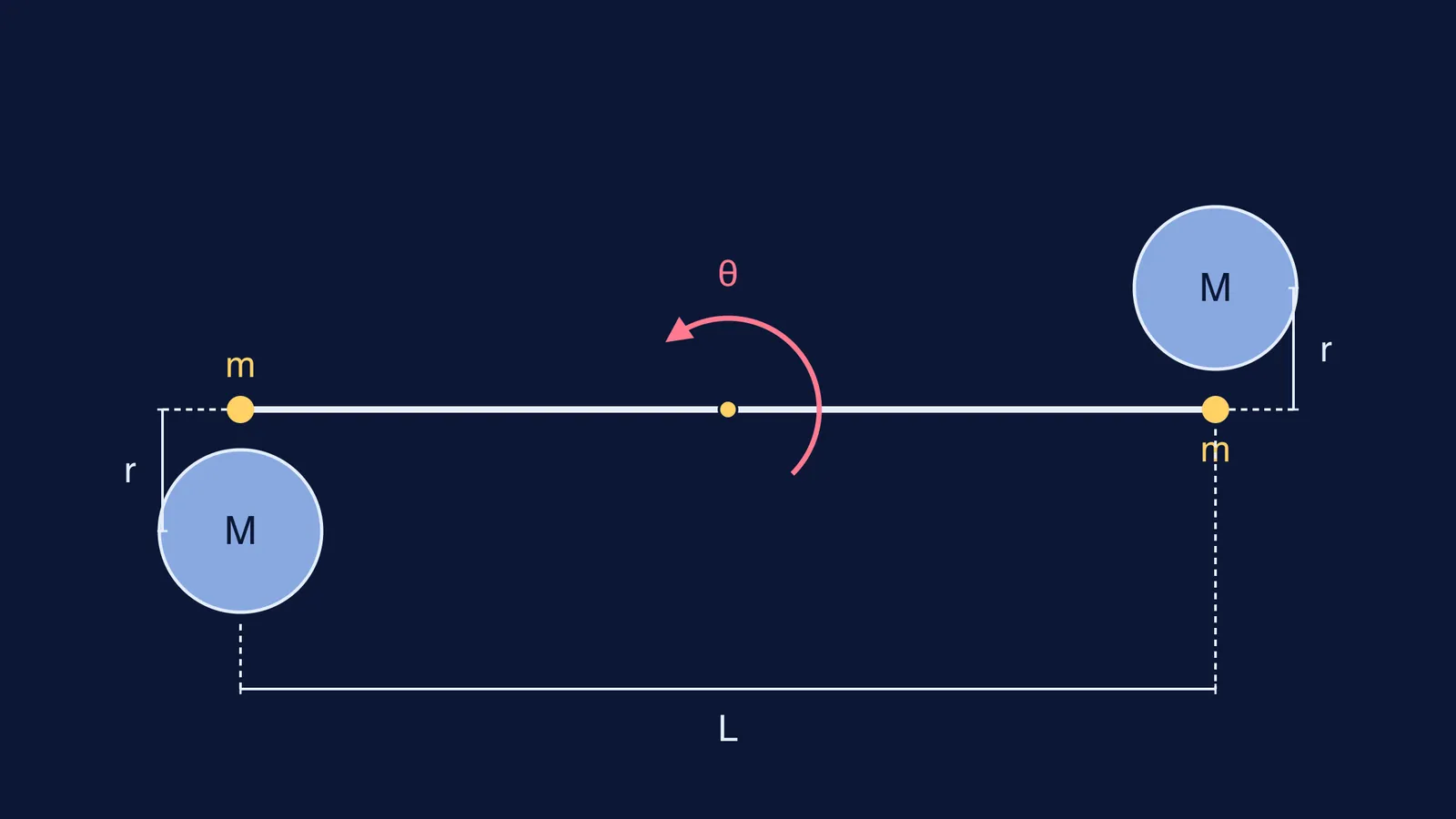
The apparatus came from his friend, the geologist John Michell, who died before he could use it. The American Physical Society's history describes it: two-inch lead spheres on the ends of a six-foot wooden rod, hung from a wire at its centre so it could turn, and two twelve-inch lead spheres of about 350 pounds each brought near them. Cavendish watched the rod through a telescope, through a window.
In metric units, the Wikipedia summary of the experiment gives small balls of 0.73 kg, large balls of 158 kg, a centre-to-centre gap of about 225 mm, and an oscillation period of about 7.5 minutes once he fitted a stiffer wire. The same page notes that his 5.48 came from an arithmetic slip (the corrected figure is 5.448), and that his result implies G ≈ 6.74 × 10⁻¹¹ m³ kg⁻¹ s⁻², within about 1% of the modern value.
How does the torque balance give G?
Each large ball pulls its neighbouring small ball sideways. The two pulls sit on opposite ends of the rod and point in opposite directions, so their torques add and the rod twists until the wire pushes back equally. Here is the chain, with the symbols used on the Wikipedia page:
Force on each small ball: F = GMm/r², where r is the centre-to-centre distance.
Gravitational torque about the wire: two forces, each at L/2, so τ = F·L.
Restoring torque of the twisted wire: τ = κθ, where κ is the torsion constant. At rest, κθ = F·L.
You cannot look κ up, so time the swing: T = 2π√(I/κ), with I = 2m(L/2)² = mL²/2. That gives κ = 4π²I/T².
Put it together and m cancels: G = 2π²Lr²θ/(MT²).
Why is G so small?
The current CODATA value from NIST is G = 6.67430 × 10⁻¹¹ m³ kg⁻¹ s⁻². In plain terms, two 1 kg masses 1 m apart attract each other with about 6.7 × 10⁻¹¹ N, far too little to feel.
G is small because gravity is a very weak force at the scale of kilograms and metres, the scale our units were built around. You notice gravity only when one of the masses is enormous. The Earth's mass is 5.9722 × 10²⁴ kg and its mean radius 6371 km, according to the NASA Earth fact sheet. Put those into g = GM/R² and you get 9.82 m/s², the same mean surface gravity NASA lists.
This is why the experiment is called weighing the Earth. Cavendish compared the balls' pull with the Earth's pull on the same balls, which gave the Earth's density directly. In modern terms, once G is known, g = GM/R² gives the Earth's mass M.
How big was the deflection? A worked estimate
Use the round numbers from the Wikipedia summary: M = 158 kg, m = 0.73 kg, L = 1.8 m, r = 0.225 m, T = 450 s, and G from NIST.
Force: F = 6.674 × 10⁻¹¹ × 158 × 0.73 / 0.225² ≈ 1.52 × 10⁻⁷ N. That is the weight of about 15 micrograms.
Torque: τ = F·L = 1.52 × 10⁻⁷ × 1.8 ≈ 2.74 × 10⁻⁷ N m.
Moment of inertia: I = mL²/2 = 0.73 × 1.8² / 2 ≈ 1.18 kg m².
Torsion constant: κ = 4π²I/T² = 39.5 × 1.18 / 450² ≈ 2.31 × 10⁻⁴ N m per radian.
Angle: θ = τ/κ ≈ 1.19 × 10⁻³ rad, about 0.07°.
Movement of each rod end: 0.9 m × 1.19 × 10⁻³ ≈ 1.1 mm. Swinging the large balls to the other side reverses the torque, so the full swing between the two positions is about 2 mm.
This is idealised: it ignores the pull of each large ball on the far small ball and on the rod, which a real analysis corrects for. Wikipedia gives the real force as about 1.74 × 10⁻⁷ N and the measured deflection as about 0.16°, so the estimate gets the scale right without matching his figures: a 1.8 m rod whose ends move a millimetre or so.
If step 4, finding κ from a period, is where you get stuck, the Fermi Problem Library has worked problems with a step-by-step solver that explains the reasoning rather than printing an answer.
What should you remember for JEE and board exams?
G is a universal constant with units m³ kg⁻¹ s⁻²; g is the local acceleration in m/s², and it changes from place to place.
The balance works because a thin wire has a tiny κ, so a tiny torque gives a measurable angle.
The period is measured to find κ; the small mass cancels.
Cavendish reported a density, not G; the symbol G only became standard long after him, as the Wikipedia history notes.
For practice, try the worked numerical on the gravitational force between two spheres, see how another torsion balance tested a deeper idea in how Eötvös showed gravitational and inertial mass are equal, then use G yourself to find the mass of the Sun from Earth's orbit. To revise torsion and gravitation as linked topics, open the Fermi Concept Library.