

On this page
A classic gravitation numerical gives you two spheres, their masses and radii, and the gap between their surfaces. The trap is the distance. Get that one step right and the rest is arithmetic.
What distance do you use for two spheres?
Newton's law of gravitation is F = Gm₁m₂/r². For point masses, r is simply the distance between them. For uniform spheres the same formula works, with r measured between the centres: OpenStax University Physics states that the law applies to any spherically symmetric objects, "where r is the distance between the centers of mass of those objects."
The reason is the shell theorem. A uniform spherical shell pulls on anything outside it as if all its mass sat at its centre, and a solid sphere is a stack of such shells. We go through the theorem and its other uses in our post on why gravity inside a shell is zero.
Two conditions matter:
The sphere must be spherically symmetric: uniform, or with a density that changes only with distance from the centre. A cube or a lumpy rock does not qualify.
The other mass must be outside the sphere. Inside, only the mass closer to the centre than you counts.
So the working rule is: r = gap + r₁ + r₂.
How do you solve a two-sphere gravitation numerical?
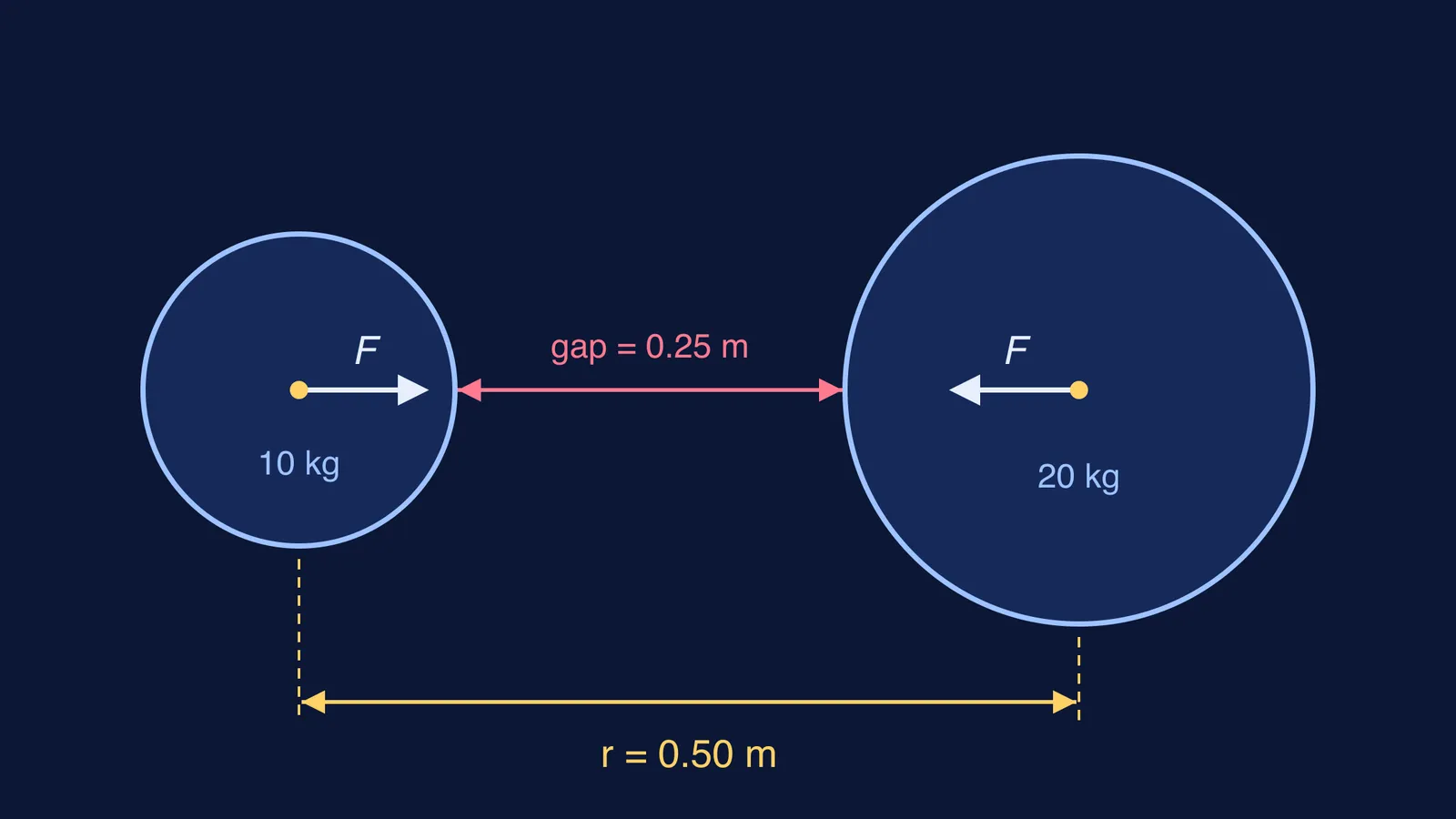
Worked example: two uniform solid spheres have masses 10 kg and 20 kg and radii 0.10 m and 0.15 m. Their surfaces are 0.25 m apart. Find the gravitational force between them.
The gravitational constant is G = 6.674 30 × 10⁻¹¹ m³ kg⁻¹ s⁻², the CODATA 2022 value published by NIST.
Find the centre-to-centre distance: r = 0.25 + 0.10 + 0.15 = 0.50 m.
Multiply the masses: m₁m₂ = 10 × 20 = 200 kg².
Square the distance: r² = 0.25 m².
Substitute: F = 6.674 × 10⁻¹¹ × 200 ÷ 0.25 ≈ 5.34 × 10⁻⁸ N.
State the direction: each sphere is pulled toward the other along the line joining the centres, with equal and opposite forces.
If you use the 0.25 m gap as r, you get about 2.14 × 10⁻⁷ N, four times too big. In a multiple-choice paper, that wrong answer is often among the options.
Why don't everyday objects attract each other noticeably?
Because G is tiny. OpenStax works it out: two 1.0 kg masses 1.0 m apart attract each other with 6.7 × 10⁻¹¹ N, about the weight of a grain of pollen.
Try it with two 60 kg students sitting 1 m apart, treating each as a rough sphere and using the NIST value of G: F = 6.674 × 10⁻¹¹ × 60 × 60 ÷ 1² ≈ 2.4 × 10⁻⁷ N. Floor friction easily beats that.
Now let Earth do the pulling. NASA's Earth fact sheet lists Earth's mass as 5.9722 × 10²⁴ kg and its mean radius as 6,371 km. Treat Earth as a sphere, measure from its centre, and the same student feels F = GMm/R² ≈ 589 N, which matches the fact sheet's mean surface gravity of 9.820 m/s². Same formula, same G; the only difference is that Earth's mass is about 10²³ times the student's.
This weakness is why measuring G took so long. According to OpenStax, Henry Cavendish did it about a century after Newton published his law, using a torsion balance to measure the pull between small suspended masses and larger fixed ones. His 1798 paper, Experiments to determine the density of the earth, reported Earth's density, and G can be worked out from his results. For how gravity compares with the electric force, see the ratio of electric to gravitational force between an electron and a proton. For where the inverse square came from, read how Newton discovered the inverse square law of gravity.
What mistakes cost marks in these questions?
Run this checklist before you mark your answer:
Convert radii and gaps to metres first; many questions give centimetres.
Add both radii to the gap to get r.
Square r. The formula is inverse square, not inverse.
Handle powers of ten separately: multiply the plain numbers, then add the exponents.
Use ratios for "what if" parts: double r and the force drops to a quarter; double one mass and the force doubles.
If the point lies inside a sphere, stop. The formula does not apply as written.
If your method is right but the arithmetic keeps slipping, practise more gravitation numericals in the Fermi Problem Library, where a step-by-step solver explains the reasoning rather than printing an answer. If the shell idea itself feels shaky, the Fermi Concept Library gives each physics concept its own lesson and shows its place in the map.


