

On this page
Secondary school physics presents a startling contrast when comparing the electric attraction between an electron and a proton to their mutual gravitational pull. Both interactions follow an inverse-square law, yet their strengths differ by thirty-nine orders of magnitude.
How do you calculate the ratio of electric to gravitational force?
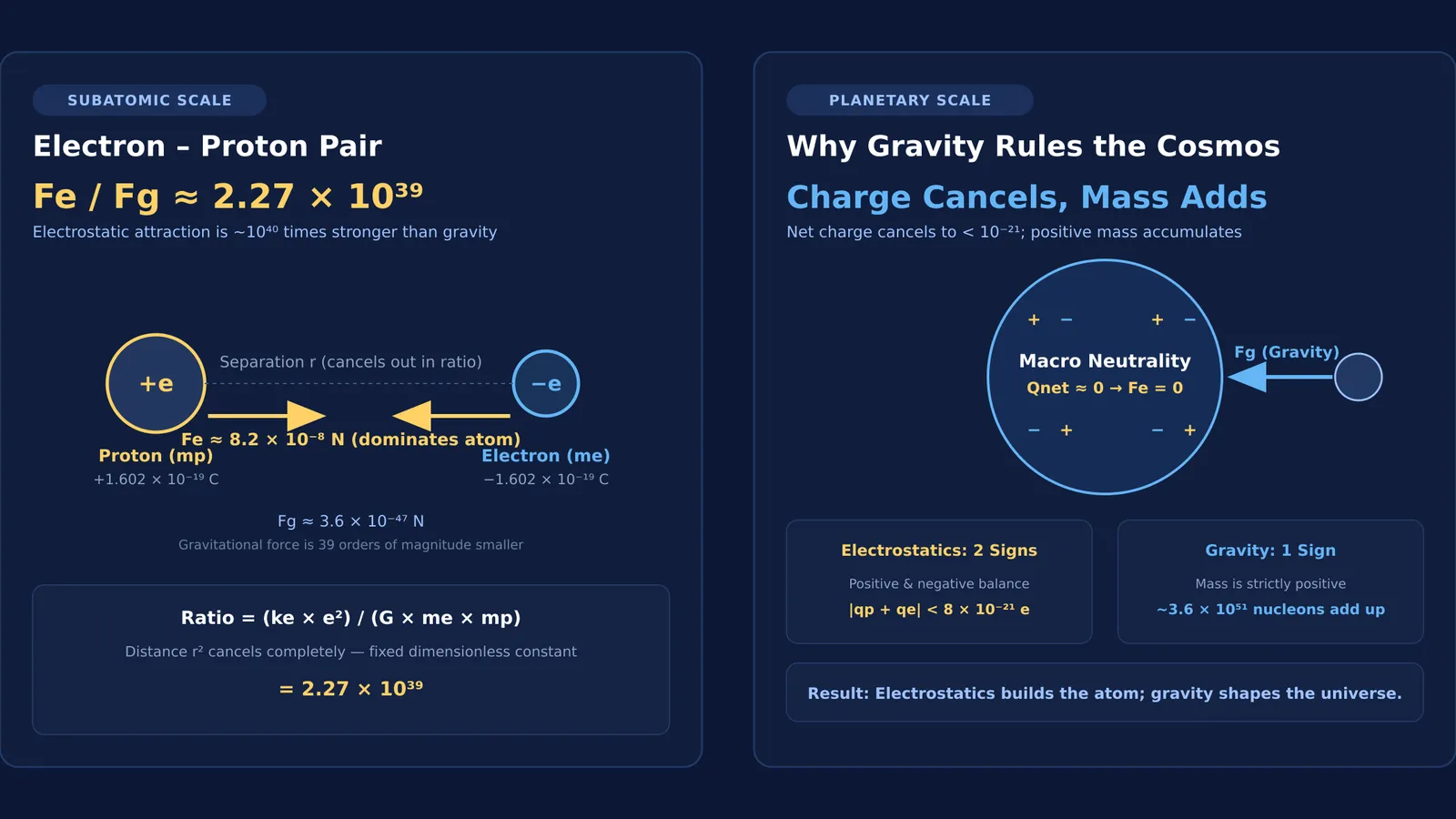
Coulomb's law defines electrostatic force between two charges as F_e = k_e × |q₁ × q₂| / r², where k_e = 1 / (4πε₀). Newton's law defines gravitational force between two masses as F_g = G × m₁ × m₂ / r². For an electron and a proton, setting up their ratio cancels the separation distance r² entirely:
Ratio = F_e / F_g = (k_e × e²) / (G × m_e × m_p)
Because distance drops out, this ratio is a fixed dimensionless constant. As shown in OpenStax College Physics 2e, at an atomic separation of 0.530 × 10⁻¹⁰ m, the electric attraction is 8.19 × 10⁻⁸ N, whereas gravitational pull is only 3.61 × 10⁻⁴⁷ N. Dividing them yields 2.27 × 10³⁹.
What do the fundamental constants tell us about the calculation?
Evaluating the ratio using the CODATA recommended values from the National Institute of Standards and Technology:
Elementary charge e is 1.602176634 × 10⁻¹⁹ C.
Gravitational constant G is 6.67430 × 10⁻¹¹ N·m²/kg².
Electron mass m_e is 9.1093837139 × 10⁻³¹ kg.
Proton mass m_p is 1.67262192595 × 10⁻²⁷ kg.
Vacuum permittivity ε₀ is 8.8541878188 × 10⁻¹² F/m, giving k_e ≈ 8.98755 × 10⁹ N·m²/C².
Multiplying the numerator gives k_e × e² ≈ 2.307 × 10⁻²⁸ N·m², while the denominator G × m_e × m_p equals 1.017 × 10⁻⁶⁷ N·m², producing 2.27 × 10³⁹. Standard Indian textbooks like NCERT Class 12 Physics round these constants to k_e ≈ 9 × 10⁹ N·m²/C² and G ≈ 6.67 × 10⁻¹¹ N·m²/kg², obtaining roughly 2.4 × 10³⁹.
Swapping the particle pair shifts the ratio:
Two protons: F_e / F_g = (k_e × e²) / (G × m_p²) ≈ 1.24 × 10³⁶.
Two electrons: F_e / F_g = (k_e × e²) / (G × m_e²) ≈ 4.17 × 10⁴².
When practicing problems with extreme exponents, the Fermi Problem Library offers worked problems with a step-by-step solver that explains the reasoning rather than printing an answer.
Why does gravity dominate planets if electricity is 10³⁹ times stronger?
If electric forces are nearly 10⁴⁰ times stronger, why does gravity steer planetary orbits while electrostatic attraction appears absent?
The resolution is charge neutrality. Electric charge has two opposing signs, positive and negative, which attract and cancel each other. In macroscopic objects, atoms contain identical counts of protons and electrons. In an acoustic resonator experiment reported in *Physical Review A*, G. Bressi and co-authors confirmed that any net charge difference between a proton and an electron is under 8 × 10⁻²¹ times elementary charge. Macroscopic bodies are neutral to better than one part in a sextillion.
Mass, however, has only one sign: positive. Gravity never cancels. Every nucleon in a celestial body adds constructively to the overall gravitational field. According to the NASA Earth Fact Sheet, Earth has a mass of 5.9722 × 10²⁴ kg, containing roughly 3.6 × 10⁵¹ nucleons pulling together. This transition from atomic electrostatics to cosmic gravity governs how students solve Coulomb's law equilibrium problems and understand gravitational potential energy beyond mgh.
What would happen if matter had a slight charge imbalance?
In The Feynman Lectures on Physics, Richard Feynman illustrated the extraordinary strength of electrostatics with a thought experiment: if two people stood at arm's length, each with just a 1% excess of electrons over protons, their mutual repulsive force would be enough to lift a weight equal to that of the entire Earth (roughly 6 × 10²⁵ N). Even a tiny imbalance of one part in 10³⁶ would cause electrostatic repulsion to blow planets apart.
How should students approach force-comparison problems in exams?
For competitive exams like JEE Main and NEET-UG:
Cancel distance algebraically: Never compute separate force magnitudes when finding a ratio; cancel r² immediately.
Separate powers of ten: Evaluate mantissas and exponents in distinct steps to avoid sign errors.
Verify the particle pair: Confirm whether the question asks for electron-proton (10³⁹), two protons (10³⁶), or two electrons (10⁴²); mixing them up is among common electrostatics mistakes in exam problem-solving.
Match scale to force: Microscopic structure relies on electrostatics, whereas celestial orbits emerge because positive and negative charges cancel out.
The Fermi Concept Library maps every concept in physics, chemistry, biology, mathematics and computing, each with its own lesson and its place in the map.


