

On this page
Isaac Newton formulated the shell theorem to simplify the mathematics of his inverse-square law of gravity. It is a fundamental principle in classical mechanics that describes how spherically symmetric objects interact.
What is the gravitational shell theorem?
The gravitational shell theorem consists of two main rules for a uniform spherical shell of mass. According to the OpenStax University Physics textbook, a uniform spherical shell attracts an external particle as if all the shell’s mass were concentrated at its centre 1/Book%3A_University_Physics_I_-_Mechanics_Sound_Oscillations_and_Waves_(OpenStax)/13%3A_Gravitation/13.02%3A_Newton's_Law_of_Universal_Gravitation).
The second part of the theorem states that a uniform spherical shell exerts no net gravitational force on a particle located anywhere inside it.
This theorem is powerful because it allows us to treat enormous, extended bodies—like moons and stars—as simple point masses, as long as they are spherically symmetric. For example, by treating the Earth as a point mass, physicists can calculate that its escape velocity is approximately 11.2 km/s 2/Book%3A_University_Physics_I_-_Mechanics_Sound_Oscillations_and_Waves_(OpenStax)/13%3A_Gravitation/13.04%3A_Gravitational_Potential_Energy_and_Total_Energy).
Why is the gravity inside a hollow shell zero?
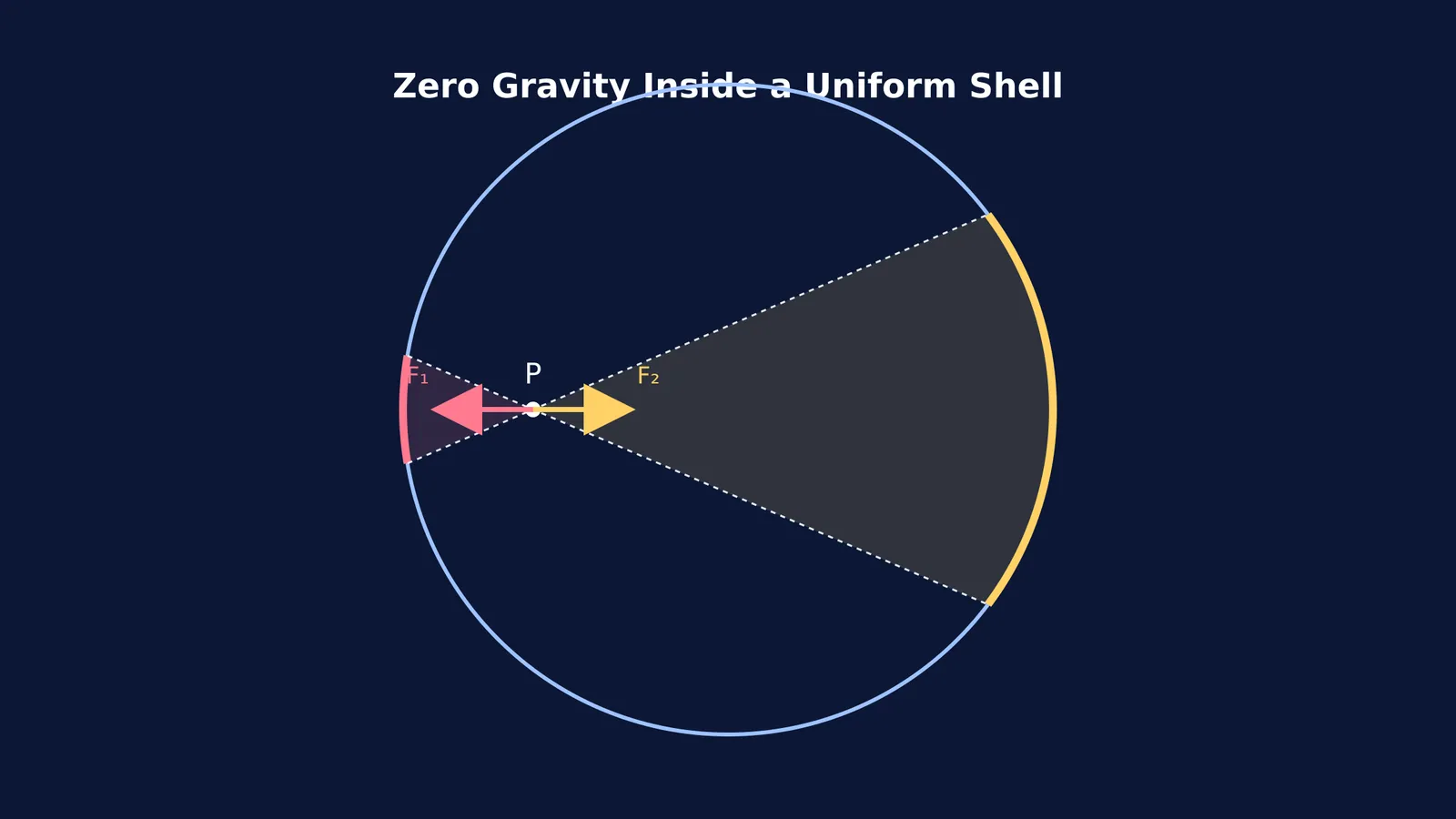
If you were floating inside a massive hollow sphere, you might expect to feel a pull toward the wall closest to you. However, gravity follows an inverse-square law.
While you are closer to one side of the shell, the far side of the shell covers a much larger area in your field of view. The larger amount of mass on the far side perfectly balances out the stronger pull from the closer side. No matter where you stand inside the hollow cavity, these forces cancel out exactly, leaving you with a net force of zero.
Because of the mathematical similarities, this also applies to electromagnetism. The electric field inside a uniform hollow sphere of charge is also zero. For more on this connection, read our guide on Gravitational field lines compared with electric field lines.
What happens if you travel inside a solid planet?
Imagine you travel deep underground, halfway to the Earth's centre. How does gravity change?
According to the shell theorem, all the rock and magma in the spherical shells *above* your depth exert zero net force on you. You only feel the gravitational pull of the solid sphere *below* you.
As you go deeper, the mass pulling you inward decreases. At the exact centre of the Earth, the mass in every direction cancels out, meaning you would feel completely weightless. You can explore how this affects density calculations in our post on how to Find the density of Earth from g and its radius.
How to use the shell theorem in exams?
Questions on the shell theorem appear frequently in JEE and NEET because they test your conceptual clarity over your ability to integrate complex equations. Keep this checklist in mind:
Check if it is hollow or solid: A hollow shell has zero internal gravity. A solid sphere has linearly decreasing gravity as you move toward the centre.
Measure from the centre: When calculating force on an outside object, measure the distance r from the centre of the sphere, not its surface.
Ignore the outer layers: If a mass is placed in a cavity at the centre of a solid sphere, the outer layers do not contribute to the force.
Visualise the orbits: When working on planetary motion, you can mentally shrink planets to point masses. Try Understanding planetary orbits with a gravity simulation to see this in action.
How do you solve a solid sphere gravity problem?
Suppose a mass m is placed at a distance R/2 from the centre of a uniform solid planet of mass M and radius R. What is the gravitational force on it?
Break the solid planet into a set of concentric shells.
The outer shells (with a radius greater than R/2) exert zero net force on the mass.
Only the inner sphere of radius R/2 pulls on the mass.
Because volume scales with the cube of the radius, the inner sphere has (1/2)³ = 1/8 of the total volume. Therefore, its mass is M/8.
Apply Newton's law: F = G × (M/8) × m / (R/2)².
Simplify the fraction: F = (1/2) G M m / R².
If you are struggling to picture the geometry of these layers, Fermi's Concept Library maps out every concept in physics, chemistry, biology, mathematics and computing, each with its own lesson and its place in the map. Fermi teaches — it holds a line of reasoning across a whole session, notices where a student is stuck, and decides whether to explain, ask, or show.


