

On this page
How do you derive the density of a planet from surface gravity?
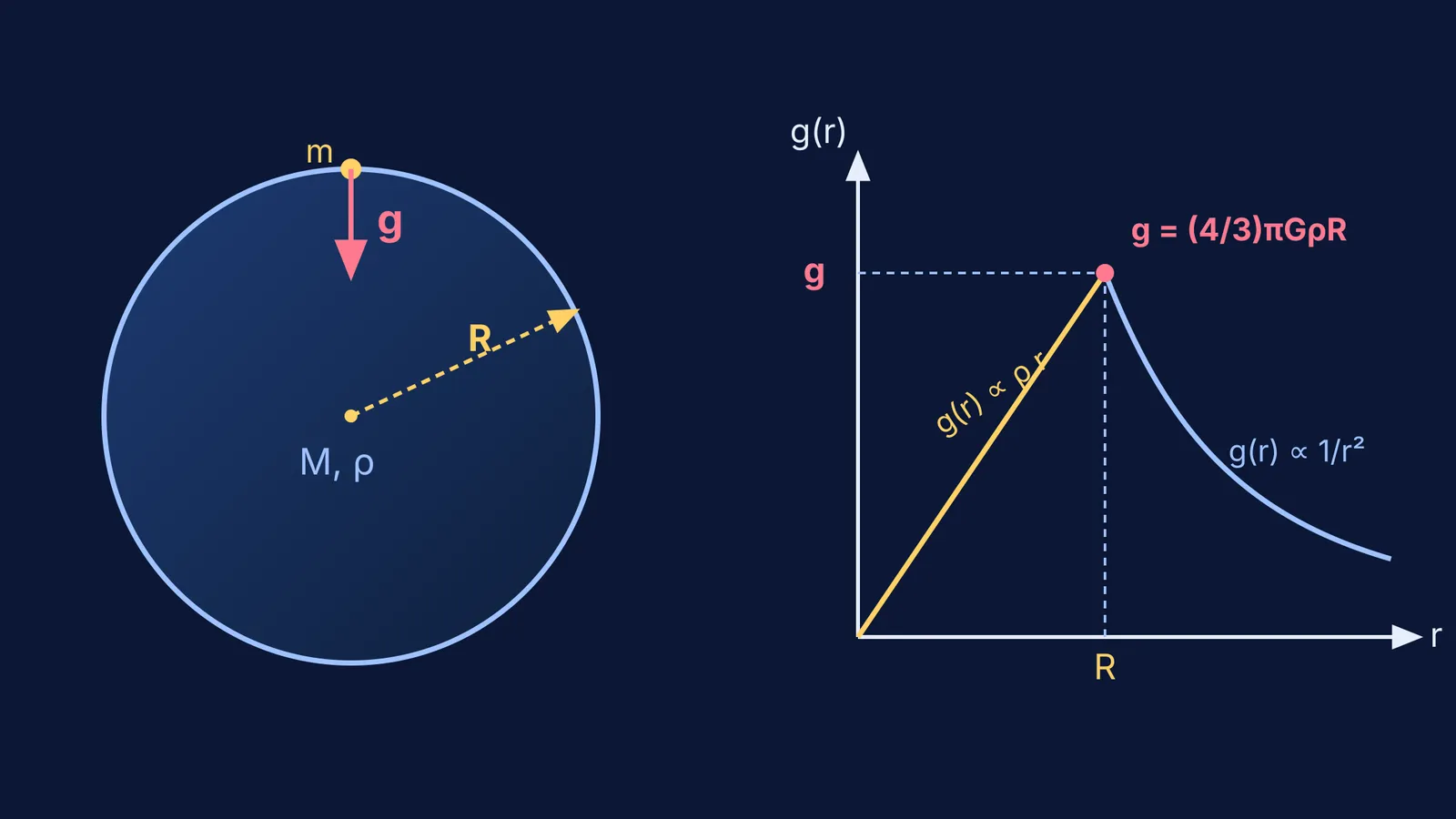
In classical mechanics, a spherical planet's surface gravitational acceleration and its bulk density are directly linked through Newton's law of universal gravitation. As presented in the NCERT Class 11 Physics Gravitation chapter, the gravitational force on a test mass m at the surface of a planet of mass M and radius R is F = GMm/R².
By Newton's second law, surface acceleration is g = F/m = GM/R². Assuming the planet is a uniform sphere with average density ρ, its total mass is its volume times density: M = (4/3)πR³ρ.
Substituting this mass into the surface gravity equation gives:
g = G × [(4/3)πR³ρ] / R² = (4/3)πGρR
Rearranging to solve for average density ρ yields:
ρ = 3g / (4πGR)
This formula shows that surface gravity depends on both radius and density. It also governs the linear restoring force in simple harmonic motion through a tunnel across the Earth, where gravity inside a uniform sphere scales as (4/3)πGρr.
What values of g, G, and radius do you use for Earth?
To calculate Earth's density with this relation, you need three empirical constants in SI units:
Gravitational constant G: The NIST CODATA database recommends G = 6.67430 × 10⁻¹¹ m³/(kg·s²).
Surface gravity g: The standard reference defined in the NIST CODATA standard acceleration of gravity is g = 9.80665 m/s². Across Earth's surface, actual values recorded in the NASA Earth Fact Sheet range from 9.780 m/s² at the equator to 9.832 m/s² at the poles due to rotation, as detailed in the guide on variation of g with height, depth and Earth's rotation.
Mean radius R: The NASA Earth Fact Sheet lists Earth's volumetric mean radius as 6,371.0 km, or 6.371 × 10⁶ m.
In competitive exams like JEE Main and NEET-UG, questions routinely simplify these to g = 9.8 m/s², R = 6.4 × 10⁶ m, and G = 6.67 × 10⁻¹¹ N·m²/kg² for mental arithmetic.
Step-by-step calculation: what is the mean density of Earth?
Substituting the measurements from the NIST CODATA database and the NASA Earth Fact Sheet into ρ = 3g / (4πGR):
Numerator: 3 × g = 3 × 9.80665 m/s² = 29.41995 m/s².
Denominator: 4 × π × (6.67430 × 10⁻¹¹ m³/(kg·s²)) × (6.371 × 10⁶ m). Factoring powers of ten yields 10⁻¹¹ × 10⁶ = 10⁻⁵. Then 4 × 3.14159 × 6.67430 × 6.371 ≈ 534.347, giving a denominator of 5.34347 × 10⁻³ m⁴/(kg·s²).
Quotient: ρ = 29.41995 / (5.34347 × 10⁻³) ≈ 5,505.8 kg/m³.
Using NASA's mean surface gravity of 9.820 m/s² from the NASA Earth Fact Sheet yields 5,513 kg/m³, matching NASA's measured bulk density of 5,513 kg/m³.
With rounded exam numbers (g = 9.8 m/s², R = 6.4 × 10⁶ m, G = 6.67 × 10⁻¹¹ N·m²/kg²), the denominator is 4 × (22/7) × 6.67 × 10⁻¹¹ × 6.4 × 10⁶ ≈ 5.364 × 10⁻³, giving ρ ≈ 29.4 / (5.364 × 10⁻³) ≈ 5.48 × 10³ kg/m³ (5.48 g/cm³).
When solving multi-step mechanics questions with scientific notation, the Fermi Problem Library offers worked problems with a step-by-step solver that explains the reasoning rather than printing an answer.
Why is the calculated density different from surface rocks?
This calculated bulk density of ~5,513 kg/m³ provides critical geological insight: Earth's overall density is roughly twice that of typical crustal rocks, as documented by the USGS.
Surface rocks like granite and basalt have densities between 2,600 kg/m³ and 3,000 kg/m³, while water is 1,000 kg/m³. Because the crust is light, the interior must be much denser to produce an average above 5,500 kg/m³.
This was first shown experimentally in 1798 by Henry Cavendish (Cavendish, 1798). Using a torsion balance to measure the gravitational pull between lead spheres, he found Earth's density was 5.48 times that of water, as recounted in Henry Cavendish's 1798 experiment that weighed the Earth. Modern seismology, such as the Preliminary Reference Earth Model (Dziewonski & Anderson, 198190046-7)), confirms that Earth has a metallic iron-nickel core exceeding 12,000 kg/m³.
How does this derivation appear in competitive exam problems?
In physics curricula and competitive entrance examinations, gravitational scaling problems build directly on Newton's law of gravitation as formulated in OpenStax University Physics (Section 13.2):
Planet comparison ratios: If planet A has gravity g₁ and radius R₁, and planet B has g₂ and R₂, their density ratio is ρ₁/ρ₂ = (g₁/g₂) × (R₂/R₁). A planet with identical surface gravity but twice the radius has half the average density.
Constant density scaling: For uniform density ρ, surface gravity scales as g ∝ R. A planet with Earth's density but double the radius has twice Earth's surface gravity.
Compression: If Earth shrank to half its radius at constant mass M, density would increase eightfold (ρ ∝ 1/R³), while surface gravity would quadruple (g ∝ 1/R²).
Remember to convert radius from kilometres to metres before calculating, and track powers of ten separately. For mastering how planetary parameters connect across physics, the Fermi Concept Library maps every concept in physics, chemistry, biology, mathematics and computing, each with its own lesson and its place in the map.


