

On this page
The discovery of the inverse square law of gravity was not a single moment of inspiration under a tree, but a mathematical puzzle that took Isaac Newton over two decades to solve.
How did the apple inspire the Moon test?
During the plague years of 1665 and 1666, Newton retreated to Woolsthorpe Manor according to his biography in the MacTutor History of Mathematics. By invoking his law of inertia, he reasoned that without a force acting upon it, the Moon would fly off in a straight line. He wondered if the same force pulling an apple to the ground could extend all the way out to the Moon, keeping it tethered to Earth according to Wikipedia's history of universal gravitation.
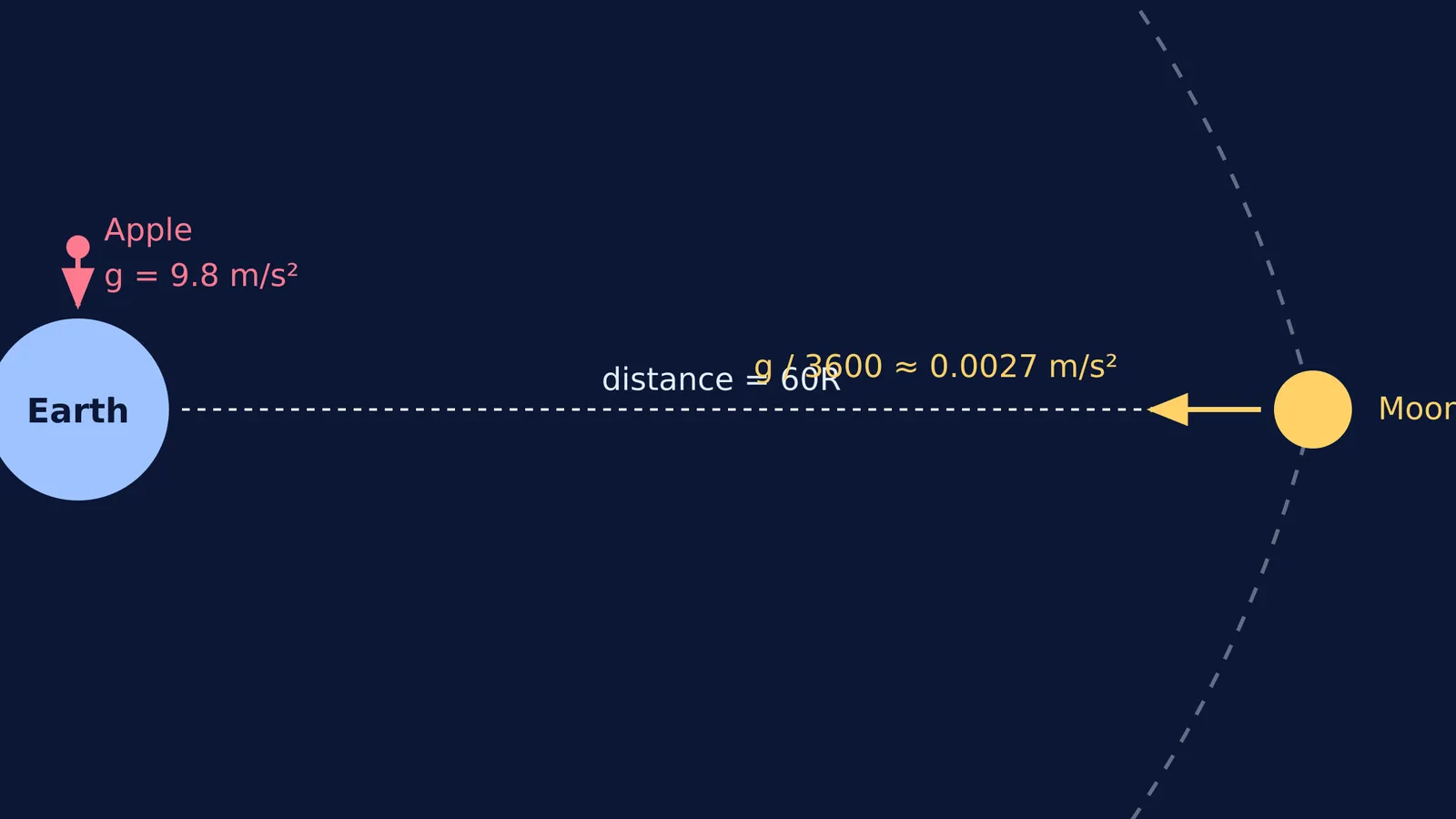
To test this, Newton performed a calculation now known as the "Moon test." He knew the Moon was approximately 60 Earth radii away from the center of the Earth according to Britannica's guide to Newton's law of gravity. If gravity weakened with the square of the distance (1/r²), then the Earth's pull at the Moon's distance should be 1/60², or 1/3600, as strong as it is at the Earth's surface.
What were the results of the Moon test?
An apple falls with an acceleration of approximately 9.8 m/s². The Moon's predicted centripetal acceleration should therefore be 9.8 divided by 3600, which is roughly 0.0027 m/s² according to Britannica. When Newton calculated the Moon's actual acceleration from its orbital period and distance, the numbers matched, proving the inverse square law. He showed that the attraction of a spherical body is the same as if all its mass were concentrated at its centre, confirming his approach.
If you are trying to master these gravitation problems, the Fermi Problem Library has worked problems with a step-by-step solver that explains the reasoning rather than printing an answer.
A worked example of the Moon test
You can reproduce Newton's test with the numbers used in Class 11 physics:
Find Earth's surface gravity: g = 9.8 m/s² at a distance R from the Earth's center.
Find the distance ratio: The Moon is about 60R away from the Earth's center.
Apply the inverse square law: The acceleration at the Moon's distance should be g / 60² = 9.8 / 3600 ≈ 0.0027 m/s².
Compare with the Moon's orbit: Using the formula for centripetal acceleration v²/r (with the Moon's velocity v and orbital radius r), the actual acceleration is also ≈ 0.0027 m/s². The match proves that terrestrial gravity extends to the Moon and weakens by 1/r².
What did Edmond Halley ask Newton in 1684?
Despite this breakthrough, Newton set the work aside for many years. He was famously uncomfortable with the idea of "action at a distance" through a vacuum according to Wikipedia. The catalyst that brought his attention back was a visit from the astronomer Edmond Halley in 1684. Halley travelled to Cambridge to ask a specific question: what would be the shape of a planet's orbit if the force of attraction toward the sun followed an inverse square law?
Newton immediately replied that the orbit would be an ellipse according to MacTutor. When Halley asked for the proof, Newton promised to rewrite it and send it to him. This conversation spurred the intense work where Newton formalised the mathematics of planetary motion.
Why was the 1687 Principia so important?
Halley did more than ask the right question; he persuaded Newton to write a full treatment of his new physics and personally financed its publication. In 1687, Newton published *Philosophiae naturalis principia mathematica* (Mathematical Principles of Natural Philosophy) according to MacTutor.
The *Principia* proved mathematically that an inverse square force naturally results in the elliptical orbits described by Kepler's laws. It united the earthly mechanics of falling apples with the celestial mechanics of orbiting moons into one universal system. This singular achievement marked the first great unification in physics, establishing the very same universal law of gravitation that forms the core of Class 9 and 11 physics syllabuses today.


