

On this page
Sometimes a discovery starts as an annoyance. In August 1974 a graduate student at the Arecibo Observatory could not get a clean period for one new pulsar, however carefully he measured. That stubborn number turned out to be a star in orbit, and the orbit became a test of Einstein's theory of gravity. This post covers how Russell Hulse and Joseph Taylor found the binary pulsar, works through the clues with Class 11 physics, and ends with the habits behind the discovery.
Who were Hulse and Taylor?
The Nobel Prize facts pages record that Russell Hulse was born in New York on 28 November 1950 and Joseph Taylor in Philadelphia on 29 March 1941. In 1974 Taylor was a professor at the University of Massachusetts, Amherst, and Hulse his research student. In his Nobel biography, Hulse describes building an amateur radio telescope as a schoolboy and teaching himself FORTRAN at college by writing orbit simulations.
How was the binary pulsar found?
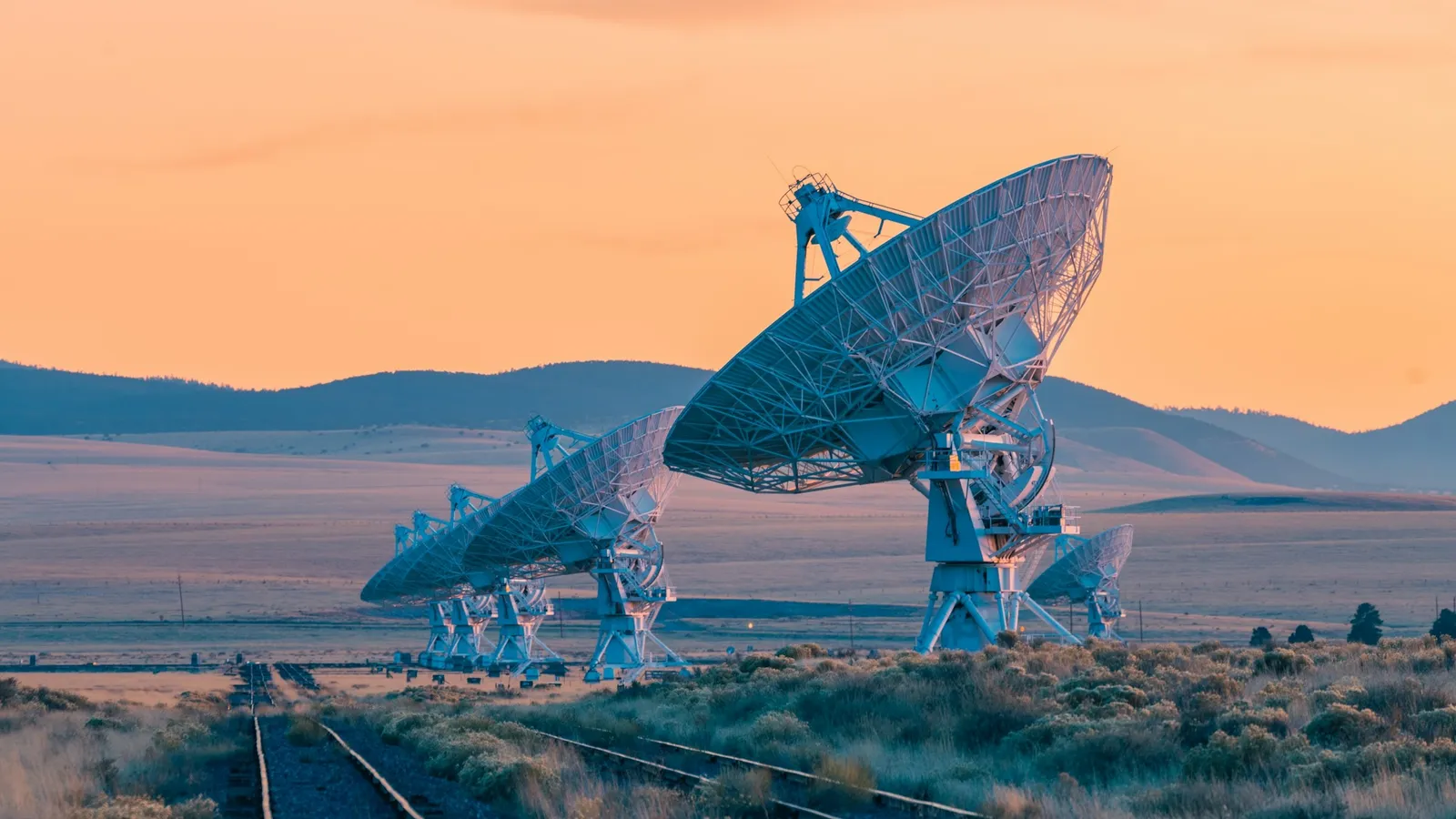
Hulse's Nobel lecture tells the story in detail. He ran a computer search for pulsars at the 300-metre Arecibo telescope, on and off from December 1973 to January 1975, using a minicomputer with 16K words of memory whose code he wrote himself. The search found 40 new pulsars.
PSR 1913+16 appeared in data from 2 July 1974 with a signal strength of 7.25, just above the cut-off of 7.0. Its period of 59 ms made it the second fastest pulsar then known. On 25 August, two measurements a couple of hours apart gave periods differing by 27 microseconds. His reaction, he says, was not "Eureka" but "Nuts - what's wrong now?"
He built a faster recording system. The drift got worse, not better. Then, on plots from 1 and 2 September, he noticed the two days' curves matched if one was shifted by 45 minutes. He suspected the period was changing because the pulsar was moving in an orbit, the Doppler effect. Before telling anyone, he set himself a test: if it was an orbit, the period must stop falling, reach a minimum and rise again. On 16 September it did. The discovery paper, Discovery of a pulsar in a binary system, appeared in January 1975.
What do the numbers say? A worked example
The 45-minute shift. The orbit takes 7 h 45 min. Three orbits take 3 × 465 min = 1,395 min = 23 h 15 min, which is 45 minutes short of a day. Each day at Arecibo the pulsar was at almost the same point in its orbit, just 45 minutes earlier, exactly as Hulse explains.
Speed from the Doppler shift. For small speeds, ΔP/P ≈ Δv/c. With ΔP = 27 μs and P = 0.05903 s (the value in the Nobel press release), Δv ≈ 3.00 × 10⁸ × 27 × 10⁻⁶ ÷ 0.05903 ≈ 1.4 × 10⁵ m/s. The pulsar's speed along our line of sight changed by about 140 km/s in a couple of hours.
Size of the orbit. Kepler's third law gives a³ = GMP²/4π². Weisberg, Nice and Taylor give masses of 1.4398 and 1.3886 solar masses, so M = 2.8284 × 1.9884 × 10³⁰ kg ≈ 5.62 × 10³⁰ kg. With G = 6.674 × 10⁻¹¹ N m²/kg² and P = 27,900 s:
GM = 3.75 × 10²⁰ m³/s².
a³ = 3.75 × 10²⁰ × (27,900)² ÷ 39.48 ≈ 7.40 × 10²⁷ m³.
a ≈ 1.95 × 10⁹ m, about 2.8 times the Sun's radius of 6.957 × 10⁸ m from the NASA Sun fact sheet.
Average orbital speed 2πa/P ≈ 4.4 × 10⁵ m/s, about 0.0015 of the speed of light.
Hulse's lecture summarises the first analysis in the same terms: an orbital velocity "on the order of 0.001 the velocity of light" and an orbit "on the order of the radius of our sun".
Common mistakes: using the mass of one star instead of the total, leaving the period in hours, and forgetting to take the cube root at the end.
If Kepler's law problems still feel shaky, the Fermi Problem Library has worked problems with a step-by-step solver that explains the reasoning rather than printing an answer.
Why does the orbit test general relativity?
The press release explains that such a fast, tight orbit makes relativistic effects large. The orbit's closest point swings round by 4 degrees per year, compared with 43 arcseconds per century for Mercury. General relativity also predicts that the pair should radiate energy as gravitational waves and slowly spiral together. Timing showed the orbital period shrinking by about 75 millionths of a second per year, first reported by Taylor and co-workers at the end of 1978. The 2010 timing paper found the decay rate to be 0.997 ± 0.002 times the general relativity prediction.
The Nobel Prize in Physics 1993 went to both men "for the discovery of a new type of pulsar, a discovery that has opened up new possibilities for the study of gravitation". Our posts on Jocelyn Bell Burnell and the first pulsar and LIGO-India continue the story.
What can a student take from their way of working?
Treat an annoying number as data. The changing period was the discovery.
Look for patterns across days. The 45-minute shift only showed when two days were compared.
Decide what would prove you right. Hulse waited for the period minimum.
Build the tools. He wrote the search code and a special recording system himself.
Try it now: at 75 microseconds per year, how much shorter would the orbital period be after 30 years? Check that you get about 2.3 milliseconds.


