On this page
Some discoveries come from a clever theory. The discovery of pulsars came from a graduate student who read long rolls of paper chart closely enough to notice a mark that did not belong. This post tells the story of Jocelyn Bell Burnell's discovery from the primary accounts, works through the physics that told astronomers they were seeing a neutron star, and ends with the habits a student can take from how she worked.
How was the first pulsar found?
The clearest account is by her supervisor Antony Hewish, in his 1974 Nobel lecture. He built a new radio telescope at Cambridge to study the twinkling of radio sources: an array of 2048 dipole antennas covering 18,000 square metres, working at a wavelength of 3.7 m. Jocelyn Bell joined as a new graduate student and became responsible for the network of cables connecting the dipoles. The telescope was complete and tested by July 1967.
The survey produced a flood of paper from four chart recorders, and Hewish writes that it is greatly to her credit that she kept up with it. Around the middle of August 1967 she showed him a record of fluctuating signals in a part of the sky where strong twinkling was not expected. They first thought it might be interference. It kept coming back. On 28 November a high-speed recording showed regular pulses at intervals of just over one second. From 11 December, daily timing showed the pulses arrived in a regular pattern to within 0.1 s.
In January 1968, Hewish writes, Bell went through all the survey records again "with her typical persistence and diligence" and produced a list of possible further pulsar positions. The team's paper, Observation of a Rapidly Pulsating Radio Source, appeared in Nature on 24 February 1968 with Bell as second author. It suggested the source might be linked to oscillations of white dwarf or neutron stars.
Who received the Nobel Prize, and how was she recognised?
The Nobel Prize in Physics 1974 went to Martin Ryle and Antony Hewish, with Hewish cited "for his decisive role in the discovery of pulsars". Bell was not included. Decades later, in 2018, she received a Special Breakthrough Prize in Fundamental Physics worth $3 million. The prize statement says that with "perceptiveness and persistence she characterized the signal and showed it originated from space."
The same statement lists her later roles: project manager of the James Clerk Maxwell Telescope, President of the Royal Astronomical Society, and the first female President of both the Institute of Physics and the Royal Society of Edinburgh. She was made a Dame in 2007.
Why must a pulsar be a neutron star? A worked example
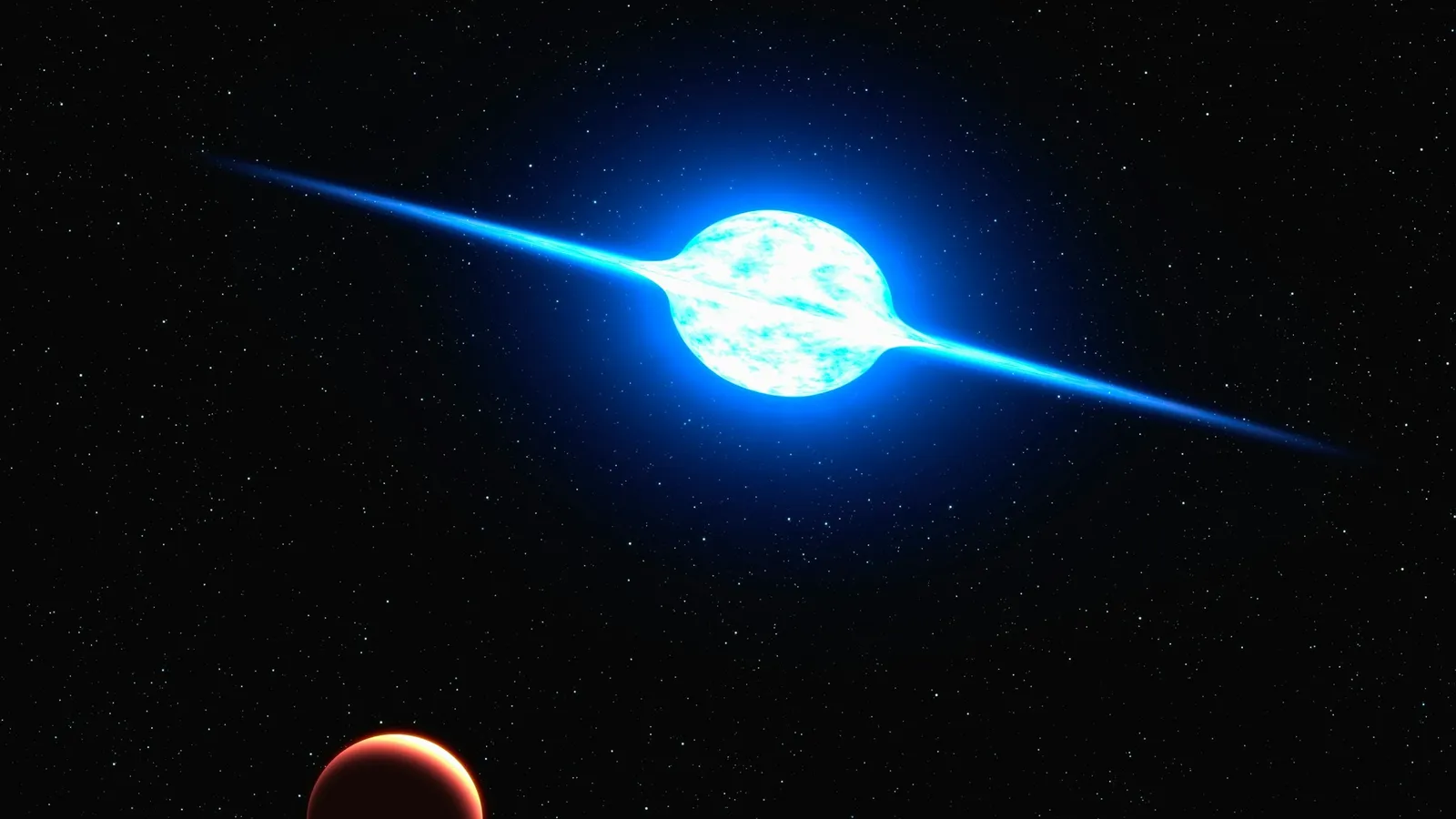
Hewish's lecture explains the final answer: pulsars are rotating neutron stars that sweep a beam past Earth like a lighthouse, and "no other star could spin fast enough, without fragmenting". You can check that with Class 11 circular motion.
A star spinning too fast flings material off its equator. The limit comes when gravity at the surface can only just supply the centripetal force: GM/R² = ω²R, so ω_max = √(GM/R³) and the shortest possible period is T_min = 2π/ω_max.
Take a star with roughly the mass of the Sun, M = 2.0 × 10^30 kg, so GM = 6.67 × 10^−11 × 2.0 × 10^30 = 1.33 × 10^20 m³/s².
A white dwarf. Assume a radius of about 7,000 km, R = 7.0 × 10^6 m, so R³ = 3.43 × 10^20 m³.
GM/R³ = 1.33 × 10^20 / 3.43 × 10^20 = 0.39 s⁻², so ω_max = 0.62 rad/s.
T_min = 2π / 0.62 ≈ 10 s.
A white dwarf spinning once every second would break apart. It cannot be the source.
A neutron star. The Nobel Committee's 1974 press release describes neutron stars as about 10 km in diameter, so R = 5.0 × 10^3 m and R³ = 1.25 × 10^11 m³.
GM/R³ = 1.07 × 10^9 s⁻², so ω_max ≈ 3.3 × 10^4 rad/s.
T_min = 2π / (3.3 × 10^4) ≈ 0.0002 s, a fraction of a millisecond.
A period of about one second is easy. Hewish notes that by 1974 more than 130 pulsars were known, with periods from 33 ms to 3.5 s, all within the neutron star limit.
Two common mistakes: using the diameter as R, which changes R³ by a factor of 8, and forgetting to cube the radius at all. This is only an estimate, since a real star flattens as it spins, but it shows why the answer is a neutron star.
Neutron stars and white dwarfs are both end points of stellar life; our post on the Chandrasekhar limit explains why a white dwarf cannot be heavier than a certain mass.
What can a student take from Bell Burnell's way of working?
Know what normal looks like. She could spot the odd signal because she had read so many ordinary ones. Solve enough routine problems that an unusual one stands out.
Rule out the boring explanation first. The team checked for interference before claiming anything new. When an answer surprises you, check units and arithmetic before celebrating.
Keep careful records. Her sky chart let a repeating source show up week after week. Keep a dated error log so patterns in your mistakes appear.
Build the instrument. She helped wire the telescope. Doing practicals yourself teaches you where data can go wrong.
If circular motion or gravitation is the shaky part, the Fermi Problem Library has a step-by-step solver that explains the reasoning, so you can check each line of an estimate like this one.
Try it now: redo the neutron star estimate with R = 10 km and see how much the shortest period changes.