

On this page
You cannot put the Sun on a weighing scale, but Earth does the weighing for you every year. Its orbit needs only two numbers you already know, how far Earth is from the Sun and how long a year lasts, plus the gravitational constant G. It is a good test of your powers of ten.
Where does GM = 4π²r³/T² come from?
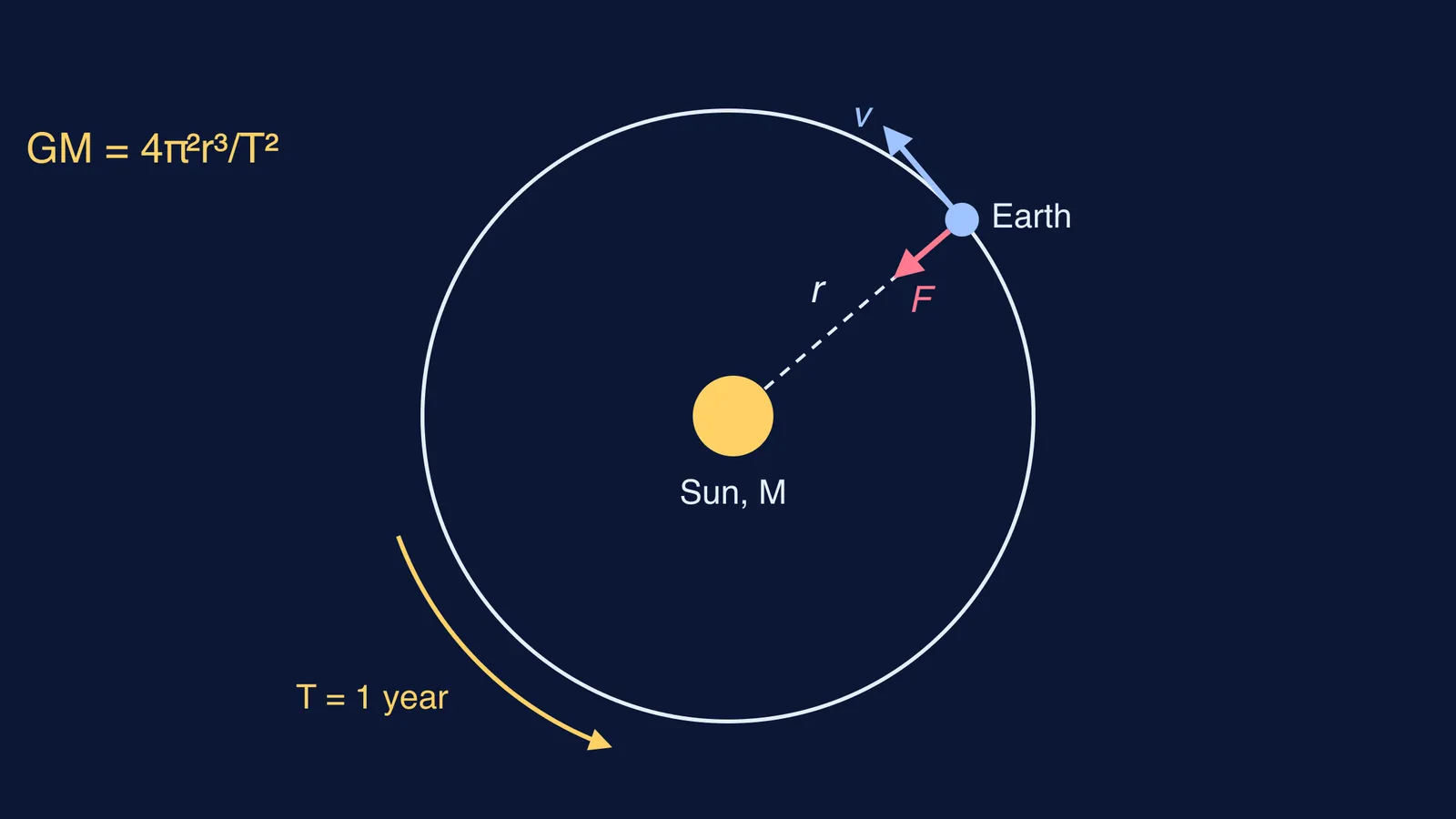
Treat Earth's orbit as a circle of radius r. The Sun's gravity is the only force pulling Earth towards the centre, so it supplies the centripetal force:
GMm/r² = mv²/r
Here M is the Sun's mass and m is Earth's. Earth covers one circumference in one year, so its speed is v = 2πr/T. Substitute and simplify:
GM = v²r = 4π²r³/T², so M = 4π²r³/(GT²)
This is Kepler's third law in Newton's form: T² is proportional to r³, with a constant set by the central mass.
Is a circle good enough? NASA's Earth fact sheet lists Earth's orbital eccentricity as 0.0167, with perihelion at 147.095 million km and aphelion at 152.100 million km. That is a difference of about 3%, so the circle works well. For a true ellipse, r becomes the semimajor axis.
How do you calculate the mass of the Sun step by step?
Start with three numbers, all in SI units:
r = 1.5 × 10¹¹ m. NASA's Earth fact sheet gives Earth's semimajor axis as 149.598 million km, and the International Astronomical Union fixed the astronomical unit at exactly 149,597,870,700 m in 2012.
T = 365.25 days × 86,400 s per day = 3.156 × 10⁷ s.
G = 6.674 30 × 10⁻¹¹ m³ kg⁻¹ s⁻², the CODATA 2022 value published by NIST.
Now work through it:
Cube the radius: r³ = (1.5 × 10¹¹)³ = 3.375 × 10³³ m³.
Square the period: T² = (3.156 × 10⁷)² = 9.96 × 10¹⁴ s².
Multiply r³ by 4π² (about 39.48): 1.332 × 10³⁵ m³.
Divide by T²: GM = 1.338 × 10²⁰ m³ s⁻².
Divide by G: M = 1.338 × 10²⁰ ÷ 6.674 × 10⁻¹¹ = 2.0 × 10³⁰ kg.
How close is that? NASA's Sun fact sheet lists the Sun's mass as 1.9884 × 10³⁰ kg and GM as 1.32712 × 10²⁰ m³ s⁻². Our answer is about 0.8% high, almost all from rounding r up from 1.496 to 1.5; cubing r triples that small error.
You can check the method a second way. With the same numbers, v = 2πr/T comes to about 29.9 km/s, and the Earth fact sheet lists Earth's mean orbital velocity as 29.78 km/s.
What mistakes give the wrong mass of the Sun?
Most wrong answers are unit slips, not physics errors:
T in days. Using T = 365.25 gives about 1.5 × 10⁴⁰ kg, too big by 86,400², roughly 7.5 billion times.
r in kilometres. Using 1.5 × 10⁸ makes r³ a billion times too small, so you get about 2 × 10²¹ kg.
Squaring the wrong thing. It is 4π², not 4π, and r is cubed, not squared.
Using the diameter of the orbit. r is the Sun–Earth distance, not twice it.
Rounding too early. A 1% error in r becomes a 3% error in M. A 1% error in T becomes 2%.
Before you touch the calculator, check the exponents: r³ is about 10³³, T² about 10¹⁵, and 4π² is about 40, so GM is near 10²⁰. Dividing by G, about 10⁻¹⁰, gives 10³⁰. If your answer is far from the Sun fact sheet value of about 2 × 10³⁰ kg, look for a unit slip.
If you keep landing on the wrong power of ten, the Fermi Problem Library has worked problems with a step-by-step solver that explains the reasoning rather than printing an answer, so you can see which step went wrong.
How can you practise this method?
The same formula weighs any body that has something orbiting it. Try weighing Earth from the Moon's orbit using NASA's Moon fact sheet, which lists a semimajor axis of 384,400 km and a revolution period of 27.3217 days.
Convert: r = 3.844 × 10⁸ m and T = 27.3217 × 86,400 = 2.361 × 10⁶ s.
Substitute into M = 4π²r³/(GT²).
You should get about 6.0 × 10²⁴ kg. The same fact sheet gives Earth's mass as 5.9724 × 10²⁴ kg.
It comes out about 1% high because the Moon's mass, 0.07346 × 10²⁴ kg on the NASA sheet, is not negligible: strictly, the formula gives the combined mass of Earth and Moon, about 6.05 × 10²⁴ kg.
If GM = 4π²r³/T² still feels like a formula to memorise rather than something you could derive, the Fermi Concept Library gives each concept in physics its own lesson and shows where it sits in the map. Then cover this page and derive it again from GMm/r² = mv²/r.


