

On this page
A full cofactor expansion of a 3×3 determinant gives you plenty of places to slip, and in an exam you rarely need it. The NTA syllabus for JEE Main 2025 lists "determinants and matrices of order two and three, evaluation of determinants" in Unit 3, Matrices and Determinants, and many such questions get much shorter once you apply a property or two.
Here determinants are written row by row, semicolons between rows; R1 is row 1, C1 is column 1.
Which properties of determinants save the most time?
Gilbert Strang's MIT linear algebra course puts it simply: "Three simple properties completely describe the determinant" (MIT OpenCourseWare 18.06SC). The rules you will use most follow from them, and are listed in the Wikipedia article on determinants:
Swapping two rows or two columns multiplies the determinant by −1.
If two rows or two columns are equal, the determinant is zero.
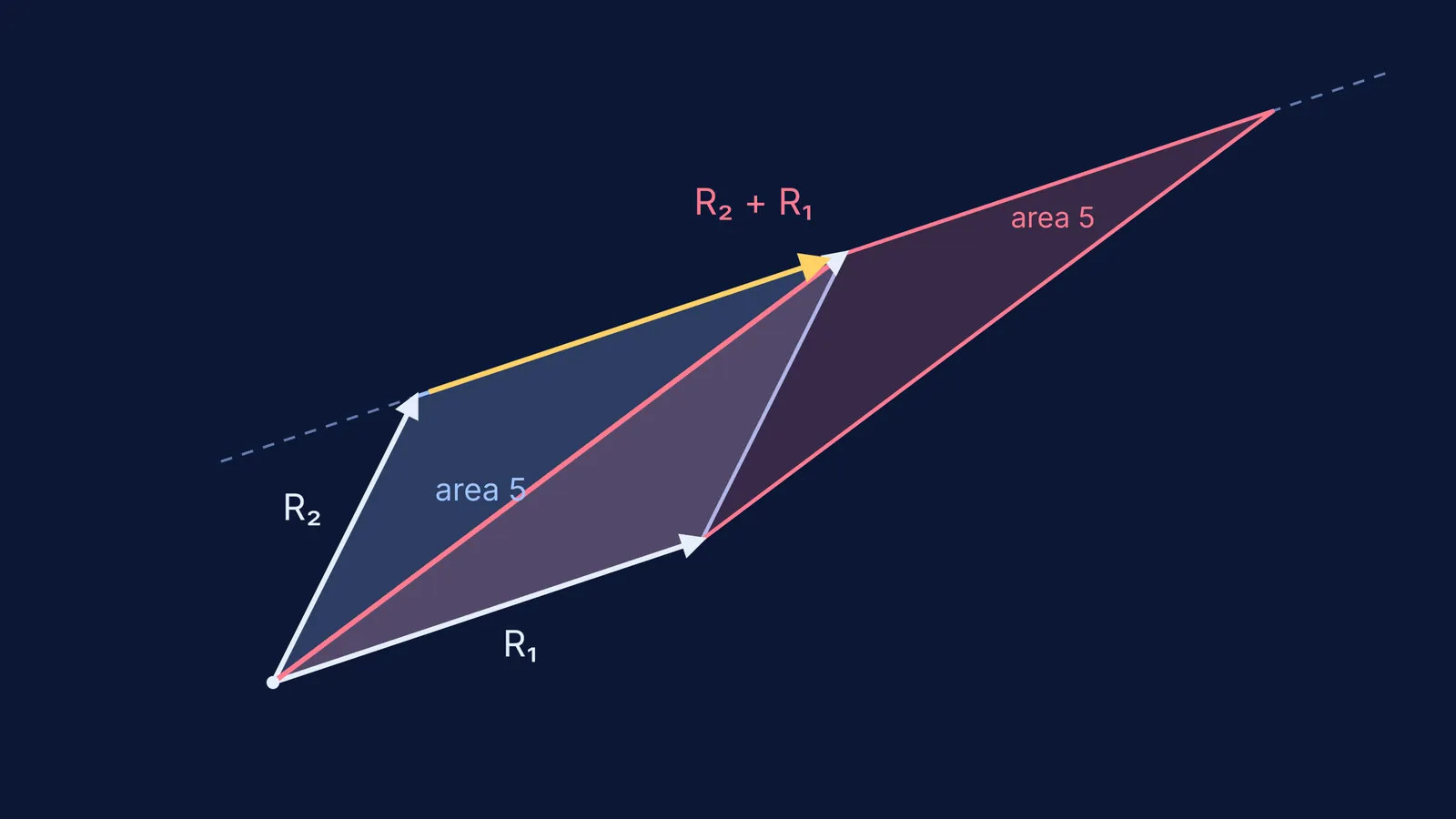
Adding a multiple of one row (or column) to another does not change the determinant.
Multiplying one row by k multiplies the determinant by k, so a factor common to a whole row comes outside.
A matrix and its transpose have the same determinant, so every row rule works for columns too.
The determinant of a triangular matrix is the product of its diagonal entries.
It follows that a row of zeros, or two proportional rows, also give zero.
How do you evaluate a 3×3 determinant using row operations?
Take |2 3 4; 4 7 9; 6 11 17|.
R2 → R2 − 2R1 gives the new row 0, 1, 1.
R3 → R3 − 3R1 gives 0, 2, 5.
R3 → R3 − 2R2 gives 0, 0, 3.
The determinant is now triangular, |2 3 4; 0 1 1; 0 0 3|, so its value is 2 × 1 × 3 = 6.
Full expansion, 40 − 42 + 8, also gives 6, but with bigger products.
How do you spot a zero determinant without expanding?
Take |1 a b+c; 1 b c+a; 1 c a+b|. Apply C3 → C3 + C2. Every entry of the third column becomes a + b + c. Take that common factor outside and the third column is 1, 1, 1, exactly the same as the first column. Two equal columns, so the determinant is 0 for every a, b and c.
Before expanding anything, run this quick scan:
Is any row or column all zeros?
Are two rows or columns equal, or one a multiple of another?
Does adding all columns (C1 → C1 + C2 + C3) or all rows produce a repeated value you can factor out?
Is one row a sum of the other two?
The same zero test is how you check collinearity in the area of a triangle using determinants.
How does the factor theorem help with determinants?
When the entries are letters, treat the determinant as a polynomial. Take |1 1 1; a b c; a² b² c²|. Put a = b: the first two columns become equal, so the determinant becomes zero. By the factor theorem, (a − b) is a factor. In the same way (b − c) and (c − a) are factors.
Each term of the expansion has degree 0 + 1 + 2 = 3, and the three factors already give degree 3, so the determinant is k(a − b)(b − c)(c − a) for some constant k. Compare one term: the diagonal product is bc², and in (a − b)(b − c)(c − a) the bc² term comes from (−b)(−c)(c) = bc². So k = 1.
Check: a = 2, b = 5, c = −3 gives (−3)(8)(−5) = 120, and so does expanding |1 1 1; 2 5 −3; 4 25 9|.
A routine to use before you expand
Scan for zero rows, equal rows and proportional rows.
Take out any common factor from a row or column.
Try adding all rows or all columns to create a repeated entry.
Use R2 → R2 − kR1 style operations to make zeros in one column.
Expand along the row or column with the most zeros.
For letter determinants, test factors by setting variables equal, then fix the constant.
These properties come back in the adjoint and inverse of a matrix and in checking whether linear equations are consistent.
If you keep choosing the wrong row operation, the Fermi Problem Library has worked problems with a step-by-step solver that explains the reasoning rather than printing an answer. If a property itself feels shaky, the Fermi Concept Library gives every mathematics concept its own lesson and its place in the map.
Try the routine on your next five practice determinants and note which step finished each.


