On this page
Questions about a shared root of two quadratics reduce to one condition you can derive in four lines. Derive it once and you will not need to memorise it.
What is the condition for two quadratic equations to have a common root?
Take two equations, a₁x² + b₁x + c₁ = 0 and a₂x² + b₂x + c₂ = 0. They have at least one root in common exactly when (c₁a₂ − c₂a₁)² = (a₁b₂ − a₂b₁)(b₁c₂ − b₂c₁).
The resultant is a polynomial in the coefficients that is zero if and only if two polynomials share a root, as the Wikipedia article on the resultant defines it; for two quadratics it is the difference of the two sides above. It works for complex roots too.
How do you derive the cross-multiplication condition?
Let α be the common root. Then both equations hold at x = α:
a₁α² + b₁α + c₁ = 0
a₂α² + b₂α + c₂ = 0
Treat α² and α as two separate unknowns and solve these two linear equations by cross-multiplication:
α² / (b₁c₂ − b₂c₁) = α / (c₁a₂ − c₂a₁) = 1 / (a₁b₂ − a₂b₁)
So:
α = (c₁a₂ − c₂a₁) / (a₁b₂ − a₂b₁)
α² = (b₁c₂ − b₂c₁) / (a₁b₂ − a₂b₁)
But α² is the square of α. Square the first line, equate it to the second and clear denominators to get the condition: (c₁a₂ − c₂a₁)² = (a₁b₂ − a₂b₁)(b₁c₂ − b₂c₁).
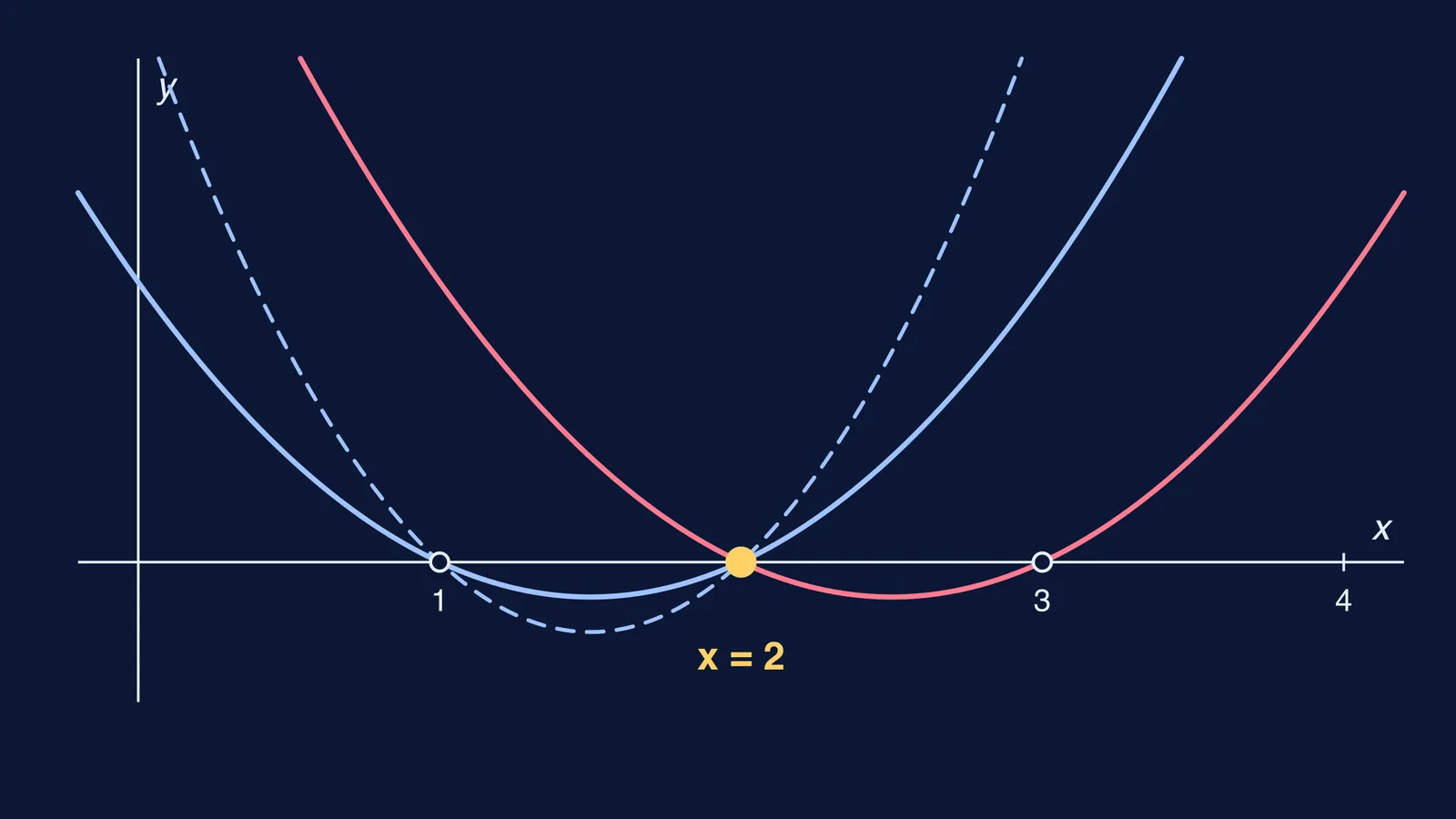
Check it on the pictured pair, x² − 3x + 2 = 0 (roots 1, 2) and x² − 5x + 6 = 0 (roots 2, 3): c₁a₂ − c₂a₁ = 2 − 6 = −4, a₁b₂ − a₂b₁ = −5 + 3 = −2 and b₁c₂ − b₂c₁ = −18 + 10 = −8. The left side is 16, the right side is (−2)(−8) = 16, and the common root is −4 / −2 = 2. It matches.
When do two quadratics have both roots common?
A quadratic with roots α and β can always be written as a(x − α)(x − β). If two quadratics share both roots, each is a constant multiple of the other, so their coefficients are in proportion: a₁/a₂ = b₁/b₂ = c₁/c₂.
In the picture, the dashed 2x² − 6x + 4 = 0 is twice x² − 3x + 2 = 0, so it has the same roots, 1 and 2. With proportional coefficients every bracket in the one-root condition is zero, so it holds as 0 = 0: it means at least one common root. For exactly one, also check the ratios are not all equal.
If a real quadratic has non-real roots, they come as a conjugate pair, so a second real quadratic sharing one must share both. The discriminant decides which case you are in; revise it in our post on finding k for equal roots of a quadratic.
How is this asked in JEE Main?
Here is a past question, listed as JEE Main, 9 April 2016 (online) on Cracku's solved paper: if x² + bx − 1 = 0 and x² + x + b = 0 have a common root different from −1, find |b|. The listed answer is √3.
Method 1, the condition. Here a₁ = 1, b₁ = b, c₁ = −1 and a₂ = 1, b₂ = 1, c₂ = b.
c₁a₂ − c₂a₁ = −1 − b, so the left side is (b + 1)².
a₁b₂ − a₂b₁ = 1 − b.
b₁c₂ − b₂c₁ = b² + 1.
So (b + 1)² = (1 − b)(b² + 1). Expanding, b² + 2b + 1 = b² + 1 − b³ − b, which simplifies to b³ + 3b = 0, or b(b² + 3) = 0.
Method 2, subtract. Subtracting the first equation from the second removes x²: (1 − b)α + (b + 1) = 0, so α = (b + 1)/(b − 1). Substituting back gives the same cubic; use the condition as your check.
Now the trap. If b = 0, the equations are x² − 1 = 0 and x² + x = 0, whose common root is −1, which the question excludes. So b² = −3, b = ±i√3, and |b| = √3.
If the substitution step is where you get lost, the Fermi Problem Library has a step-by-step solver that explains the reasoning rather than printing an answer.
What mistakes cost marks on common-root questions?
Dividing by a₁b₂ − a₂b₁ without checking it is non-zero; if it is zero, a common root needs all three ratios equal.
Forgetting the excluded root: test each parameter value in both equations.
Assuming b is real: |b| in the question hints that b may be complex.
For two more root shortcuts, see why a + b + c = 0 means one root is 1 and the condition when one root is double the other.