On this page
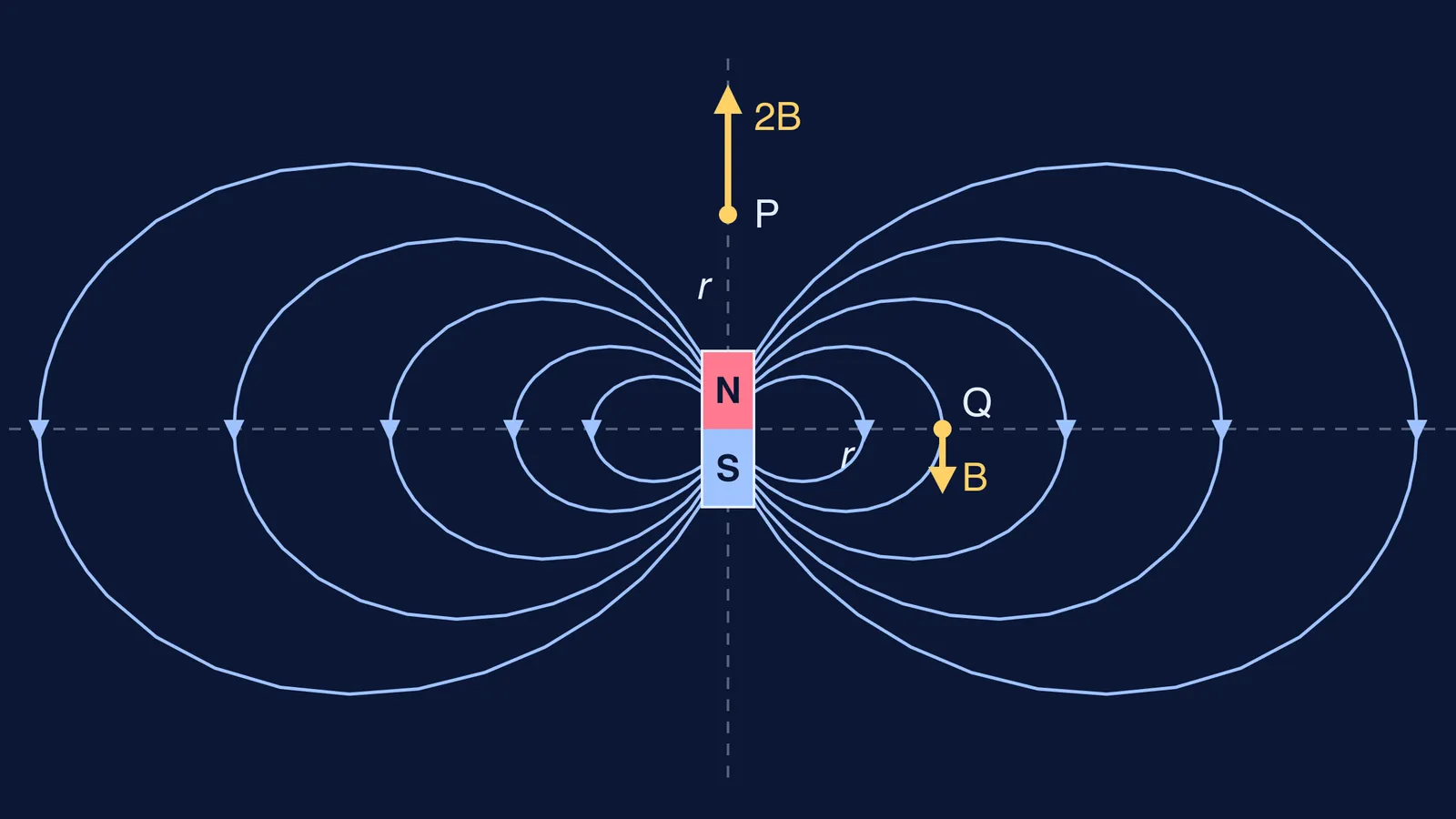
At the same distance from a short bar magnet, the field on its axis is twice the field on its equator, and the two point in opposite directions (NCERT Physics, chapter 5).
What is the magnetic field of a bar magnet at an axial point?
NCERT's Class 12 Physics textbook (chapter 5, Magnetism and Matter) gives the axial field of a bar magnet of magnetic moment m, at a distance r much larger than the magnet, as B = (μ0/4π)(2m/r³) (NCERT Physics Part I, chapter 5, eq. 5.5). The field points along m, the south-to-north direction; on the north side of the magnet that is away from it.
The same chapter shows how to get it. Take any result for an electric dipole and replace E with B, p with m, and 1/4πε0 with μ0/4π (NCERT, section 5.2.4). So the derivation is really the electric dipole one, which you can do from Coulomb's law:
Put charges +q and −q a distance 2a apart, so the dipole moment is p = q × 2a. Take a point on the axis at distance r from the centre, on the +q side.
The two fields point in opposite directions along the axis: E = (1/4πε0) q [1/(r − a)² − 1/(r + a)²].
Combine the fractions: E = (1/4πε0) × 4qar/(r² − a²)² = (1/4πε0) × 2pr/(r² − a²)².
For r much larger than a, (r² − a²)² becomes r⁴, so E = (1/4πε0)(2p/r³).
Swap in the magnetic symbols: B = (μ0/4π)(2m/r³).
What is the field at an equatorial point?
NCERT writes the equatorial field as B = −(μ0/4π)(m/r³) for r much larger than the magnet, and the minus sign means the field points opposite to m (NCERT, eq. 5.4). On the electric side:
Each charge is at distance √(r² + a²) from the point, so each field has magnitude (1/4πε0) q/(r² + a²).
The components perpendicular to the axis cancel. The components parallel to the axis add, each a fraction a/√(r² + a²) of the full field.
Total: E = (1/4πε0) × 2qa/(r² + a²)^(3/2) = (1/4πε0) p/(r² + a²)^(3/2), pointing from +q towards −q.
For r much larger than a, this is (1/4πε0)(p/r³). Swap symbols: B = (μ0/4π)(m/r³), directed from the north end towards the south end, opposite to m.
Why is the axial field twice the equatorial field?
Divide the two far-field results (NCERT, eqs. 5.4 and 5.5) and r³ cancels: (2m/r³) ÷ (m/r³) = 2. The physical reason sits inside the derivations. On the axis, the near and far poles pull in opposite directions, and their difference works out to about 4a/r³ times q. On the equator, the two fields are equal, but only the fraction a/r of each survives the cancellation, giving 2a/r³ times q. Four against two: that is the 2:1.
Worked example: how strong is the field 10 cm from a short magnet?
Take a magnet 5 cm long (half-length l = 2.5 cm) with m = 0.40 A m², and points 10 cm from its centre. Use μ0/4π = 10⁻⁷ T m/A: the measured value of μ0 is 1.25663706127 × 10⁻⁶ N A⁻² (NIST CODATA 2022), which matches 4π × 10⁻⁷ to nine significant figures.
Axial: B = 10⁻⁷ × 2 × 0.40 / (0.10)³ = 8.0 × 10⁻⁵ T, or 80 μT, pointing along m.
Equatorial: B = 10⁻⁷ × 0.40 / (0.10)³ = 4.0 × 10⁻⁵ T, or 40 μT, pointing parallel to the magnet from its N end towards its S end.
Check the approximation. Treat the poles as points at the ends (a = l) and use the un-simplified forms from step 3 of each derivation: B = (μ0/4π) 2mr/(r² − l²)² gives about 91 μT, and B = (μ0/4π) m/(r² + l²)^(3/2) gives about 36.5 μT. The ratio is near 2.5, not 2.
Move out to 30 cm and the short-magnet formulas are within about 1.5% of these longer forms, and the ratio is back near 2.
So 2:1 is a far-field result: use the r³ forms for a "short magnet", the full forms when r is only a few magnet lengths.
Which mistakes cost marks here?
In the full forms, using the full length of the magnet where the formula wants the half-length l.
Giving the equatorial field the same direction as m. It is opposite.
Forgetting that m is in A m², so r must be in metres before you cube it.
Quoting the 2:1 ratio for a point close to a long magnet, where it does not hold.
Writing μ0 = 10⁻⁷. It is μ0/4π that is 10⁻⁷ T m/A (NIST CODATA 2022).
If a step in the dipole derivation still feels shaky, the Fermi Concept Library covers every concept in physics, chemistry, biology, mathematics and computing. Field lines are also easier to see than read, which is what the Fermi Simulation Lab is for.
Try the example again with r = 20 cm before your next test, and check that the ratio moves closer to 2.