On this page
Biofortification is the answer to a simple problem: many people eat enough calories but not enough vitamins, minerals or protein. Instead of adding nutrients to food in a factory, scientists breed or engineer the crop so the nutrient is already inside the grain or root when it is harvested. For your exam, three examples come up again and again: Atlas 66 wheat, golden rice and vitamin-rich vegetables.
What is biofortification?
The World Health Organization defines biofortification as "the process by which the nutritional quality of food crops is improved through agronomic practices, conventional plant breeding, or modern biotechnology" (WHO eLENA). Fortification is different: WHO describes it as deliberately increasing the content of an essential micronutrient in a food (WHO eLENA).
The aim is to reach people who depend on one staple, such as rice or wheat, and cannot easily buy supplements or fortified foods. A 2020 Government of India release put the scale plainly: two billion people worldwide suffer from micronutrient deficiency (PIB, 14 October 2020).
Why is Atlas 66 wheat the classic example?
Atlas 66 is a wheat variety known for high grain protein, and breeders have crossed it with other wheats to study and carry that trait into new lines. A 1978 Crop Science study by Vogel, Johnson and Mattern, for example, crossed Atlas 66 with another high-protein wheat, Nap Hal, and traced how protein was spread between the bran and the endosperm of the offspring (University of Nebraska record of the paper).
That is why exam answers call Atlas 66 a "donor": it is the parent that brings the high-protein genes. The method here is conventional breeding, not genetic engineering.
How does golden rice make vitamin A?
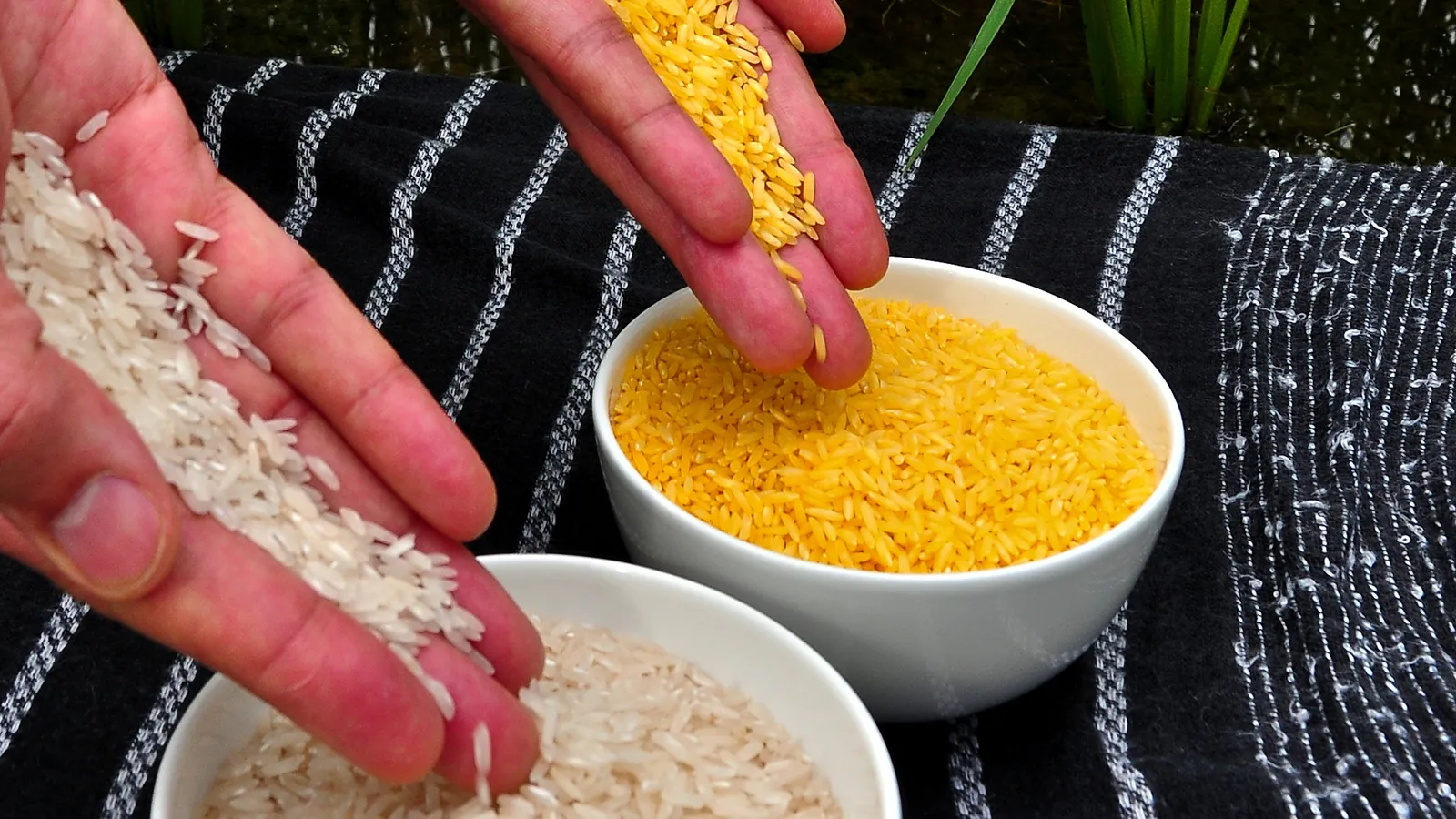
The endosperm, the white part of the rice grain that is left after milling and that we eat, lacks provitamin A. In 2000, Ye, Beyer, Potrykus and colleagues reported in Science that they had used recombinant DNA technology to engineer the provitamin A (beta-carotene) pathway into that carotenoid-free endosperm (Ye et al., Science 2000). Your body converts beta-carotene into vitamin A.
Golden rice is the example the current NCERT Class 12 book uses. In Chapter 10, Biotechnology and its Applications, "golden rice, i.e., Vitamin 'A' enriched rice" is listed as a way genetic modification has enhanced the nutritional value of food (NCERT Class 12 Biology, Chapter 10).
Its real-world story is contested. Down To Earth reported in May 2024 that the Philippines became the first country to approve commercial production of golden rice in 2021, but that on 17 April 2024 its Court of Appeals ordered a stop to commercial propagation and field testing until all safety, health and legal issues were addressed (Down To Earth). If you want the wider debate on genetically modified crops, our post on the advantages of GM crops in NCERT sets out the points to learn.
Which vegetables and Indian crops count as biofortified?
Vitamin-A-rich vegetables are the third group. Pusa Rudhira, a red carrot released by the Indian Agricultural Research Institute (IARI), New Delhi, has roots rich in total carotenoids, beta-carotene, lycopene, iron and zinc (Mathew, Indian Journal of Horticulture 2024).
India has since released many more. In October 2020 the government announced that the Prime Minister would dedicate 17 biofortified varieties of 8 crops to the nation, including CR Dhan 315 rice with high zinc and HI 1633 wheat rich in protein, iron and zinc (PIB, 14 October 2020). The same release says ICAR developed 53 biofortified varieties in the previous five years, and only one before 2014. Plant breeders do this work; if it interests you as a career, read what a plant breeder and crop scientist does.
How should you write a biofortification answer in the exam?
Use this four-part frame for a 3-mark or 5-mark board answer; the same facts cover NEET-UG multiple-choice questions.
Define it in one line: breeding or engineering crops for higher vitamins, minerals, protein or healthier fats.
State the aim: to fight hidden hunger (micronutrient deficiency) in people who rely on a few staples.
Give one example per method: Atlas 66 wheat (conventional breeding, high protein); golden rice (genetic engineering, beta-carotene); IARI vegetables such as vitamin-rich carrots.
Add one line on limits: a GM crop needs biosafety approval, and golden rice has faced legal challenges.
Before you learn the lists, check what your exam actually asks. Golden rice is in the current NCERT text, but syllabi change, so confirm the biology units on the official NEET-UG site and in your board's syllabus. Then put examples like these into one sheet using the blank-table method for NEET biology examples.
If the difference between breeding and recombinant DNA still feels fuzzy, the Fermi Concept Library has a lesson on each biology concept and shows where it sits in the map. To practise, the Fermi Problem Library has worked problems with a step-by-step solver that explains the reasoning rather than printing an answer.