On this page
The hypothalamus sits at the base of your forebrain, and it runs the anterior pituitary by sending it hormones rather than nerve impulses. The NCERT Class 11 chapter Chemical Coordination and Integration sorts these hormones into two kinds and gives one example of each: GnRH and somatostatin. If you can trace how those two reach the pituitary, and what each one controls, you have the core of section 19.2.1.
What are hypothalamic releasing and inhibiting hormones?
NCERT defines them by their effect on the pituitary: releasing hormones stimulate the secretion of pituitary hormones, and inhibiting hormones inhibit it (NCERT Class 11 Biology, Chapter 19).
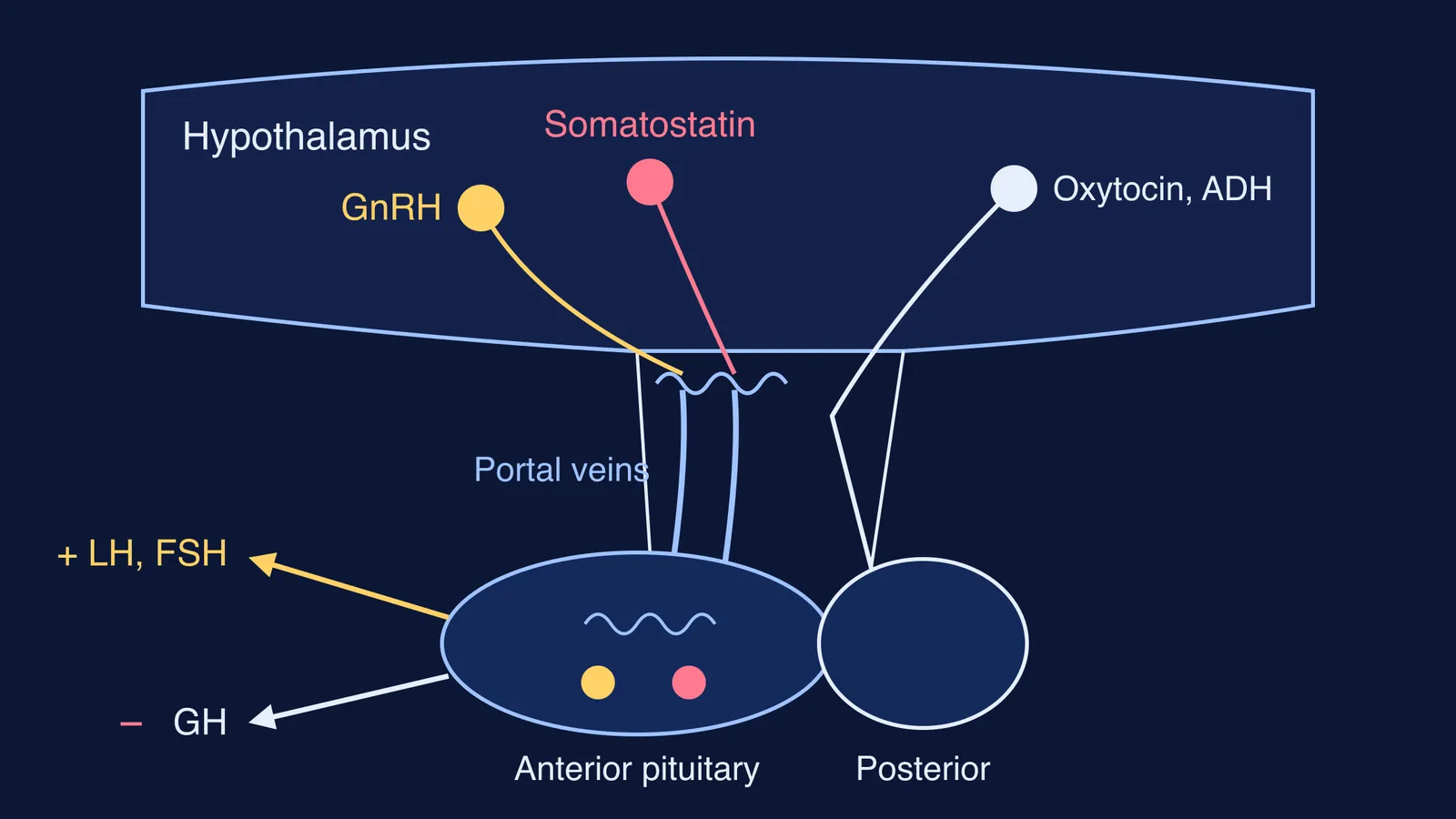
Gonadotrophin releasing hormone (GnRH) stimulates the pituitary to make and release gonadotrophins, the hormones LH and FSH (same NCERT chapter).
Somatostatin from the hypothalamus inhibits the release of growth hormone from the pituitary (same NCERT chapter).
OpenStax's Anatomy and Physiology textbook gives somatostatin its other name, growth hormone-inhibiting hormone (GHIH), and pairs it with GHRH, the releasing hormone for growth hormone. Growth hormone therefore has a hypothalamic accelerator and a brake.
How do GnRH and somatostatin reach the anterior pituitary?
They travel by blood, through a short private circuit called the hypophyseal portal system. Here is the route, combining NCERT and OpenStax:
Neurosecretory cells in groups called nuclei in the hypothalamus make the hormone.
The hormone passes down the axons and is released from the nerve endings.
It enters a primary capillary plexus at the base of the hypothalamus.
Portal veins in the pituitary stalk (the infundibulum) carry it down into the anterior pituitary.
There it acts on the pituitary cells. The hormones they release in response, such as LH, FSH and GH, enter a secondary capillary plexus and drain into the circulation.
The point of a portal system is that hypothalamic hormones reach the anterior pituitary without first entering the systemic circulation, OpenStax explains. They are not first diluted in the blood of the whole body.
Which pituitary hormone does each one control?
GnRH controls LH and FSH. According to NCERT, LH in males stimulates the testis to make androgens. In females, LH induces ovulation and maintains the corpus luteum. FSH, together with androgens, regulates spermatogenesis, and FSH stimulates the growth of ovarian follicles. The menstrual cycle hormone graph shows what those two hormones do across a month.
The timing of GnRH matters as much as the amount. In a 1978 study of rhesus monkeys whose own gonadotropin release had been abolished by hypothalamic lesions, Belchetz and colleagues found that a constant infusion of GnRH failed to restore sustained release. Giving the same synthetic decapeptide once per hour did restore it. GnRH is a decapeptide, a chain of 10 amino acids, and the authors traced the effect to the pattern of delivery rather than the amount.
Somatostatin controls growth hormone, as a brake. In 1973, Roger Guillemin's group reported a peptide from sheep hypothalamus that inhibits growth hormone secretion. The structure they reported in Science is a chain of 14 amino acids. To see why the brake matters, read how too much or too little growth hormone shows up at different ages.
Who discovered the hypothalamic hormones?
The 1977 Nobel Prize press release tells the story. In 1930, researchers found small blood vessels connecting the hypothalamus with the pituitary. From the late 1950s, Roger Guillemin and Andrew Schally, each in his own laboratory, raced to identify the releasing factors. Guillemin worked with 5 million hypothalamic fragments from sheep, and Schally with the same amount from pigs. In 1969 the nature of TRF, the TSH-releasing factor, was established: a peptide of three amino acids. Within two years LH-RH, the older name for GnRH, was isolated, sequenced and synthesised. The press release describes somatostatin as the first inhibitor of pituitary function. Half of the 1977 prize went jointly to Guillemin and Schally; the other half went to Rosalyn Yalow.
How do you check that you have it?
Try this assertion-reason item before reading the answer.
Assertion: Somatostatin is a releasing hormone of the hypothalamus.
Reason: Somatostatin reaches the anterior pituitary through the portal system.
The assertion is false: somatostatin inhibits growth hormone release, so it is an inhibiting hormone. The reason is true. Answer: A is false, R is true.
Next: if the portal vessels were blocked, what would happen to LH and FSH? GnRH could no longer reach the anterior pituitary, so their release would fall. Oxytocin and vasopressin travel down axons, so they do not need the portal vessels.
Write this chain from memory once a day for a week: hypothalamic nucleus, axon, primary plexus, portal veins, anterior pituitary cell, hormone, secondary plexus, general blood, target gland. If a link is shaky, the Fermi Concept Library covers every concept in biology, each with its own lesson and its place in the map, so you can see the hypothalamus, pituitary and gonads as one connected system. For the wider picture, start with why the pituitary is called the master gland.