

On this page
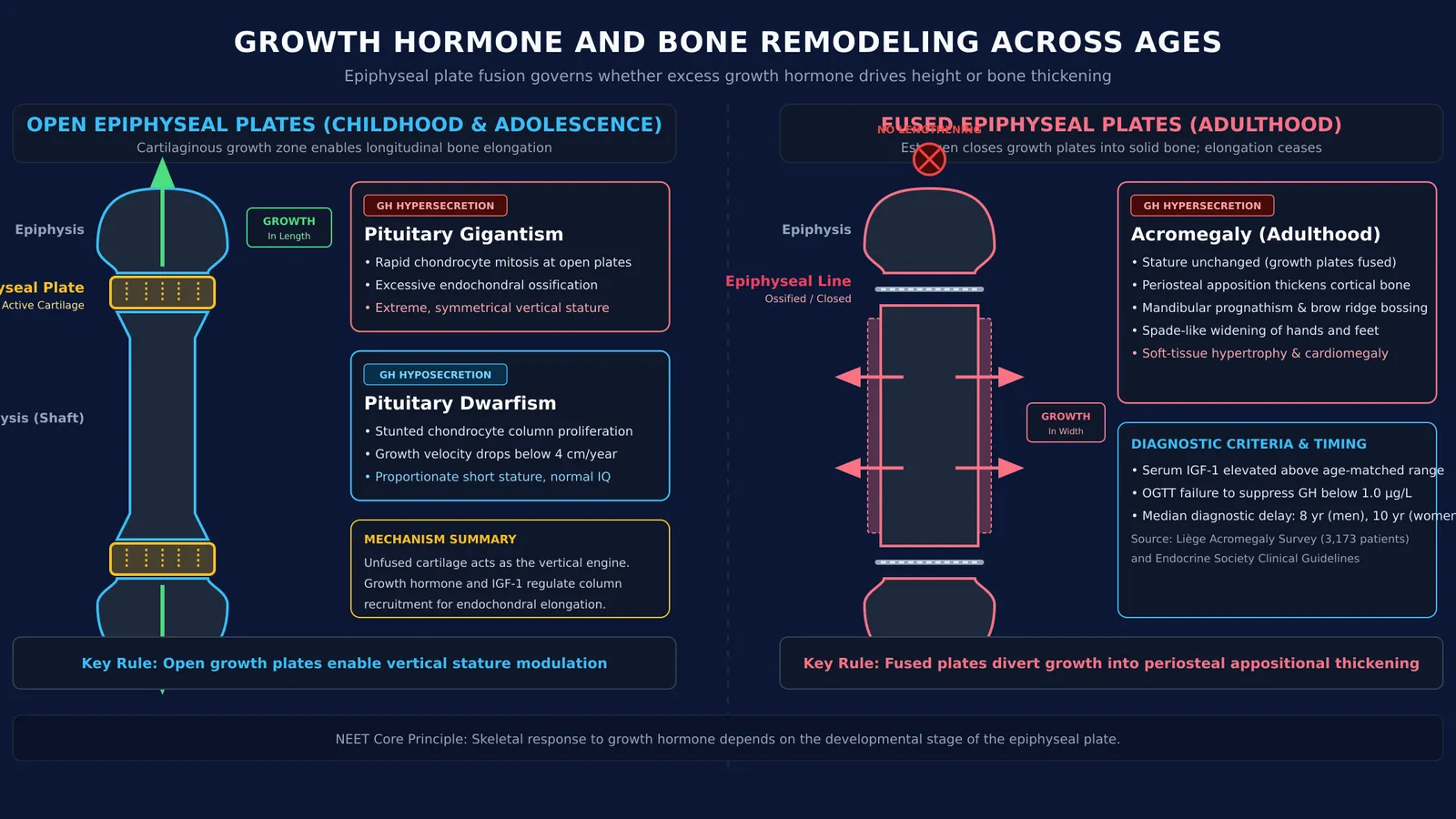
When growth hormone levels stray from normal, timing decides the disease. In childhood, abnormal pituitary secretion alters vertical stature, causing pituitary dwarfism or gigantism. In adulthood, however, the same excess produces acromegaly, a disorder that thickens bones and soft tissues without adding height. The biological switch lies inside long bones: the cartilaginous epiphyseal growth plate, which enables longitudinal elongation during youth but permanently ossifies into solid bone after puberty.
How does growth hormone control bone elongation?
Longitudinal growth requires coordinated signaling between the anterior pituitary gland and developing bones. Somatotroph cells in the anterior pituitary release growth hormone (GH), a 191-amino-acid peptide reviewed in our anterior pituitary hormones guide. While GH acts directly on cartilage cells, much of its skeletal effect is mediated by insulin-like growth factor 1 (IGF-1), produced primarily in the liver, as detailed in Endocrine Reviews.
Long bones such as the femur have three anatomical parts: the rounded epiphysis at each end, the central diaphysis, and the metaphysis between them. The metaphysis contains the epiphyseal plate, where chondrocytes divide in columns. As newer chondrocytes form, older ones hypertrophy, calcify, and undergo apoptosis, allowing osteoblasts to lay down bone matrix through endochondral ossification. As long as this cartilage plate stays open, bones lengthen vertically. To understand how hormones orchestrate these pathways, the Fermi Concept Library provides lessons for every concept in biology, each with its place in the map.
What happens when childhood growth hormone levels fall too low?
Hyposecretion of growth hormone during childhood slows endochondral ossification, producing pituitary dwarfism. Linear growth drops below 4 centimetres per year, according to consensus guidelines from the Growth Hormone Research Society, causing height to lag behind standard developmental percentiles.
The hallmark of pituitary dwarfism is proportionate short stature: the limbs, head, and torso remain symmetrically balanced because cartilage proliferation slows uniformly across all growth plates. Intelligence and mental development remain intact, distinguishing it from cretinism. Under consensus guidelines from the Growth Hormone Research Society, confirming childhood growth hormone deficiency requires provocative stimulation tests demonstrating peak GH levels below 10 µg/L.
Why does growth hormone excess cause gigantism in children but acromegaly in adults?
Oversecretion of growth hormone typically arises from a benign somatotroph adenoma. Whether this excess causes gigantism or acromegaly depends on epiphyseal plate status.
In children with open growth plates, excess GH and IGF-1 drive rapid chondrocyte mitosis. Continuous endochondral ossification produces extraordinary vertical stature, leading to pituitary gigantism. In a 208-patient cohort in Endocrine-Related Cancer, 78.4% of gigantism cases were male, 84% had macroadenomas measuring at least 10 mm, and 77% showed extrasellar extension.
During puberty, rising estrogen levels in both sexes accelerate chondrocyte senescence, ultimately closing the plates by late adolescence into an ossified epiphyseal line. Once fused, long bones cannot lengthen.
In adults, excess GH stimulates periosteal appositional bone growth rather than elongation. This causes acromegaly, marked by a protruding lower jaw (prognathism), enlarged brow ridges, widening hands and feet, macroglossia, and cardiomegaly.
Because external changes develop slowly, acromegaly often goes unrecognized for years. The Liège Acromegaly Survey of 3,173 patients in Endocrine-Related Cancer reported a median diagnostic delay of 8 years in men and 10 years in women, with 28.8% developing hypertension and 27.5% developing diabetes mellitus. In India, registry data in Neurology India showed a younger median diagnosis age of 37 years, with 91.8% presenting with macroadenomas after an average diagnostic delay of 4.7 years. Diagnosis under Endocrine Society guidelines requires elevated serum IGF-1 and failure to suppress GH below 1.0 µg/L during an oral glucose tolerance test. For feedback mechanisms, see our explainer on endocrine negative feedback loops and our guide to posterior pituitary hormones.
How do NEET questions test pituitary disorders?
When tackling exam questions on pituitary disorders, follow this four-step reasoning framework:
Check epiphyseal plate status: Verify whether the plates are open (childhood) or fused (adulthood).
Note hormone direction: Confirm whether growth hormone is deficient (hyposecretion) or elevated (hypersecretion).
Identify the bone mechanism: Connect height changes to endochondral ossification, and bone widening to periosteal apposition.
Assess proportionality: Confirm if short stature is proportionate (pituitary dwarfism) and if overgrowth is vertical (gigantism) or acral (acromegaly).
When working through multi-step genetics and endocrinology numericals, the Fermi Problem Library provides worked problems with a step-by-step solver that explains the reasoning rather than printing an answer.


