

On this page
When biology students study the endocrine system, they often memorise a linear chain: the hypothalamus releases thyrotropin-releasing hormone (TRH), the anterior pituitary releases thyroid-stimulating hormone (TSH), and the thyroid gland secretes thyroxine (T4) and triiodothyronine (T3). In exams like NEET-UG, questions rarely test that simple sequence. Instead, they introduce a perturbation—such as excess medication or dietary iodine deficiency—and ask you to deduce what happens to TSH. Answering correctly requires treating the endocrine system not as a one-way chain, but as a dynamic negative feedback loop.
How does the thyroid negative feedback loop work?
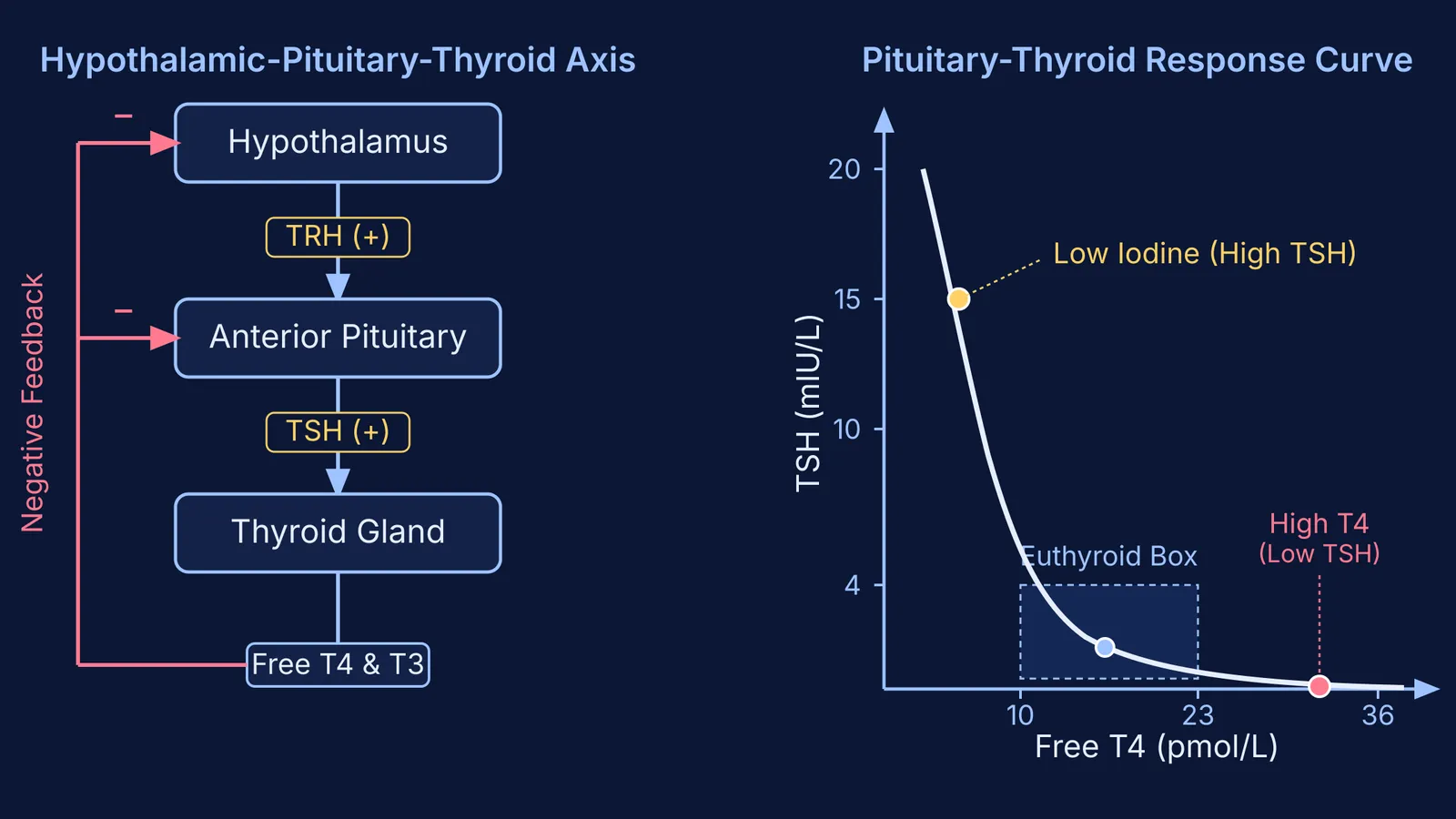
The hypothalamic-pituitary-thyroid (HPT) axis maintains metabolic homeostasis through circular regulation. TRH from the hypothalamus stimulates thyrotrophs in the anterior pituitary to secrete TSH. TSH binds follicular receptors on the thyroid gland, stimulating iodide uptake and activating thyroid peroxidase to synthesize thyroxine (T4, with 4 iodine atoms) and triiodothyronine (T3, with 3 iodine atoms).
Circulating free T4 and T3 exert negative feedback on both the pituitary and hypothalamus. Inside pituitary cells, type 2 deiodinase converts T4 into T3, downregulating TSH subunit transcription. In *Advances in Physiology Education*, Modell and colleagues (2015) noted that students often treat negative feedback as an off-switch rather than a continuous balancing mechanism. Understanding how hormonal feedback loops stabilize body levels means seeing that the loop operates constantly to keep metabolism stable.
What happens to TSH when thyroxine is high?
When free thyroxine rises above baseline, the feedback circuit acts quickly. In healthy adults, the reference interval for free thyroxine spans 10 to 23 pmol/L, while baseline TSH sits between 0.4 and 4.0 mIU/L, as documented by Goede and colleagues (2014).
As free T4 climbs beyond 23 pmol/L, excessive ligand binds pituitary receptors, exerting strong negative feedback. TSH secretion collapses, often falling below 0.1 mIU/L. In their mathematical modeling, Goede and colleagues (2014) showed that this interaction follows an inverse log-linear curve: a modest linear rise in thyroxine drives an exponential drop in TSH. In *Frontiers in Endocrinology*, Dietrich and colleagues (2016) demonstrated how simulation software reveals this non-linear sensitivity. Reviewing simulations compared to static diagrams helps students see this steep response directly.
Why does iodine deficiency cause goitre and high TSH?
When dietary iodine drops, the feedback loop triggers an unexpected outcome: the thyroid gland enlarges while hormone production falls. Iodine is the essential structural substrate for hormone synthesis; without it, thyroid peroxidase cannot assemble T4 or T3. As synthesis stalls, free T4 falls below the 10 pmol/L lower physiological baseline documented by Goede and colleagues (2014).
With less thyroxine reaching the pituitary, negative feedback weakens. Released from inhibition, the anterior pituitary releases high volumes of TSH, pushing serum levels well above 10 mIU/L. TSH acts as a growth factor: sustained stimulation causes follicular cells to multiply (hyperplasia) and swell (hypertrophy) to trap available iodide, producing a goitre. According to the World Health Organization (2007), goitre is endemic when its prevalence reaches or exceeds 5% in school-age children, signaling median urinary iodine below the normal 100 to 199 µg/L range. Mastering this loop is crucial for chemical coordination and endocrine glands for NEET.
How does predicting shifts in a simulation fix linear reasoning?
Passive reading often leads students into a linear trap: assuming that when a gland falters, all related hormones drop. Richard White and Richard Gunstone (1992) established the Predict-Observe-Explain (POE) framework, examined in computer-based tasks by Kearney and colleagues (2001). In a POE task, you commit to a prediction before altering variables.
Predicting that low iodine lowers TSH—only to watch the simulation display a sharp TSH surge—creates cognitive conflict that corrects faulty linear assumptions. The Fermi Simulation Lab provides interactive simulations for ideas that are easier to see than to read, letting students adjust synthesis parameters and observe homeostatic compensation in real time.
How can you test endocrine feedback questions step by step?
To analyse any endocrine feedback question, apply this four-step prediction framework:
Identify the primary disturbance: Determine whether the shift is an external hormone surge, a substrate deficit like iodine deficiency, or a central regulatory lesion.
Check the sensory response: Determine what pituitary and hypothalamic receptors detect. High circulating free T4 strengthens negative feedback; low free T4 removes it.
Predict the trophic hormone: Deduce the direction of TSH. Due to negative feedback, TSH shifts in the opposite direction of primary thyroid gland production.
Deduce anatomical and metabolic outcomes: Assess how tissues adapt. Chronic TSH suppression leads to thyroid gland rest or atrophy, while chronic TSH elevation drives follicular cell hyperplasia, forming a goitre.
Applying the equilibrium benchmarks from Goede and colleagues (2014), consider two core physiological scenarios:
Case 1 (Thyroxine surge): Exogenous T4 lifts free T4 above 23 pmol/L. Pituitary receptors trigger heavy negative feedback, suppressing TSH below 0.1 mIU/L.
Case 2 (Dietary iodine deficiency): Lack of iodine drops free T4 below 10 pmol/L. Relieved of feedback inhibition, the pituitary increases TSH above 10 mIU/L, stimulating follicular cell overgrowth into a goitre.
When working through difficult physiology questions, Fermi's AI tutor works out what you already know, runs the simulation, and checks understanding as it goes, helping you master circular biological control systems step by step.


