

On this page
The neurohypophysis, or posterior pituitary, does not manufacture its own hormones. Instead, it acts as a storage and release centre for two critical chemical messengers produced in the hypothalamus. These hormones travel down long nerve axons through the pituitary stalk before they are stored in the axon terminals of the posterior pituitary, waiting for a signal to be released into the bloodstream. If you are preparing for the NTA NEET biology syllabus or just looking to understand how the endocrine system regulates your body, mastering the posterior pituitary hormones oxytocin and vasopressin is a necessary step.
What are the posterior pituitary hormones?
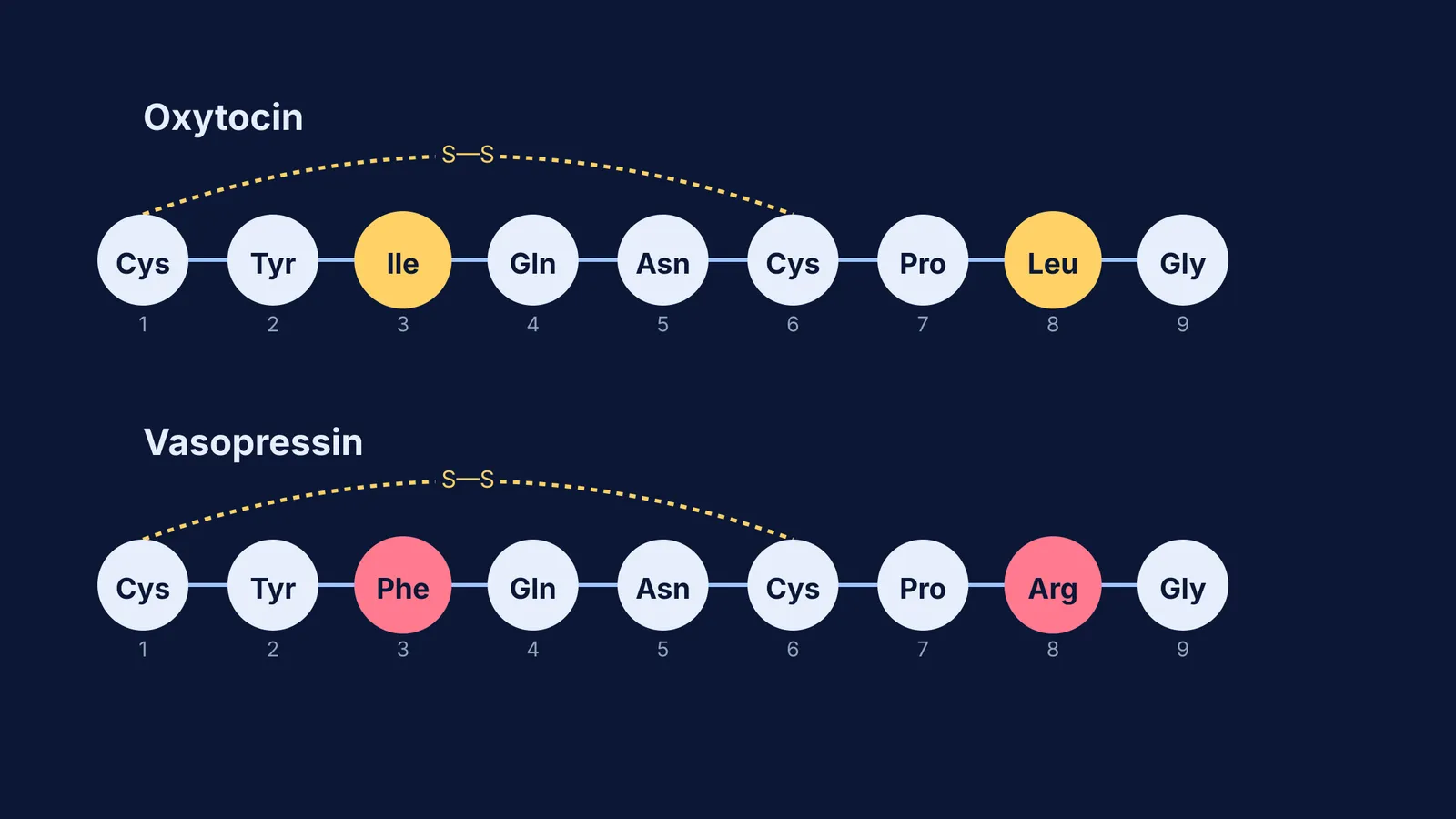
The two posterior pituitary hormones are oxytocin and vasopressin. Both are short peptide chains composed of exactly nine amino acids. Because they are so short, they are metabolised extremely quickly in the blood. The plasma half-life of oxytocin is only 3 to 5 minutes, while vasopressin lasts between 10 and 20 minutes before it is cleared by the liver and kidneys. This rapid clearance is an evolutionary advantage: it ensures that the hormonal signal can be turned off almost instantly when the body no longer needs it.
Remarkably, these two hormones are almost identical in their structure. They differ at only two amino acid positions in their nine-link chain. If you have concept gaps when memorising these biological structures, the Fermi Concept Library covers every concept in biology, chemistry and physics.
What does oxytocin do?
Oxytocin targets the smooth muscles of the body and stimulates their contraction. Its most prominent roles are in female reproduction, where it governs two highly mechanical processes.
During childbirth, the fetal ejection reflex triggers the release of oxytocin, which drives the vigorous uterine contractions necessary for delivery. This mechanism operates on a positive feedback loop: as the baby’s head pushes against the cervix, the stretching sends a neural signal to the hypothalamus to release more oxytocin. This causes a stronger contraction, which leads to further stretching and even more oxytocin, continuing until the baby is born. For this reason, it is frequently referred to as the birth hormone.
After birth, oxytocin is responsible for the milk ejection reflex, also known as the let-down reflex. When an infant suckles, sensory impulses travel to the hypothalamus, prompting the posterior pituitary to release oxytocin into the bloodstream in pulses. This hormone causes the myoepithelial cells—which act like tiny muscles surrounding the alveoli of the mammary glands—to contract, actively forcing milk into the lactiferous ducts. While prolactin is responsible for milk production in the background, oxytocin is the hormone that actually delivers it during feeding. For further details on reproduction, see our guide to Parturition and lactation: the hormones behind birth and milk.
What is the function of vasopressin?
Vasopressin is primarily known as Antidiuretic Hormone (ADH) because it prevents diuresis, which is the loss of water through urine. It is the body's primary defense against dehydration.
It acts directly on the distal convoluted tubules and collecting ducts of the kidneys, commanding them to increase water reabsorption back into the bloodstream. By default, the collecting ducts are relatively impermeable to water. When vasopressin binds to receptors on these cells, it triggers the insertion of specialized water channels called aquaporins into the cell membrane. This allows water to rush out of the urine and back into the body, which concentrates the urine and prevents dangerous fluid loss. You can explore how it works alongside other systems in Regulating kidney function: ADH, the RAAS and ANF explained.
Additionally, at higher concentrations, vasopressin constricts blood vessels, which increases peripheral resistance and rapidly raises blood pressure.
When the body fails to produce vasopressin due to pituitary damage, or when the kidney receptors cannot respond to it, a person develops diabetes insipidus. This is a rare disorder, with a global prevalence of approximately 1 in 25,000 people. Unlike diabetes mellitus, this condition does not involve high blood sugar; instead, patients suffer from unquenchable thirst (polydipsia) and excrete massive volumes of tasteless, dilute urine (polyuria), sometimes losing several litres of water a day. To understand how hormones reach their targets in such diseases, read How hormones act: membrane receptors vs intracellular receptors.


