On this page
In the hormones chapter of your Class 11 NCERT biology book, the pituitary looks like the boss of the endocrine system. Yet the section just before it shows another structure giving it orders. Seeing how the two fit together keeps TRH, TSH and thyroxine straight in an exam answer.
Why is the pituitary called the master gland?
The pituitary sits in a bony cavity called the sella turcica and is attached to the hypothalamus by a stalk, according to NCERT Class 11 Biology, Chapter 19. Its front part, the anterior pituitary (pars distalis), produces growth hormone, prolactin, TSH, ACTH, LH and FSH.
The nickname comes from where those hormones go. Several of their targets are themselves endocrine glands. NCERT lists them:
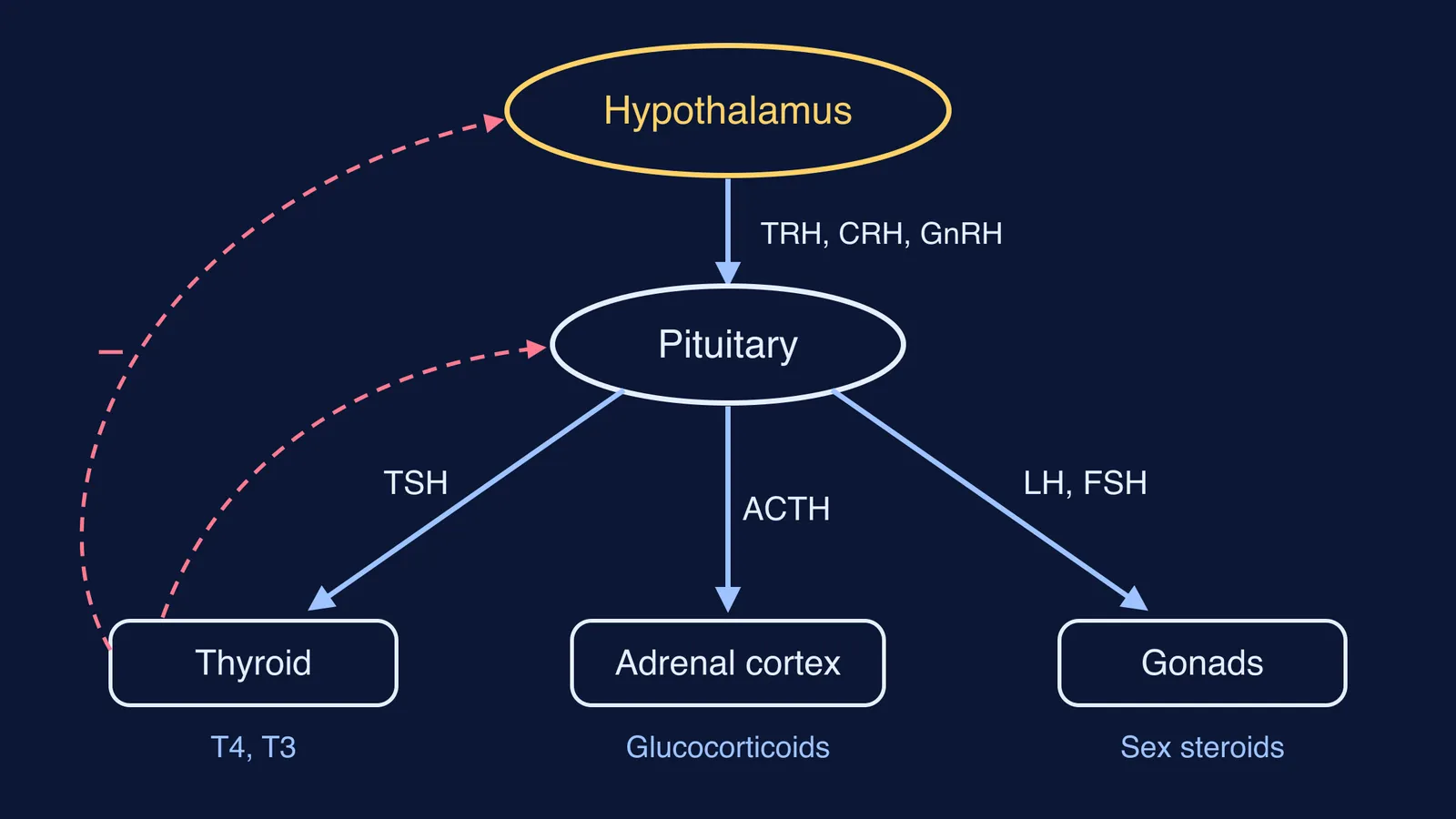
TSH stimulates the synthesis and secretion of thyroid hormones from the thyroid gland.
ACTH stimulates the adrenal cortex to make steroid hormones called glucocorticoids.
LH and FSH stimulate the testes and ovaries, which is why they are called gonadotrophins.
TSH, ACTH, FSH and LH are called tropic hormones "because they turn on or off the function of other endocrine glands", says OpenStax Anatomy and Physiology 2e, section 17.3. That control over other glands earns the pituitary the title "master".
If the pituitary is the master, who controls the pituitary?
The hypothalamus does. NCERT describes it as the basal part of the diencephalon, in the forebrain. Its neurosecretory cells make two kinds of hormones: releasing hormones, which stimulate pituitary secretion, and inhibiting hormones, which inhibit it. Gonadotrophin releasing hormone (GnRH) makes the pituitary produce and release LH and FSH. Somatostatin from the hypothalamus inhibits the release of growth hormone.
These hormones reach the anterior pituitary through a portal circulatory system. OpenStax explains why that matters: the portal system carries hypothalamic hormones to the anterior pituitary "without first entering the systemic circulation". The posterior pituitary is under even more direct control. NCERT says it is under direct neural regulation of the hypothalamus, and that oxytocin and vasopressin are actually made in the hypothalamus and carried down axons to the posterior pituitary, which stores and releases them.
So why does the hypothalamus sit above the pituitary? Because it is part of the brain. It turns signals from the nervous system into hormone signals, linking fast nerve control to slower, longer-lasting hormonal control. Our explainer on nervous control vs hormonal control sets out the differences. OpenStax calls the hypothalamus–pituitary complex the "command center" of the endocrine system.
A 2015 review in the Journal of Endocrinology traces this picture back to Geoffrey Harris's 1955 monograph, in which Harris proposed that nerve fibres from the hypothalamus release a substance into capillaries in the median eminence, and that portal vessels carry it to the anterior pituitary (Plant, 2015). Our profile of Geoffrey Harris and the hypothalamus–pituitary link tells that story.
How does negative feedback keep the system in check?
The chain does not run only one way. "TSH is released from the anterior pituitary in response to thyrotropin-releasing hormone (TRH) from the hypothalamus," says OpenStax, and "elevated levels of thyroid hormones in the bloodstream then trigger a drop in production of TRH and subsequently TSH." That is negative feedback: the product of the chain turns the chain down.
How does a lack of iodine cause goitre?
NCERT says iodine is essential for the normal rate of thyroid hormone synthesis, and that a lack of iodine in the diet causes hypothyroidism and enlargement of the thyroid, called goitre. Work along the loop:
Low iodine means the thyroid makes less thyroxine (T4) and triiodothyronine (T3).
With thyroid hormones low, the feedback that would turn TRH and TSH down is weak.
The pituitary responds by secreting more and more TSH. According to OpenStax section 17.4, this overstimulation makes colloid build up in the thyroid follicles, and the gland enlarges.
How do you write this answer in an exam?
A strong short answer to "Why is the pituitary called the master gland?" makes these points, in this order:
The anterior pituitary secretes tropic hormones that control other endocrine glands.
TSH acts on the thyroid, ACTH on the adrenal cortex, LH and FSH on the gonads.
The pituitary itself is controlled by the hypothalamus through releasing and inhibiting hormones carried by the portal system.
The posterior pituitary is under direct neural control and releases oxytocin and vasopressin made in the hypothalamus.
Hormones from target glands feed back to reduce hypothalamic and pituitary output.
Check your answer for the usual traps:
ACTH acts on the adrenal cortex, not the medulla. OpenStax section 17.6 describes the medulla as neuroendocrine tissue made of sympathetic neurons.
Oxytocin and vasopressin are made in the hypothalamus and released from the posterior pituitary.
GnRH is hypothalamic; LH and FSH are pituitary.
To place each gland on the body, use our labelled diagram of endocrine gland locations. If one link in the chain still feels shaky, the Fermi Concept Library has a lesson for every concept in biology, showing where each one sits in the map. Then practise with the Fermi Problem Library, where the step-by-step solver explains the reasoning rather than printing an answer.