

On this page
When you touch a hot pan, your hand pulls back before you consciously register pain. When you skip breakfast, your liver releases glucose over hours to stabilise blood sugar. Both actions maintain homeostasis, but they rely on two distinct communication networks: nervous control and hormonal control.
Understanding how electrical impulses and chemical messengers coordinate the body is central to Class 10 and Class 11 biology and NEET-UG. Here is how both systems differ across speed, duration, anatomical pathways, and target range.
What is the difference between nervous control and hormonal control?
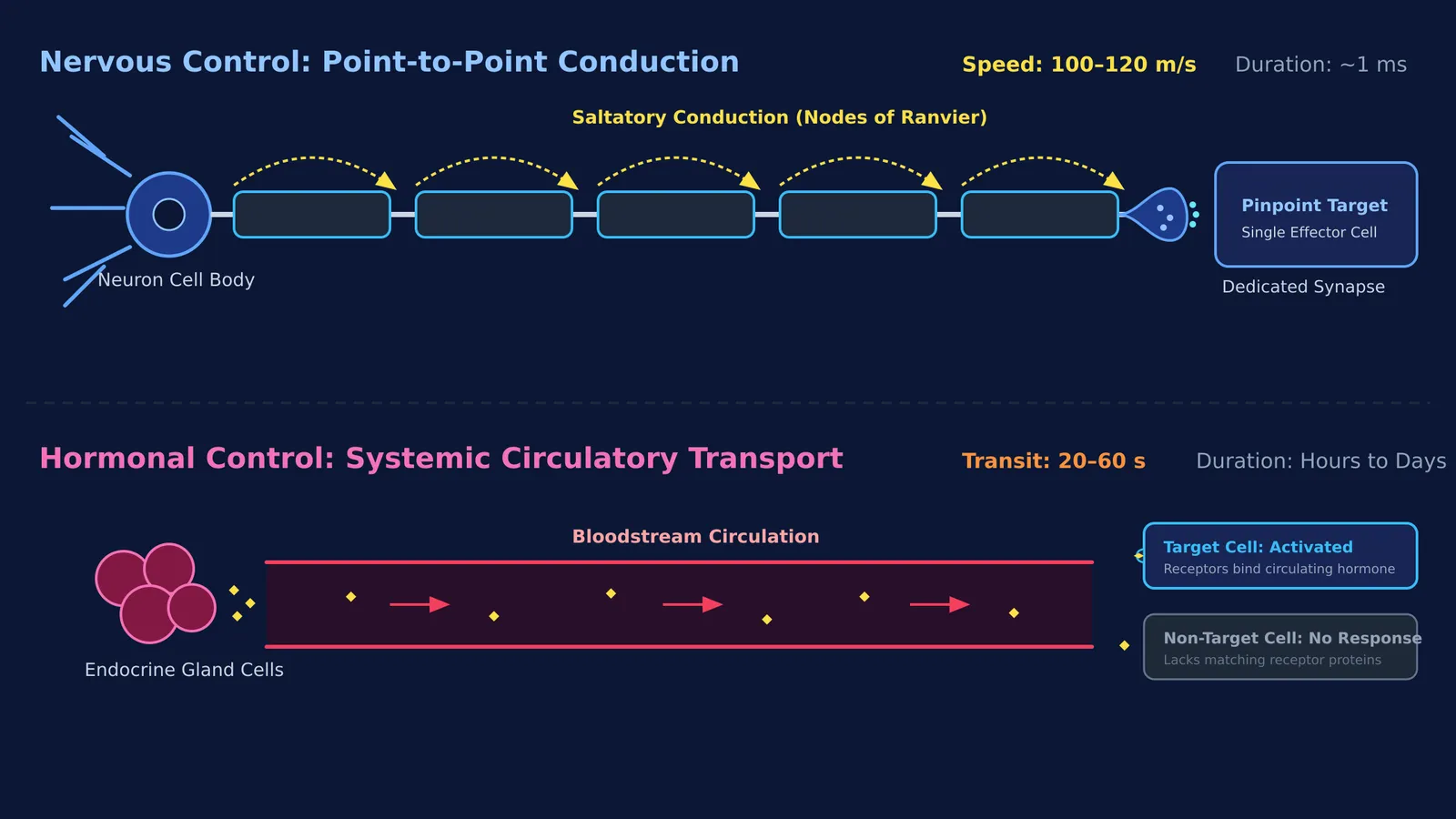
The nervous system acts as the body's high-speed telecommunications grid, while the endocrine system functions as a broadcast network. According to StatPearls: Physiology, Nerve, nervous communication transmits electrochemical impulses along individual axons to precise cellular junctions. By contrast, the endocrine system synthesizes chemical messengers that travel through extracellular fluids and the bloodstream to reach distant organs, as detailed in StatPearls: Physiology, Endocrine Hormones.
Their physiological differences can be broken down across four distinct parameters:
Speed of transmission: Large myelinated axons conduct impulses at 100 to 120 metres per second via saltatory conduction, while unmyelinated fibers conduct at 0.5 to 2.0 metres per second. Hormonal responses initiate much more slowly because blood requires roughly 20 to 60 seconds to complete a resting systemic circuit before hormones diffuse into tissues.
Duration of action: A neuronal action potential lasts approximately 1 millisecond, and synaptic transmitters clear within milliseconds via enzymatic breakdown or reuptake. Hormonal signals persist for minutes, hours, or days because circulating ligands require time to clear from plasma.
Transmission pathway: Impulses follow dedicated structural conduits made of neurons, tracts, and peripheral nerves. Hormones lack private physical conduits; they are poured directly into interstitial fluid and venous capillaries, dispersing throughout the cardiovascular system.
Target specificity: A nerve impulse produces a pinpoint, localized response at a single motor unit or sensory receptor. Hormones circulate systemically to bathe virtually every tissue, but they produce responses only in target cells equipped with matching receptors.
To explore how localized chemical messengers work at private junctions, you can read how neurotransmitters differ from circulating hormones.
How do electrical and chemical signals travel through the body?
The physical transmission of each signal reflects its distinct architecture. In a neuron, communication begins with an electrical wave. As detailed in StatPearls: Physiology, Nerve, when a stimulus reaches threshold, voltage-gated sodium channels open rapidly, driving membrane potential from -70 mV to roughly +30 mV. In myelinated nerves, myelin acts as an insulator, forcing current to jump between nodes of Ranvier.
When the impulse arrives at the presynaptic terminal, it triggers calcium influx and synaptic vesicle exocytosis. Neurotransmitters diffuse across a narrow gap measuring less than 50 nanometres, introducing a synaptic delay of just 0.5 to 1.0 milliseconds as documented in StatPearls: Physiology, Synapse. If you want to see how voltage-gated channels open and reset in real time, try simulating an action potential spike.
Hormones follow a chemical route. Endocrine cells release hormones into adjacent capillaries. Water-soluble peptide hormones, such as insulin, circulate freely in plasma and bind cell-surface receptors, triggering rapid intracellular enzymatic cascades. Lipid-soluble steroids, such as cortisol, bind plasma transport proteins, cross target cell membranes, and attach to intracellular receptors to modify gene transcription over hours.
If you find it difficult to map how cellular cascades connect to whole-body organ physiology, the Fermi Concept Library covers every concept in physics, chemistry, biology, mathematics and computing, each with its own lesson and its place in the map.
Why do multicellular animals need both nervous and hormonal systems?
A natural question arises: if electrical impulses travel so rapidly, why does the body rely on slow hormonal chemical messengers at all?
The official NCERT Class 10 Science textbook highlights two structural limitations of electrical communication:
Incomplete anatomical reach: Nerves do not connect to every individual cell in the body. Wiring billions of metabolic and connective cells with dedicated axons would be anatomically impossible and energetically unsustainable.
Mandatory reset intervals: Neurons cannot fire continuously. After transmitting an impulse, a neuron requires finite recovery time to restore resting membrane potential before firing again.
Chemical signalling overcomes both limitations. A single endocrine release diffuses across capillary beds to reach uninnervated cells, providing steady, sustained stimulation for long-term processes such as physical growth and basal metabolism.
In high-stress situations, the two systems collaborate. The autonomic nervous system delivers immediate sympathetic stimulation to elevate heart rate within fractions of a second, while adrenal release of catecholamines coordinates adrenaline's multi-organ response during emergency stress to sustain glycogenolysis and blood redistribution over several minutes.
How do you solve coordination questions in NEET and board exams?
When solving human physiology and coordination MCQs, use this four-step diagnostic checklist to determine whether a response is nervous, hormonal, or neuroendocrine:
Check latency: Millisecond reactions (reflex arcs, postural shifts) indicate nervous pathways described in the NCERT Class 11 Neural Control chapter. Latencies of seconds to hours (water retention by ADH, blood glucose regulation by glucagon) point to endocrine control.
Trace the transport medium: Dedicated cranial or spinal nerves indicate neural control; systemic blood plasma transport confirms endocrine communication.
Inspect effector range: Focal responses (a single twitching muscle) reflect point-to-point innervation. Widespread multi-organ responses (sweating, pupil dilation, glucose release) indicate circulating hormones.
Identify termination: Rapid enzymatic breakdown marks nervous synapses, whereas hepatic degradation and renal excretion clear hormones.
If you want to practice diagnosing complex multi-system exam scenarios, the Fermi Problem Library provides worked problems with a step-by-step solver that explains the reasoning rather than printing an answer.


