

On this page
The human body is constantly talking to itself. To keep you alive and responding to a changing environment, your cells must coordinate their actions perfectly. They achieve this using two primary chemical messenger systems: the nervous system and the endocrine system. While both rely on releasing molecules to trigger a response in another cell, they operate on completely different scales of time and distance.
What is the difference in transmission speed?
The most critical distinction between the two systems is how fast they act.
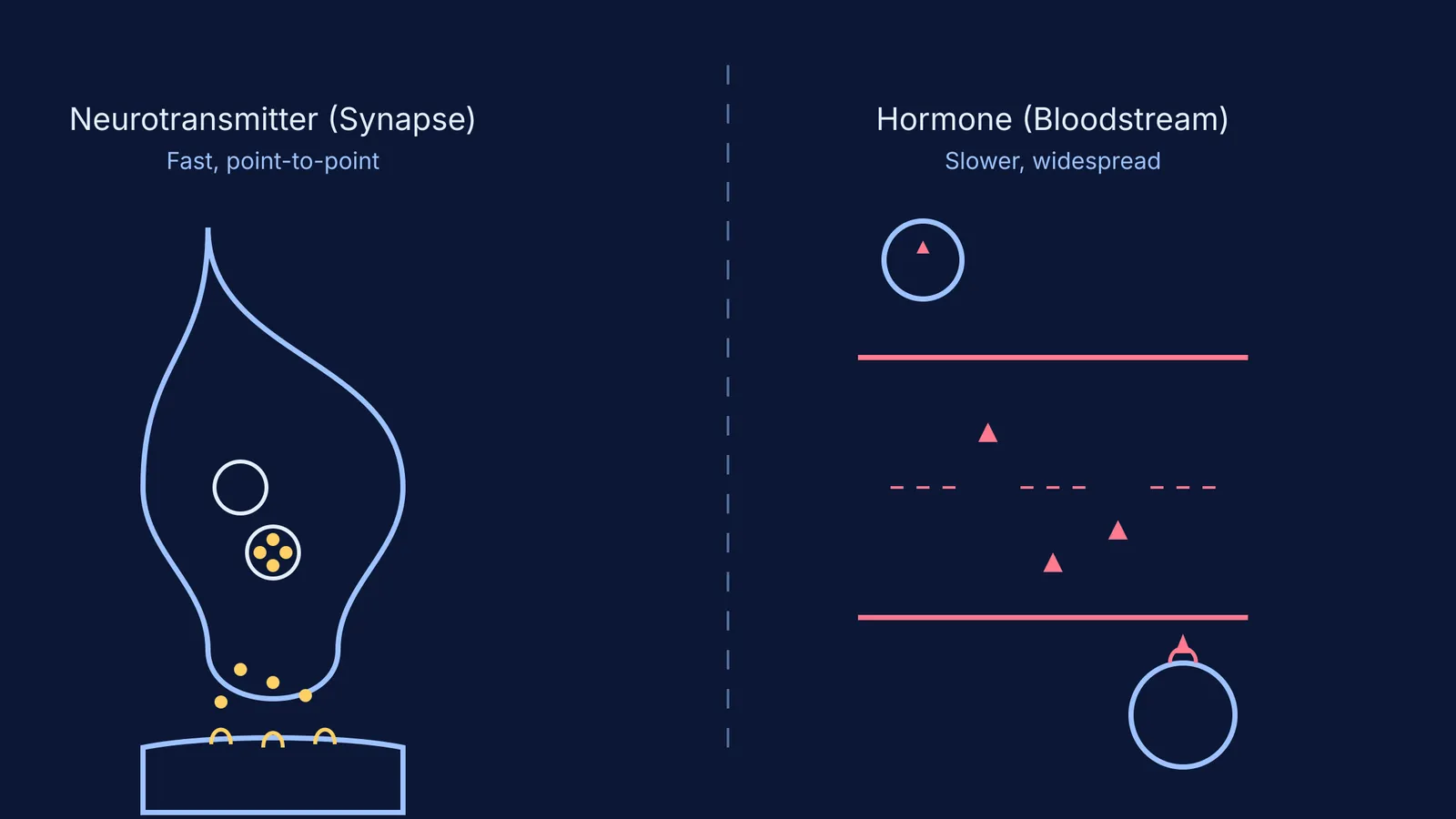
Neurotransmitters provide near-instantaneous communication. When you touch a hot stove, your nervous system must pull your hand away immediately. To do this, it uses neurotransmitters—molecules like acetylcholine or glutamate—that are released from a neuron and travel across a microscopic gap called a synapse. This gap is so small that the chemical crosses it in a fraction of a second. According to the NCERT Class 11 Biology curriculum, the neural system provides an organized network of point-to-point connections for this rapid coordination (Source). Because neurotransmitters act locally and are quickly broken down or reabsorbed, their effects are incredibly fast but short-lived. For a detailed look at this pathway, see our guide on the Nerve impulse, synapse and reflex arc.
Hormones act much more slowly. The endocrine system provides chemical integration by secreting hormones directly into the bloodstream (Source). Because they must travel through your circulatory system to find target cells, their effects take longer to fully develop. Their impact, however, is much longer-lasting. This extended duration is why you still feel your heart racing after a sudden fright, even though the immediate danger has passed.
Where do these messengers travel?
Neurotransmitters are like a direct, wired telephone call. The electrical signal travels along an axon and releases a chemical that only affects the specific, neighbouring cell—usually another neuron, a muscle fibre, or a gland. If you are struggling to picture the physical layout of these connections, exploring the Fermi Concept Library can help you visualise how axons and dendrites meet at a synapse without touching.
Hormones act more like a radio broadcast. Once an endocrine gland—such as the thyroid, pituitary, or pancreas—releases a hormone into the blood, the molecule washes throughout the entire body. However, it only affects cells that carry the specific receptor for it. You can learn more about this targeting in our article on How hormones act: membrane receptors vs intracellular receptors. This broadcast method allows a single hormone, like insulin, to simultaneously instruct your liver, muscles, and fat cells to absorb glucose from your blood.
Can a chemical be both a neurotransmitter and a hormone?
Yes, the distinction is based on how and where the chemical is used, rather than its molecular structure. Several molecules play dual roles in the body.
The classic examples are adrenaline (epinephrine) and noradrenaline. When released by neurons in the central nervous system, they act locally as neurotransmitters to increase alertness and focus. But when the adrenal glands secrete them into the bloodstream during a stressful event, they act as hormones to raise your heart rate, dilate your airways, and mobilise energy reserves system-wide. For a broader overview of these glands, review our summary of Chemical coordination for NEET.
Another example is oxytocin. It acts as a neurotransmitter in the brain to facilitate social bonding, but functions as a hormone in the bloodstream to stimulate uterine contractions during childbirth.
How can you classify a chemical signal?
If you are analysing a biological pathway for an exam and need to determine whether a signaling molecule is acting as a hormone or a neurotransmitter, ask yourself these three questions:
How is it transported? If it diffuses across a tiny synaptic cleft, it is a neurotransmitter. If it is carried by the blood, it is a hormone.
How fast does it work? If the response happens in a fraction of a second, it is a neurotransmitter. If the response takes longer to fully develop, it is a hormone.
How broad is the target? If it targets one specific adjacent cell, it is a neurotransmitter. If it targets multiple organs across the body simultaneously, it is a hormone.


