On this page
Most mistakes in this chapter come from ions going the wrong way. Students write that sodium leaves the axon during depolarisation, or that the sodium-potassium pump fires the impulse. This post traces one impulse step by step, explains synaptic transmission, sorts out where the reflex arc now sits in NCERT, and lists the brain facts that are asked most.
What does the syllabus include now?
The NEET (UG)-2026 syllabus lists "Neuron and nerves; Nervous system in humans-central nervous system, peripheral nervous system and visceral nervous system; Generation and conduction of nerve impulse". The current NCERT Class 11 chapter on neural control (reprint 2026-27) covers these, plus transmission across synapses and the parts of the brain. Reflex action and the reflex arc are not in that chapter; they are in NCERT Class 10 Science, Chapter 6, Control and Coordination. Check the syllabus for your exam year, and learn the reflex arc as background and for Class 10 boards.
How is the human neural system organised?
The CNS is the brain and spinal cord. The PNS is all the nerves connected to them.
Afferent fibres carry impulses to the CNS; efferent fibres carry them from it.
The somatic system serves skeletal muscle; the autonomic system serves involuntary organs and smooth muscle, and has sympathetic and parasympathetic parts.
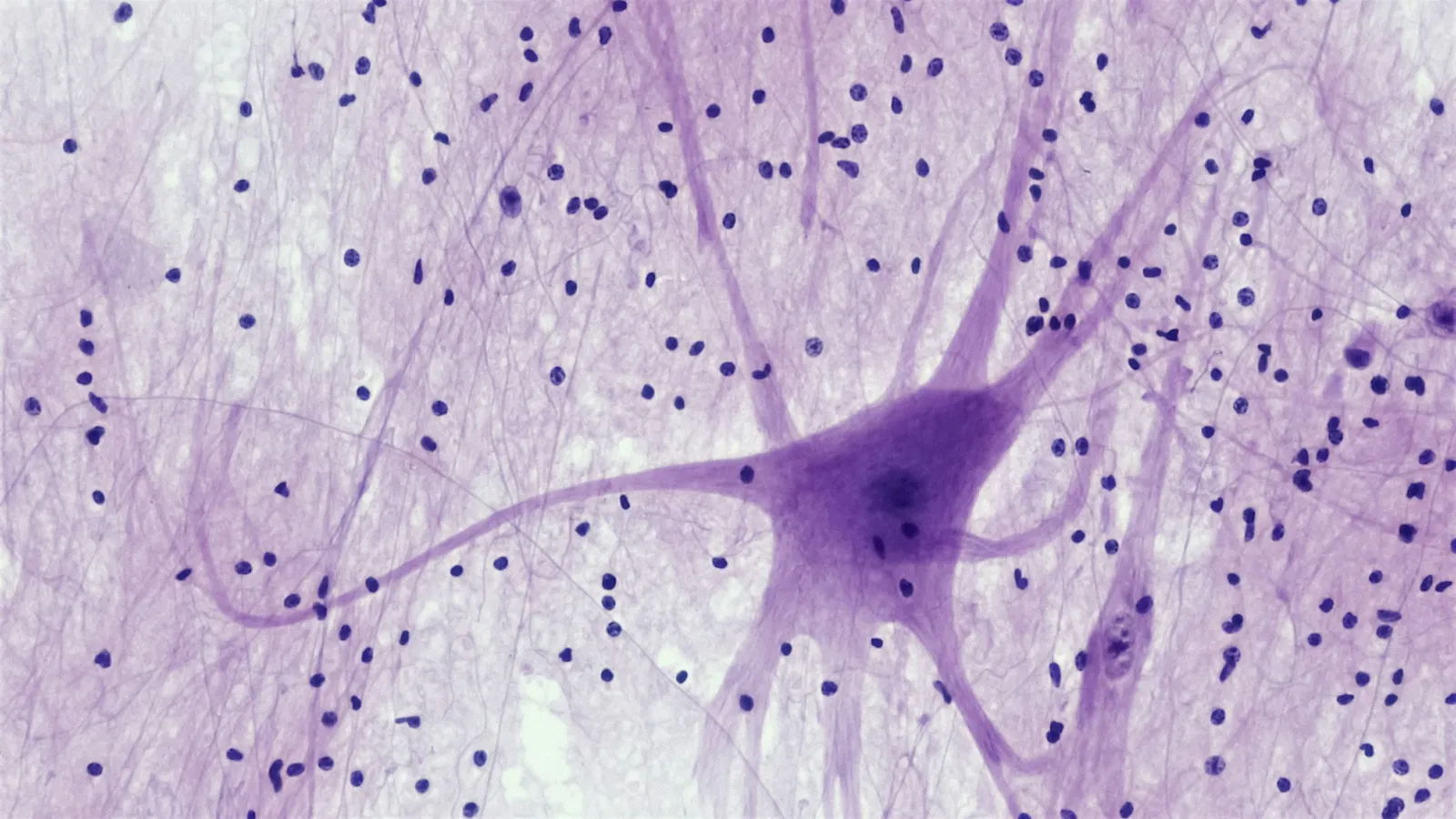
A neuron has a cell body with Nissl's granules, dendrites that carry impulses towards it, and an axon that carries them away to synaptic knobs.
Types: multipolar (cerebral cortex), bipolar (retina), unipolar (usually embryonic).
Myelinated fibres are wrapped by Schwann cells, with gaps called nodes of Ranvier; they are found in spinal and cranial nerves.
Why is a resting neuron polarised?
At rest, the axon membrane is fairly permeable to K+, nearly impermeable to Na+, and impermeable to the negatively charged proteins inside. So the axoplasm has high K+, negative proteins and low Na+, while the outside fluid has high Na+ and low K+. The sodium-potassium pump keeps these gradients by moving 3 Na+ out for every 2 K+ in. The outer surface ends up positive and the inner surface negative. That potential difference is the resting potential.
Worked example: tracing one impulse
Picture two points on an axon: A, where the stimulus lands, and B, just ahead.
At rest: A and B are both positive outside and negative inside.
Stimulus at A: the membrane becomes freely permeable to Na+. Na+ rushes in. The inside turns positive and the outside negative. This reversed potential is the action potential, the nerve impulse.
Current flows: on the inner surface, current flows from A to B; on the outer surface, from B to A. This depolarises B, and an action potential forms there.
Recovery at A: the rise in Na+ permeability is very short. K+ permeability then rises, K+ diffuses out, and A returns to its resting potential, ready for the next stimulus.
Repeat: the sequence moves along the axon, so the impulse is conducted.
Now the pump, with numbers. Each cycle moves 3 Na+ out and 2 K+ in, so one positive charge leaves per cycle. After 1,000 cycles: 3,000 Na+ out, 2,000 K+ in, and a net 1,000 positive charges out. The pump keeps the gradients; it is the opening of ion channels that produces the impulse.
Alan Hodgkin and Andrew Huxley gave the first quantitative description of membrane current in nerve (1952). With John Eccles they received the 1963 Nobel Prize "for their discoveries concerning the ionic mechanisms involved in excitation and inhibition" of the nerve cell membrane.
What happens at a synapse?
A synapse is formed by the membranes of a pre-synaptic and a post-synaptic neuron.
Electrical synapses: the membranes are very close and current flows directly. Transmission is always faster than at chemical synapses, but electrical synapses are rare in humans.
Chemical synapses: a fluid-filled synaptic cleft separates the membranes. When an impulse arrives, synaptic vesicles move to the membrane, fuse and release neurotransmitters. These bind receptors on the post-synaptic membrane, opening ion channels. The new potential may be excitatory or inhibitory.
Bernard Katz, Ulf von Euler and Julius Axelrod shared the 1970 Nobel Prize for discoveries about transmitters in nerve terminals and how they are stored, released and inactivated.
What is a reflex arc?
NCERT Class 10 explains that thinking about touching a flame would take too long, so the nerves that detect heat connect to the nerves that move muscles in a simpler way, in the spinal cord. The path in its figure is: heat or pain receptors in the skin, sensory neuron, relay neuron in the spinal cord, motor neuron, and the effector, a muscle in the arm. The information still reaches the brain.
Which brain facts get asked most?
Forebrain: cerebrum, thalamus and hypothalamus. The corpus callosum joins the two hemispheres. The cortex is grey matter.
Hypothalamus: controls body temperature and the urge to eat and drink.
Limbic system with the hypothalamus: emotions, motivation and sexual behaviour.
Midbrain: corpora quadrigemina; the cerebral aqueduct passes through it.
Hindbrain: pons (fibre tracts), cerebellum and medulla. The medulla controls respiration, cardiovascular reflexes and gastric secretions.
Brain stem: midbrain, pons and medulla.
Ion movements are easier to follow when you can watch them change. The Fermi Simulation Lab has interactive simulations for ideas that are easier to see than read.
A practice routine
Draw an axon with points A and B and annotate the five steps, with arrows for each ion.
Explain the chemical synapse aloud in six sentences without notes. Our guide to self-explanation shows how to do this well.
Draw the reflex arc and label all five parts.
Make a card for each brain region with its functions, and test yourself in mixed order.
Continue to locomotion and muscle contraction, where the impulse reaches the muscle.
Today, write the five impulse steps from memory and mark which ion moves in each.