

On this page
Most students learn the action potential as a graph to copy: a flat line, a sharp peak, a dip. The graph makes much more sense once you have made one happen yourself. A neuron simulation lets you poke a virtual axon and watch the ions move. It works best if you predict before you click. This guide gives you the facts you need and then five test runs.
What happens when you stimulate a neuron?
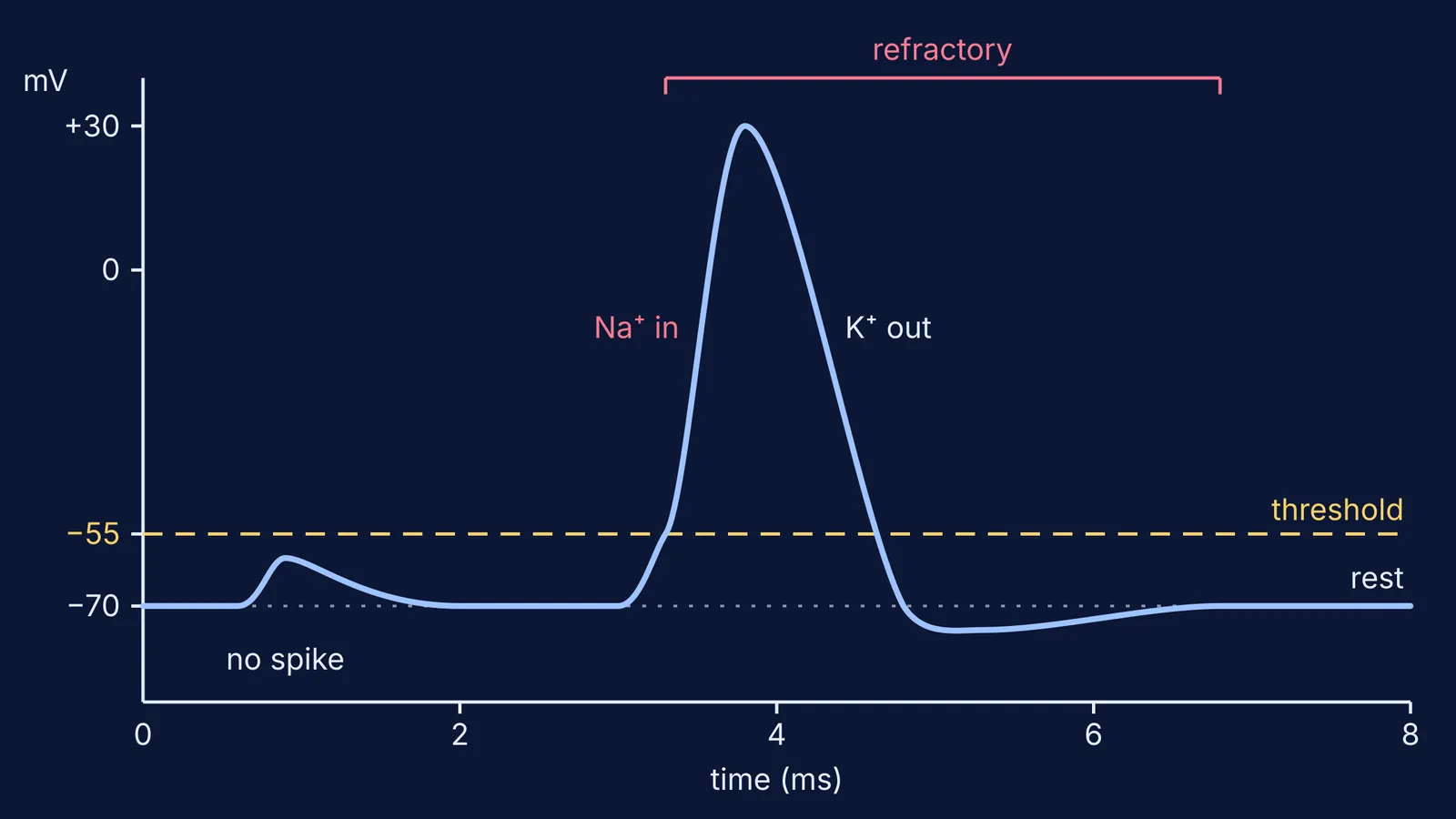
A resting neuron is negative inside. OpenStax Biology puts it at about 70 millivolts more negative inside than outside, or −70 mV (OpenStax Biology 2e, 35.2). The sodium-potassium pump keeps that gradient going: it moves three Na⁺ ions out and two K⁺ ions in for each ATP it uses (same source).
A stimulus pushes the inside of the cell less negative. That is called depolarisation. If the voltage reaches the threshold of about −55 mV, voltage-gated sodium channels open (OpenStax Anatomy and Physiology 2e, 12.4). Sodium rushes in, and the membrane climbs to roughly +30 mV. OpenStax Biology gives about +40 mV, so expect the exact peak to vary between books and simulations. According to the Anatomy and Physiology text, the whole sequence takes about 2 milliseconds.
The mathematics behind this came from Alan Hodgkin and Andrew Huxley. They published their equations for membrane current in nerve in 1952 (The Journal of Physiology, 117: 500–544). They shared the 1963 Nobel Prize in Physiology or Medicine with John Eccles "for their discoveries concerning the ionic mechanisms involved in excitation and inhibition" in nerve cells (NobelPrize.org). Our step-by-step guide to nerve impulses, synapses and reflex arcs sets this in the context of the whole nervous system.
Why is the action potential all-or-none?
In the words of OpenStax: "Either the membrane reaches the threshold and everything occurs as described above, or the membrane does not reach the threshold and nothing else happens" (OpenStax A&P 2e, 12.4).
The reason is positive feedback. Once sodium starts coming in, the membrane depolarises further. That opens more sodium channels, which lets in more sodium. Past the threshold, the spike drives itself, so a bigger stimulus does not make a taller spike. A stimulus that stops short of threshold just fades away.
What do sodium and potassium channels do during a spike?
The two kinds of channel have different timing, and that difference shapes the spike (OpenStax A&P 2e, 12.4):
Sodium channels have two gates. The activation gate opens at −55 mV. The inactivation gate closes a fraction of a millisecond later, so the sodium inflow stops.
Potassium channels have one gate and open more slowly. K⁺ flows out and brings the voltage back down.
The undershoot. Potassium keeps leaving for a moment after the membrane is back at rest, so the membrane briefly becomes more negative than rest (hyperpolarises).
Absolute refractory period. While the sodium channels are inactivated, no new action potential can start, however strong the stimulus.
Relative refractory period. After that, a new action potential can start, but only with a stronger stimulus than usual.
One common mix-up: the pump does not make the spike. Channels make the spike. The pump keeps the gradients in place over time.
How do you use a neuron simulation to test yourself?
The free PhET Neuron simulation from the University of Colorado Boulder has a "Stimulate Neuron" button and shows sodium and potassium moving through their channels. Any simulation with a voltage chart will do. For each run, write your prediction first, then click.
Baseline. Predict the reading before you touch anything. (About −70 mV, flat.)
One stimulus. Predict the order of events. (Na⁺ flows in first, then K⁺ flows out, then a brief dip below rest.)
Slow it down. Pause the run at the peak. Predict which channels are open. (Sodium channels are closing because the inactivation gate has shut. Potassium channels are opening.)
Double stimulus. Stimulate again just after the peak, while the voltage is still falling. Predict the result. (Expect no second spike: the sodium channels are still inactivated. This is the absolute refractory period.)
Wait, then stimulate. Wait until the trace is back at rest and stimulate again. Predict the height. (The same height as the first spike: all-or-none.)
If a prediction was wrong, write one sentence saying why before you move on. Our look at the research on simulations versus static diagrams found that motion on its own is not what helps. Control and prediction are.
You can run more experiments like this in the Fermi Simulation Lab. It has interactive simulations for ideas that are easier to see than to read. If one step still feels shaky, the Fermi Concept Library has a lesson for each concept in biology.
For a sense of how fast these signals travel along a nerve, read how Hermann Helmholtz first measured nerve speed.


