

On this page
Your textbook calls the pituitary the "master gland", but the pituitary takes orders from the brain just above it. The man who proved this, and showed how the orders travel, was the British physiologist Geoffrey Harris (1913–1971), often called the father of neuroendocrinology (Wikipedia biography). His answer was not nerves. It was blood.
What did Geoffrey Harris discover?
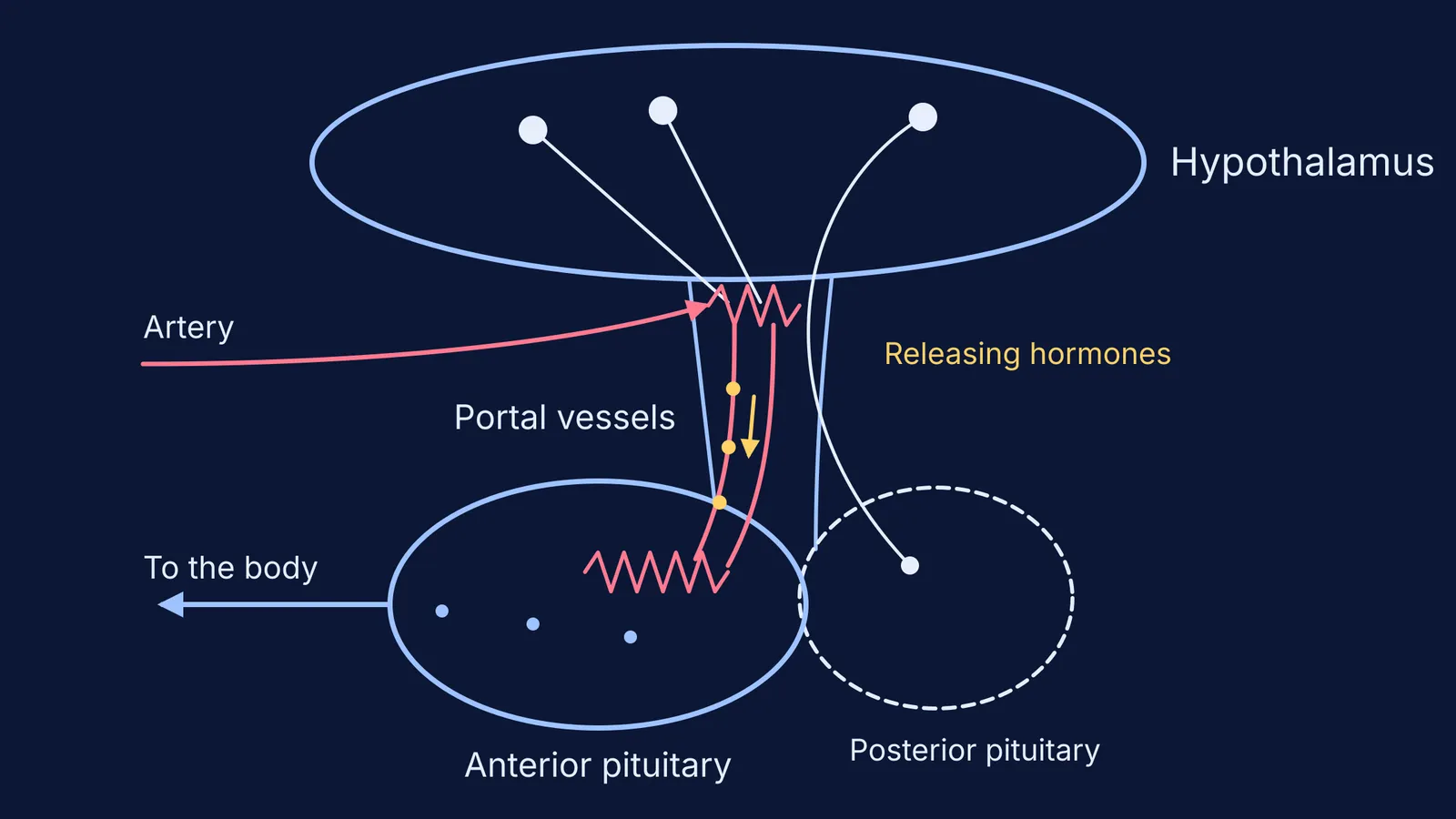
Harris showed that nerve cells in the hypothalamus release chemical substances into a small set of blood vessels, the hypophysial portal vessels, which carry them straight to the anterior pituitary. So says a 2015 review by George Fink in the Journal of Endocrinology, which also notes that Harris worked "alone and in collaboration with John Green and Dora Jacobsohn" through the 1940s and early 1950s.
This joined two control systems that had looked separate: fast nerve signals and slower hormones in blood. Harris found where the brain turns one into the other.
What are the hypophysial portal vessels?
A portal system links two capillary networks in series. In this one, arteries feed a first capillary network in the median eminence at the base of the hypothalamus, portal veins run down the pituitary stalk, and a second capillary network supplies the anterior pituitary (overview of the hypophyseal portal system).
Others saw these vessels first. A 1933 paper in the Journal of Anatomy, reproduced by UNSW Embryology, records that Popa and Fielding described "hypophysio-portal veins" in 1930 and thought they carried material up from the pituitary to the brain. George Wislocki and Lester King studied the same blood supply in 1936. Direction mattered: upward flow would make the vessels a drain, downward flow a message line. Green and Harris published direct observations of the portal vessels in living rats in 1949, and the hypothalamus-to-pituitary direction became the basis of Harris's theory.
What experiments proved the hypothalamus controls the pituitary?
Harris built the case in three steps.
The brain can trigger the pituitary. In 1937 Harris induced ovulation in rabbits by electrical stimulation of the hypothalamo-hypophysial mechanism. As his paper notes, rabbits normally ovulate only after "some form of sexual excitement", so a brain signal had to be reaching the pituitary somehow.
The signal travels in blood. Harris gathered the evidence in a 1948 review, Neural control of the pituitary gland, backed by the 1949 portal vessel observations.
Position is everything. Harris and Dora Jacobsohn placed pituitary grafts at three sites in rats whose own pituitary had been removed (Proceedings of the Royal Society B, 1952). Grafts under the median eminence connected to the portal vessels, and many of them in female rats had normal function, with "oestrous cycles, pregnancy, milk secretion". Grafts at the other two sites were not supplied by the portal system and had greatly diminished function, if any.
How were the hypothalamic releasing hormones finally found?
Harris predicted the messengers but could not isolate them. That took Roger Guillemin and Andrew Schally, who shared half of the 1977 Nobel Prize "for their discoveries concerning the peptide hormone production of the brain" (Nobel Prize summary).
The Nobel press release describes the scale of the hunt. Each lab worked with 5 million hypothalamic fragments, Guillemin from sheep and Schally from pigs. They ended up with 1 mg of a pure substance, TRF, that released TSH from the pituitary. The nature of these factors was established in 1969, and TRF turned out to be a small peptide of three amino acids.
How can you use Harris's method to answer exam questions?
Exam questions on the hypothalamus–pituitary axis can describe an experiment and ask what it shows. Read any such question with four checks, the way Harris built his case:
What was changed? (graft position, a cut stalk, a stimulus)
What stayed the same? (same tissue, same animals)
What was measured? (ovulation, oestrous cycles, gland histology)
What is the only explanation left? (control arrives through portal blood)
Worked example: "A pituitary is moved to a site far from the hypothalamus. Its output of TSH falls. Why?" Answer: the gland still exists, but it is cut off from the portal blood that brings releasing hormones such as TRH. That is the 1952 graft logic.
Then extend the chain one step at a time: hypothalamus (releasing hormone) → anterior pituitary (a stimulating hormone such as TSH) → target gland → effect. Our explainer on hormonal feedback loops shows how feedback along this chain keeps hormone levels steady. For the full list of glands, see chemical coordination for NEET, and for where hormone research began, read about Bayliss, Starling and secretin.
If the glands blur together, the Fermi Concept Library gives each biology concept its own lesson and shows its place in the map, so you can see how the ideas connect. When you're not sure where to start with the endocrine chapter, Fermi's AI tutor works out what you already know and builds a plan for the session.
Next time you draw the pituitary, add the portal vessels and an arrow pointing down. That arrow is what Harris discovered.


