

On this page
"Find k for which the equation has equal roots" is a staple of Class 10 maths. The method takes three lines. Marks are lost in a fourth line most students skip: checking that the equation is still quadratic once k is put back in.
What does "equal roots" mean for a quadratic?
The NCERT Class 10 chapter on quadratic equations defines a quadratic equation as one of the form ax² + bx + c = 0, where a, b and c are real numbers and a ≠ 0 (NCERT, Chapter 4).
The same chapter calls b² − 4ac the discriminant and states that the equation has two equal real roots if b² − 4ac = 0, two distinct real roots if it is positive, and no real roots if it is negative (NCERT, Section 4.4).
When the discriminant is zero, the ± in the quadratic formula adds nothing, so both roots equal −b/2a. On a graph, the parabola just touches the x-axis. For a refresher on the formula, see our guide to quadratic equations in Class 10: factorisation, formula and roots.
How do you find k for equal roots?
Four steps, every time:
Expand and rearrange into the standard form ax² + bx + c = 0. Write a, b and c in terms of k.
Set b² − 4ac = 0.
Solve that equation for k.
Put each value of k back into a. Reject any k that makes a = 0, because then the equation is no longer quadratic.
NCERT itself warns that an equation can look quadratic but turn out not to be, so simplify before deciding (NCERT, Example 2 remark).
Worked example: kx(x − 2) + 6 = 0
This is Question 2(ii) of NCERT Exercise 4.3, which asks for the values of k that give two equal roots (NCERT, Exercise 4.3).
Expand: kx² − 2kx + 6 = 0, so a = k, b = −2k, c = 6.
Discriminant: (−2k)² − 4(k)(6) = 4k² − 24k = 4k(k − 6).
Set it to zero: k = 0 or k = 6.
Check a: if k = 0, the equation becomes 6 = 0, which has no x in it at all. Reject k = 0.
Answer: k = 6. The equation is 6x² − 12x + 6 = 0, or 6(x − 1)² = 0, so both roots are 1.
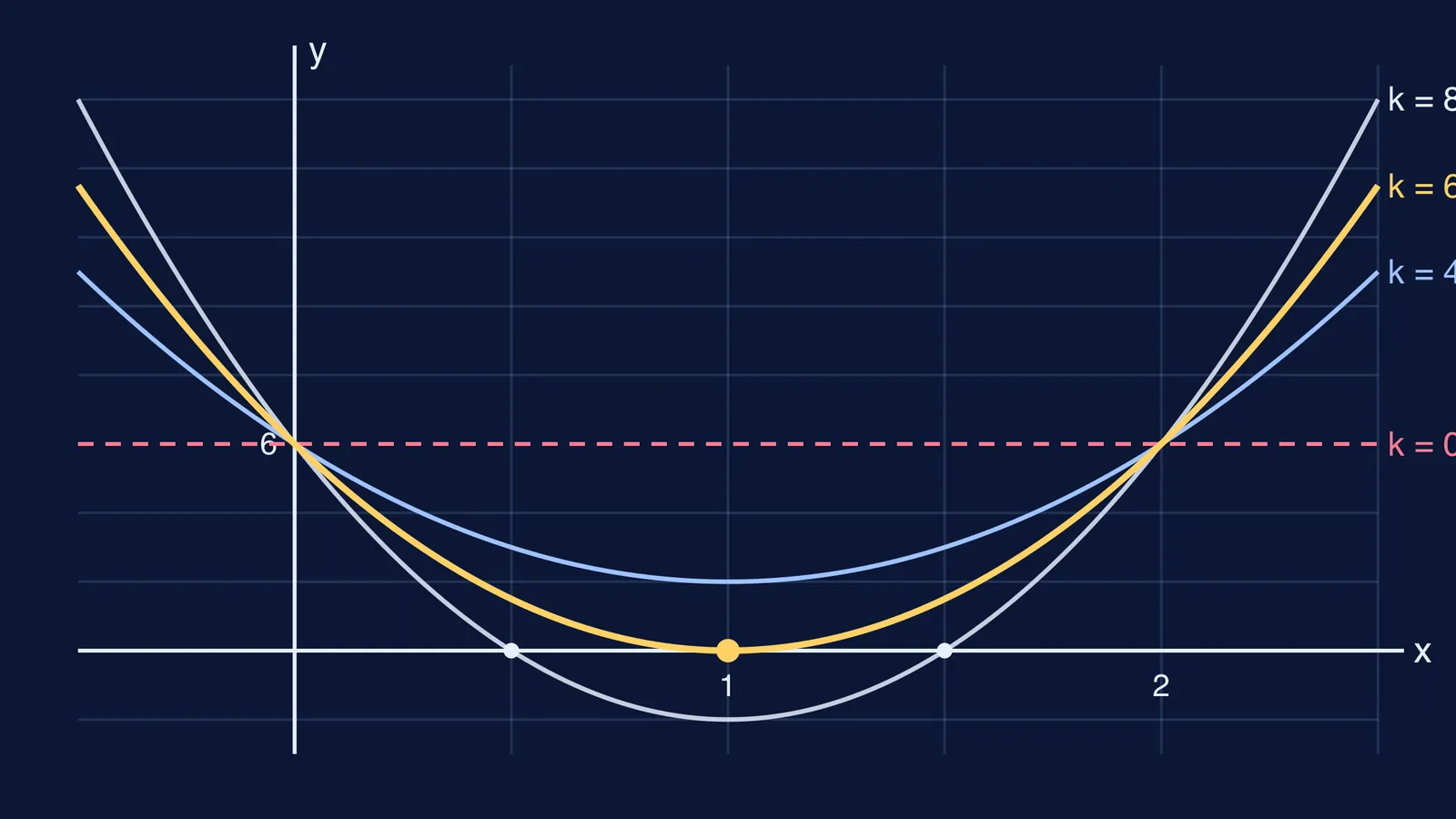
The diagram above shows this family: at k = 6 the parabola touches the x-axis at x = 1, at k = 4 it misses, at k = 8 it crosses twice, and at k = 0 it is only the flat line y = 6.
A second example, where nothing is rejected: Question 2(i) of the same exercise is 2x² + kx + 3 = 0 (NCERT, Exercise 4.3). Here a = 2, b = k, c = 3, so k² − 24 = 0 and k = ±2√6. Since a = 2 never depends on k, both values stand. The repeated root is −k/4, which is −√6/2 or √6/2.
Why must you check that the coefficient of x² is not zero?
Try (k − 12)x² + 2(k − 12)x + 2 = 0. The discriminant is 4(k − 12)² − 8(k − 12), which factorises as 4(k − 12)(k − 14). Setting it to zero gives k = 12 or k = 14.
Put k = 12 back in and the equation reads 2 = 0, which is not an equation in x at all. Only k = 14 works: 2x² + 4x + 2 = 0, which is 2(x + 1)² = 0, so both roots are −1.
Whenever k sits inside a, ask "Can this be zero?" before writing the answer. If a step goes wrong and you cannot see where, the Fermi Problem Library has worked problems with a step-by-step solver that explains the reasoning rather than printing an answer.
How can you check your answer quickly?
Substitute your k and see whether the expression becomes a constant times a perfect square, as in 6(x − 1)² or 2(x + 1)². If it does, the roots really are equal.
Related questions use the same discriminant idea. Some ask you to prove the roots are real for all values of k, and others start where the discriminant is negative, as in solving x² + x + 1 = 0 with complex roots.
Practice set
(k + 1)x² − 2(k − 1)x + 1 = 0
x² − 2kx + 7k − 12 = 0
Answers: for the first, the discriminant is 4(k² − 3k), so k = 0 or k = 3. Both keep a non-zero, giving roots −1 and 1/2. For the second, it is 4(k − 3)(k − 4), so k = 3 or k = 4, with roots 3 and 4.
If the discriminant itself still feels shaky, revise why b² − 4ac decides the nature of roots in the Fermi Concept Library, where each concept in mathematics has its own lesson, then redo this set without looking at the answers.


