

On this page
"Show that the roots are real for all values of k" looks impossible at first: k could be any real number. You don't check them all. You show that one expression, the discriminant, can never drop below zero.
What does "real for all values of k" actually ask?
For ax² + bx + c = 0 with real coefficients, the discriminant is b² − 4ac, the expression under the square root in the quadratic formula (OpenStax College Algebra 2e).
If the discriminant is positive there are two distinct real roots, if it is zero there is one repeated real root, and if it is negative there are no real roots (Discriminant, Wikipedia).
So "real for all k" means D(k) ≥ 0 for every real k; "real and distinct" needs D(k) > 0.
How do you show the discriminant is never negative?
Use the same three steps every time.
Write a, b and c in terms of k, then expand D = b² − 4ac fully.
Rearrange D into a perfect square, or a sum of squares (possibly plus a positive number).
Conclude: squares are never negative, so D ≥ 0 for every k. If a positive constant is added, D > 0 and the roots are distinct.
Worked example 1: a perfect square
Take x² − (k + 2)x + 2k = 0. Here a = 1, b = −(k + 2) and c = 2k.
D = (k + 2)² − 8k = k² + 4k + 4 − 8k = k² − 4k + 4 = (k − 2)².
Since (k − 2)² ≥ 0, the roots are real for every k, and equal only when k = 2. Check: the equation factorises as (x − 2)(x − k) = 0, so the roots are 2 and k.
Worked example 2: a square plus a positive number
Take x² + kx + (k − 2) = 0. Here a = 1, b = k and c = k − 2.
D = k² − 4(k − 2) = k² − 4k + 8 = (k − 2)² + 4.
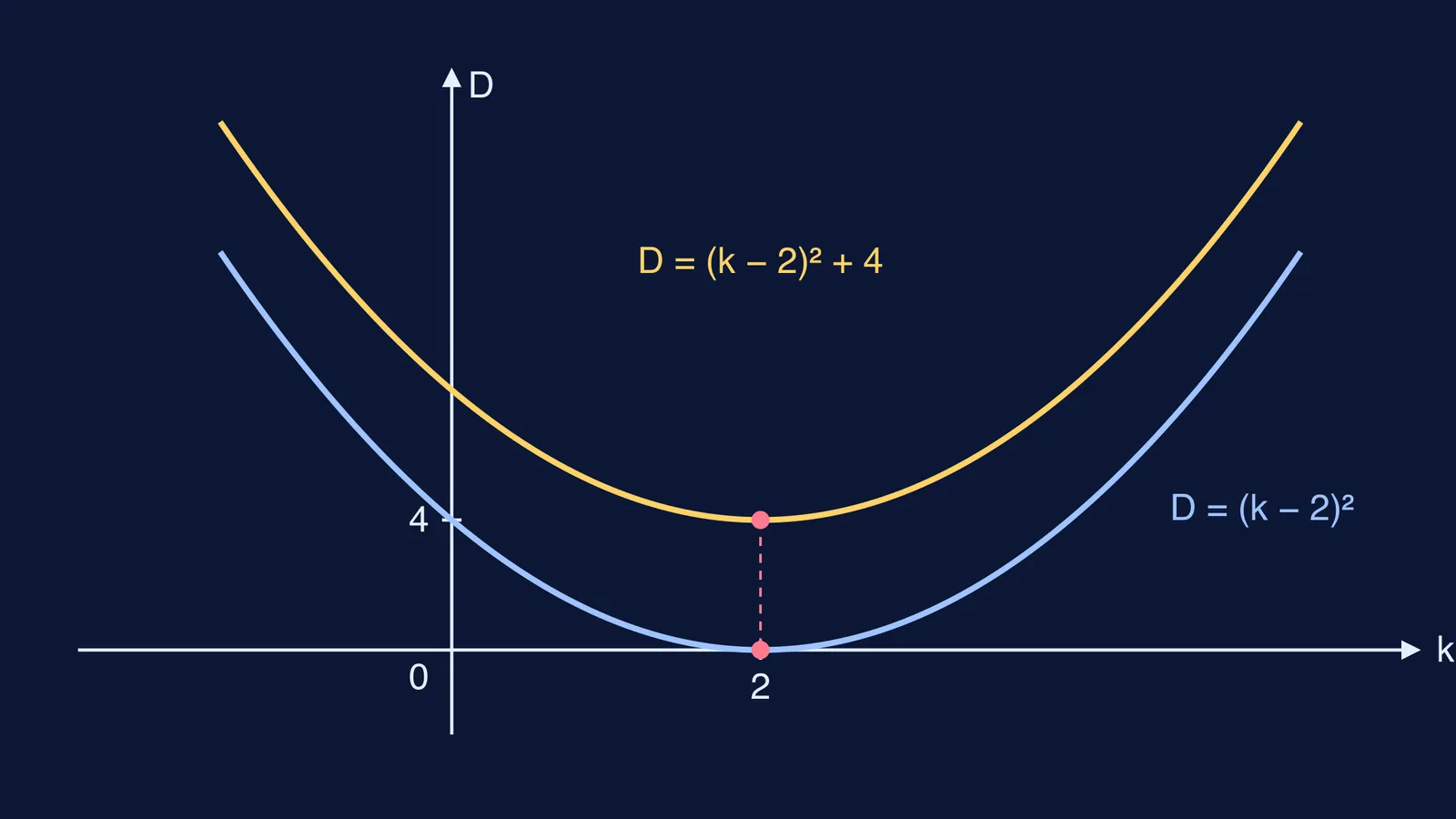
The smallest value of D is 4, at k = 2, so D > 0 for every k. The roots are real and distinct for all values of k. The diagram above plots both discriminants: (k − 2)² touches zero, while (k − 2)² + 4 never reaches the axis.
Worked example 3: a sum of three squares
Prove that the roots of (x − a)(x − b) + (x − b)(x − c) + (x − c)(x − a) = 0 are real for all real a, b and c.
Expanding gives 3x² − 2(a + b + c)x + (ab + bc + ca) = 0.
D = 4(a + b + c)² − 12(ab + bc + ca) = 4(a² + b² + c² − ab − bc − ca) = 2[(a − b)² + (b − c)² + (c − a)²].
Each bracket is a square, so D ≥ 0, with D = 0 only when a = b = c. The same move appears in when a quadratic expression is a perfect square.
What if the discriminant will not turn into squares easily?
If D is itself a quadratic in k, say D = pk² + qk + r, apply the discriminant rule a second time. When p > 0 and q² − 4pr < 0, D has no real zeros in k, so it stays positive for every k. In example 2, p = 1, q = −4 and r = 8, so q² − 4pr = 16 − 32 = −16, which confirms the result. Completing the square still makes the cleaner written answer, because it shows the reason in one line.
One more trap: if k appears in the coefficient of x², for example (k − 1)x² + 2kx + 1 = 0, then at k = 1 the equation is no longer quadratic. Deal with that value separately before using D.
If you can follow the algebra but don't know where to begin on a new version, the Fermi Problem Library has worked problems with a step-by-step solver that explains the reasoning rather than printing an answer.
Which mistakes cost marks on these questions?
Trying k = 0, 1 and 2 and stopping there. Examples are not a proof for all k.
Expanding (k + 2)² as k² + 4 and losing the 4k term.
Writing "D > 0" when D can equal zero, as in example 1 at k = 2.
Forgetting that the coefficient of x² may become zero for some k.
Ending without a sentence. Write "Since D = (k − 2)² ≥ 0 for all real k, the roots are real for all k."
If completing the square itself feels shaky, review it in the Fermi Concept Library, which has a lesson for every concept in mathematics. Then try the related problems on roots of a quadratic in a given ratio and finding α⁵ + β⁵ without solving the quadratic.


