

On this page
Algebra exams often ask you to find an unknown constant k that makes a quadratic expression a perfect square. You do not need to guess factors or complete the square manually. You only need one test: the discriminant.
What is the condition for a perfect square?
For a standard quadratic expression ax² + bx + c, the discriminant is defined as D = b² − 4ac.
The expression is a perfect square if and only if its discriminant equals zero (D = 0).
When you set b² − 4ac = 0, you are checking if the expression can be bundled into a single squared bracket, like (x − 3)² or 4(x + 5)². This means the quadratic has no leftover linear terms or constants outside the squared term.
Why does D = 0 make it a perfect square?
The roots of the equation ax² + bx + c = 0 tell you where the parabola crosses the x-axis. The quadratic formula finds these roots by adding and subtracting the square root of the discriminant.
When D > 0, you add and subtract a real, positive number. You get two distinct roots, so the parabola crosses the axis twice.
When D < 0, you cannot take the real square root. There are no real roots, and the parabola floats above or below the axis. This is the condition for the quadratic to be always positive or always negative.
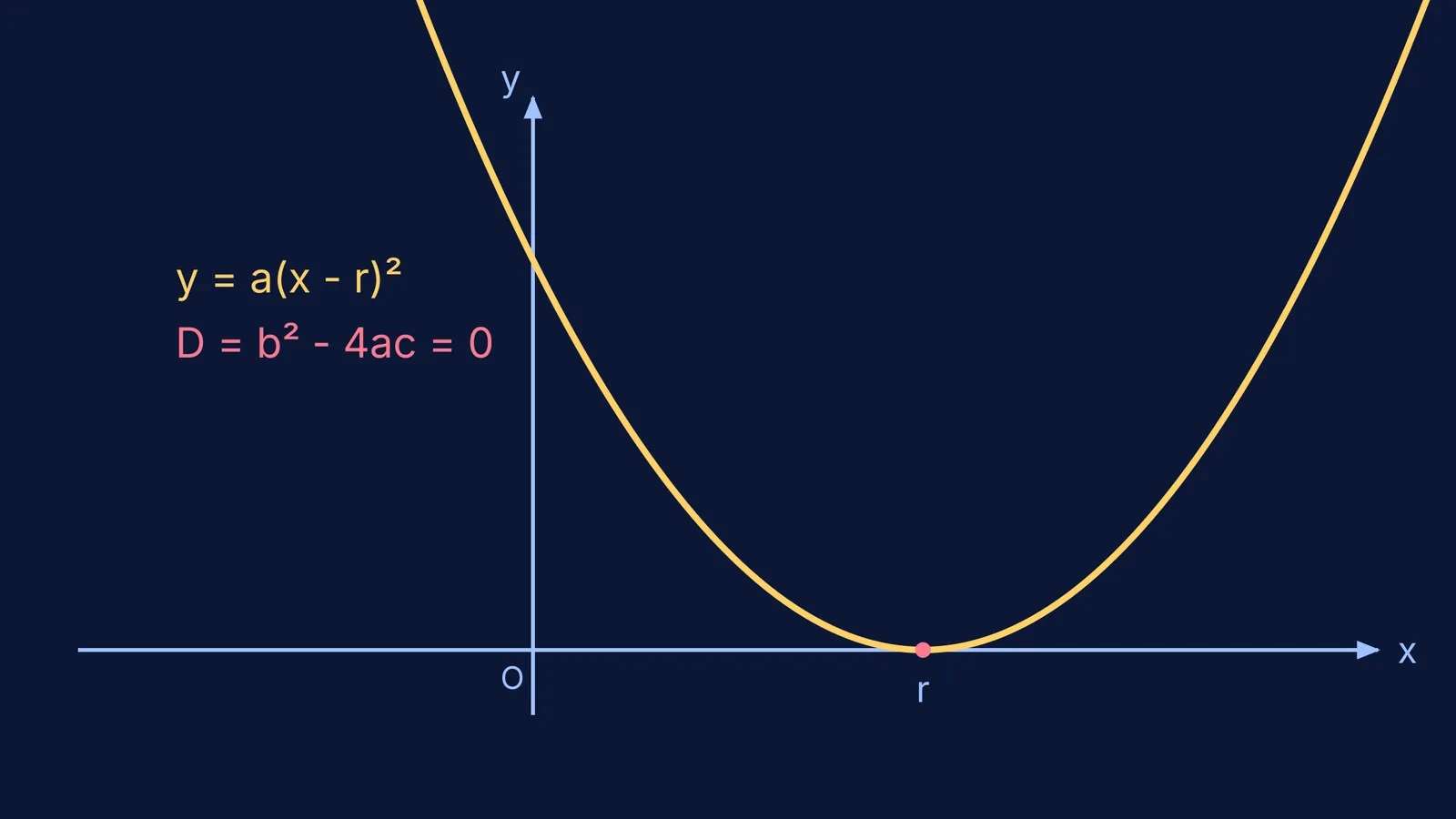
When D = 0, the square root vanishes. You add and subtract zero, leaving exactly one repeated root at x = −b / 2a.
Geometrically, a single real root means the parabola touches the x-axis at exactly one point (its vertex) without crossing it. Algebraically, having one repeated root r means the expression factors to a(x − r)². By definition, an expression that can be written entirely as a constant multiplied by a squared binomial is a perfect square.
If you have concept gaps regarding roots or the discriminant, the Fermi Concept Library covers every concept in physics, chemistry, biology, mathematics and computing, each with its own lesson and its place in the map.
How do you solve find-k questions?
Questions usually give you an expression with a missing coefficient and tell you it is a perfect square. You can solve them in four reliable steps.
Example: For what value of k is 4x² − 12x + k a perfect square?
Identify the coefficients from the expression: a = 4, b = −12, and c = k.
Set the discriminant to zero: b² − 4ac = 0.
Substitute the values you found: (−12)² − 4(4)(k) = 0.
Solve for the unknown: 144 − 16k = 0, which means 16k = 144, giving k = 9.
If you substitute k = 9 back into the original expression, it becomes 4x² − 12x + 9. You can factor this neatly to (2x − 3)². You will see this algebraic pattern repeatedly in quadratic word problems in Class 10 and in coordinate geometry.
If you make wrong-method mistakes setting up or solving these equations, the Fermi Problem Library has worked problems with a step-by-step solver that explains the reasoning rather than printing an answer.
When is a two-variable quadratic a perfect square?
Sometimes you will face a general two-variable quadratic: ax² + 2hxy + by² + 2gx + 2fy + c.
For this long expression to be a perfect square of a linear expression — meaning it can be factored entirely into the form (lx + my + n)² — several conditions must line up perfectly:
The second-degree terms (ax² + 2hxy + by²) must form a perfect square themselves, which requires h² = ab.
The linear terms must match the square roots of the quadratic coefficients, requiring g² = ac and f² = bc.
Finally, the cross-multiplied signs must align, requiring gh = af.
When all these conditions hold, the expression represents two coincident straight lines in coordinate geometry. This is a special, stricter case of the standard determinant rule, where similar conditions are used to test when two quadratics share a root or when a general equation represents a pair of distinct lines.
How can you check your work quickly?
When you finish a problem, you can verify your answer by looking at the first and last terms.
If the expression is a perfect square (px + q)², it expands to p²x² + 2pqx + q².
The first term (a) must be a perfect square number (like 1, 4, 9, 16) if the coefficients are integers.
The last term (c) must also be a perfect square.
The middle term (b) must be plus or minus double the product of their principal square roots: b = ± 2 × √a × √c.
In our earlier example of 4x² − 12x + 9, we can see that a = 4 (which is 2²) and c = 9 (which is 3²). The middle term is −12, which matches −(2 × 2 × 3). This quick mental check confirms that D = 0 did its job and you have found the correct constant.


