

On this page
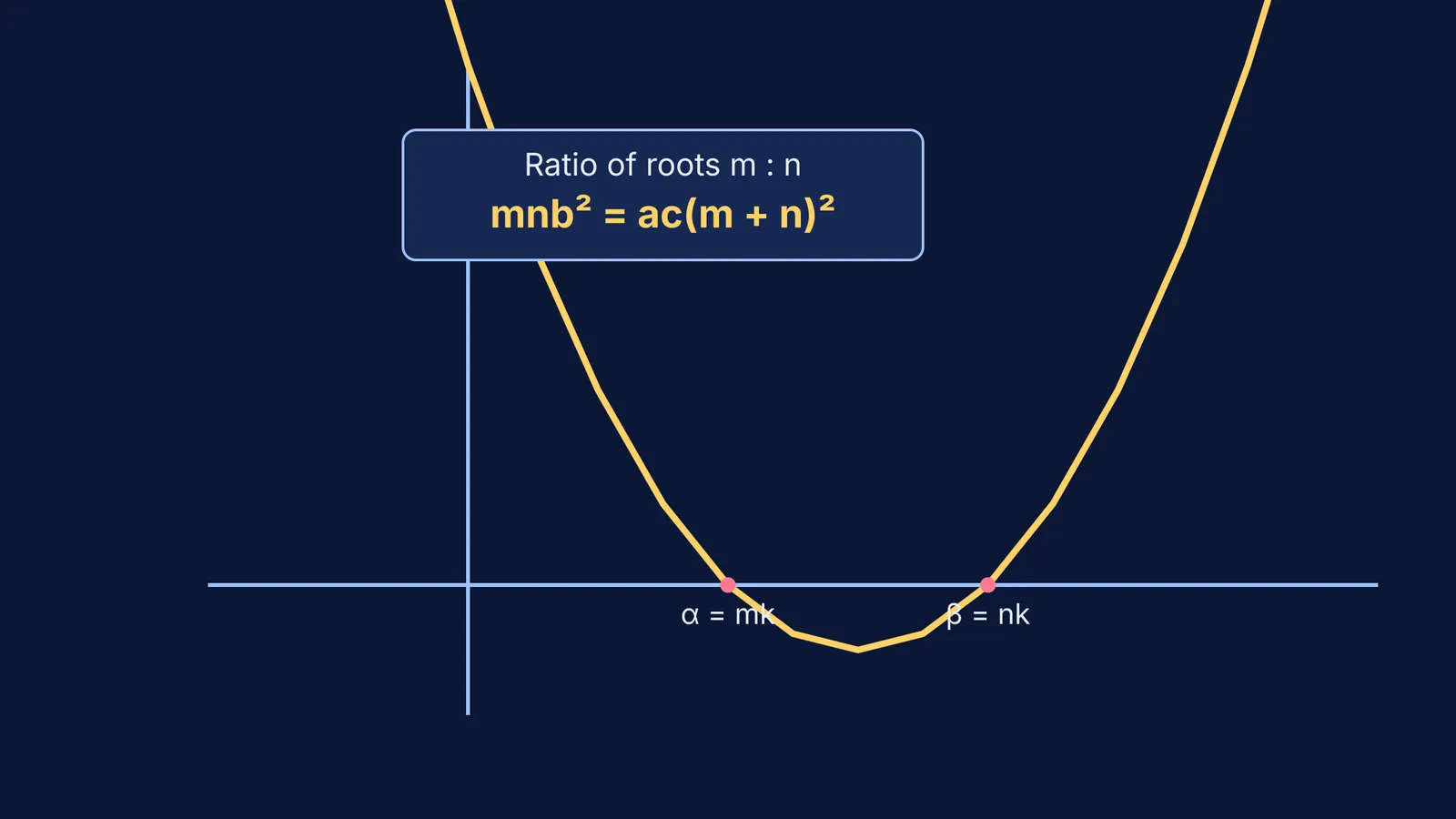
What happens when you are given a quadratic equation like ax² + bx + c = 0 and told its roots are in a specific ratio, say 2:3 or m:n? The exam question usually asks for the algebraic relation between the coefficients a, b, and c.
Instead of solving for the roots directly using the quadratic formula, we can use the sum and product of the roots. This approach gives us a clean condition: mnb² = ac(m + n)².
How to derive the condition for roots in the ratio m to n?
Let the roots of the quadratic equation be α and β. Since we are told the ratio is m:n, we can write the roots as:
α = mk
β = nk
where k is a common multiplier.
First, we write down the sum of the roots: α + β = -b/a mk + nk = -b/a k(m + n) = -b/a
From this, we isolate k: k = -b / (a(m + n)) ... (Equation 1)
Next, we use the product of the roots: α × β = c/a (mk)(nk) = c/a mnk² = c/a ... (Equation 2)
Now, substitute the value of k from Equation 1 into Equation 2: mn [ -b / (a(m + n)) ]² = c/a mn [ b² / (a²(m + n)²) ] = c/a
Multiply both sides by a²(m + n)² to clear the denominators: mnb² = ac(m + n)²
This algebraic condition for roots in a ratio is a standard problem in the CBSE Class 10 maths syllabus.
How do you test the formula with a worked example?
Let's test this derived condition with a real quadratic equation. Suppose we want an equation where the roots are 1 and 2.
The ratio of the roots is 1:2, so we set m = 1 and n = 2. The quadratic equation with roots 1 and 2 is (x - 1)(x - 2) = 0, which expands to x² - 3x + 2 = 0. Here, the coefficients are a = 1, b = -3, c = 2.
Let's check both sides of our condition mnb² = ac(m + n)²:
Left side (mnb²): 1 × 2 × (-3)² = 2 × 9 = 18
Right side [ac(m + n)²]: 1 × 2 × (1 + 2)² = 2 × 3² = 18
Both sides equal 18. The condition holds perfectly. If you are ever asked to quickly check whether a complex number is purely real or evaluate cube roots by prime factorisation, substituting a simple example like this is a great habit to confirm your formulas.
Getting unstuck with Fermi
Algebra problems often involve setting up a few equations and substituting one into another. If you drop a negative sign or square a bracket incorrectly, you can easily spend twenty minutes hunting for the mistake.
If you bring a problem like this to the Fermi Problem Library, the AI tutor does not just print the final derived formula. Instead, it works alongside you step by step. If you write down the sum of roots but get stuck on the substitution, Fermi's AI tutor will ask you what you should replace k with, checking your reasoning as you go.
What are three tips for ratio questions in quadratics?
Eliminate the constant: The core trick for all these problems is introducing a variable like k to represent the roots, and then using the sum and product to eliminate it. This works identically when dividing an amount in a given ratio.
Watch the squares: The most common algebraic mistake is forgetting to square the entire denominator a(m + n) when substituting k into the product equation.
Test with 1:1: If you ever forget whether the (m + n)² goes with ac or b², substitute m = 1 and n = 1. You know equal roots require b² = 4ac, which immediately tells you the (m + n)² (which equals 4) must sit next to ac.


