

On this page
In 1801, Carl Friedrich Gauss formally proved the fundamental theorem of arithmetic: every integer greater than 1 is either a prime itself or a unique product of prime numbers (Wikipedia). Because this prime fingerprint is unique, you can use it to rebuild numbers, spot perfect squares, or systematically find roots without guessing.
When dealing with perfect cubes, this prime factorisation method acts as a reliable filter. By breaking a number down into its core building blocks and grouping identical primes in threes, you can immediately see if a number is a cube, what its root is, and exactly what is missing if it falls short.
If prime factorisation feels like guesswork, the Fermi Concept Library offers lessons on divisibility rules and other mathematical concepts.
How do you find a cube root by prime factorisation?
To find the cube root of a number, you must write it as a product of its prime factors and group identical primes into triplets.
Because cubing a number means multiplying it by itself three times (x × x × x), every prime factor in a perfect cube must appear in a group of three. By picking one prime from each of these triplets and multiplying them together, you arrive at the cube root.
Take the number 216 as an example:
Divide 216 by the smallest possible prime, which is 2, to get 108.
Continue dividing by 2: 108 ÷ 2 = 54, and 54 ÷ 2 = 27.
Since 27 is no longer divisible by 2, move to the next prime, which is 3: 27 ÷ 3 = 9, and 9 ÷ 3 = 3.
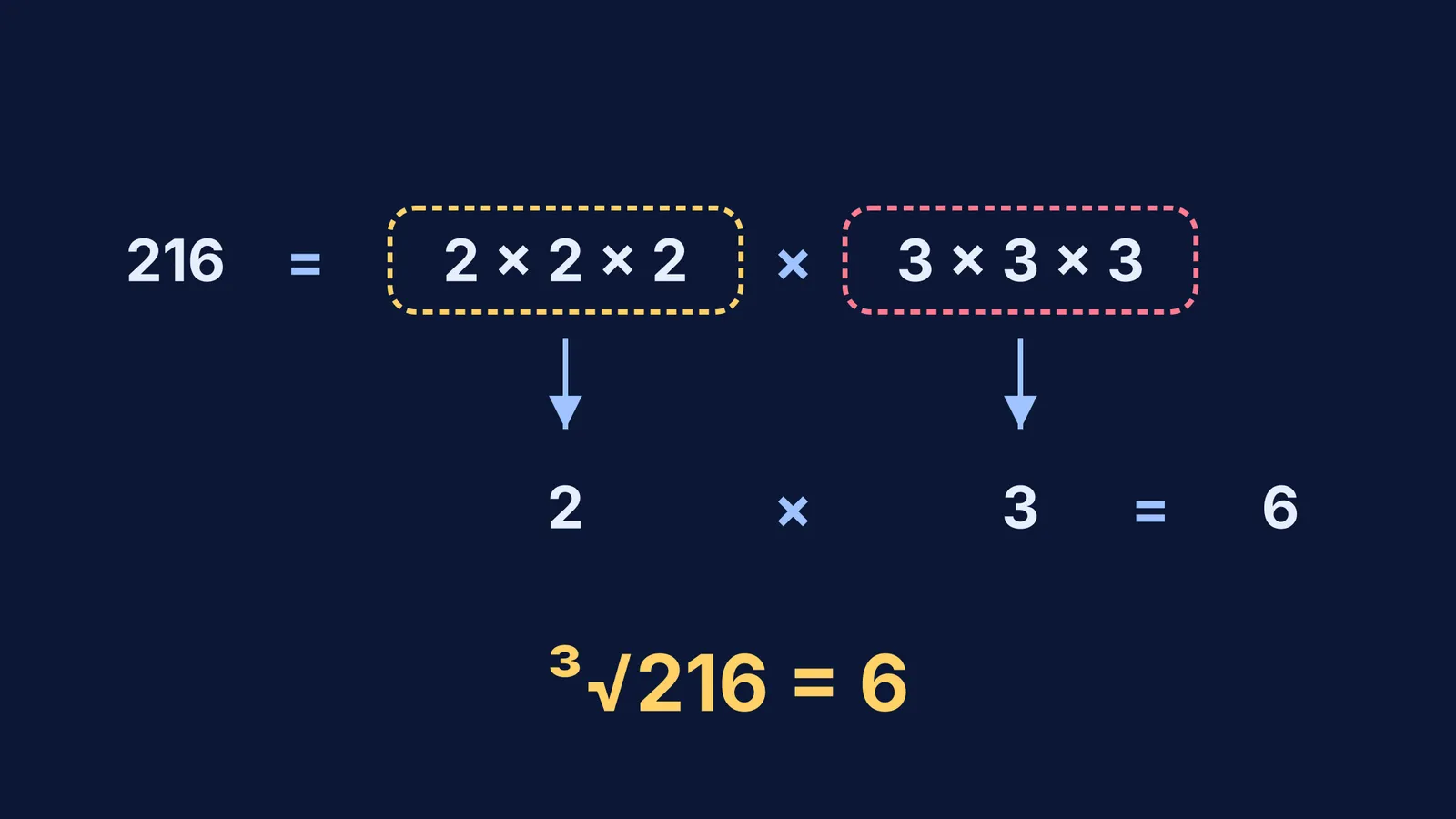
The prime factorisation of 216 is 2 × 2 × 2 × 3 × 3 × 3.
Now, group identical primes in sets of three: (2 × 2 × 2) × (3 × 3 × 3)
Take one number from each group to find the root: 2 × 3 = 6
Therefore, the cube root of 216 is 6.
What is the smallest multiplier to make a perfect cube?
When a number is not a perfect cube, its prime factorisation will have incomplete groups. The smallest multiplier is the exact number of prime factors you need to add to turn those leftovers into full triplets.
Consider the number 1080. First, find its prime factorisation by dividing repeatedly by primes: 1080 = 2 × 2 × 2 × 3 × 3 × 3 × 5
Grouping the identical primes gives: (2 × 2 × 2) × (3 × 3 × 3) × 5
The 2s and the 3s form complete groups of three, but the 5 stands alone. To make this entire expression a perfect cube, the lonely 5 needs two more 5s to become a full group of (5 × 5 × 5).
So, you multiply the number by 5 × 5, which is 25.
1080 × 25 = 27000. The prime factorisation of 27000 is (2 × 2 × 2) × (3 × 3 × 3) × (5 × 5 × 5), which gives a cube root of 2 × 3 × 5 = 30. The smallest multiplier to make 1080 a perfect cube is 25.
What is the smallest divisor to make a perfect cube?
Finding the smallest divisor takes the opposite approach. Instead of adding missing factors to complete a group, you divide the number by the incomplete group to remove it entirely.
Let's look at the same number, 1080: (2 × 2 × 2) × (3 × 3 × 3) × 5
The single 5 prevents the number from being a perfect cube. If you divide 1080 by 5, you strip away that leftover factor.
1080 ÷ 5 = 216. We already know from the first example that 216 has the prime factorisation (2 × 2 × 2) × (3 × 3 × 3) and a cube root of 6. Therefore, the smallest divisor to make 1080 a perfect cube is 5.
If you are dealing with a much larger number and get stuck figuring out which factors to tackle first, Fermi's AI tutor can work out what you already know and build a plan for the session, so you sit down to a clear next step.
The triplet framework for roots
To standardise how you approach these problems, apply this quick three-step framework. It removes the need for guessing and ensures you always find the correct multiplier or divisor.
Break it down: Write the number entirely in prime factors using systematic division. Start with 2, then try 3, 5, 7, and 11. (For more on identifying these factors quickly, read about the number of divisors and their sum).
Circle the threes: Physically group identical prime numbers into triplets. Draw brackets or circles around them on your paper.
Decide your path based on the leftovers:
Find the root: If all factors group perfectly, multiply one prime from each group.
Find the multiplier: If a group is short, multiply by whatever is missing to reach three of a kind. (See more examples in Cubes and cube roots in Class 8).
Find the divisor: To clear the incomplete groups, divide by exactly those leftover numbers.


