

On this page
Cube roots feel harder than square roots, mostly because students try to reuse the square-root method without changing it. The fix is one word: triplets, not pairs. This guide covers what makes a number a perfect cube, how to find cube roots by factors and by estimation, the 1729 story, and the mistakes examiners look for.
Where is this topic in the 2026-27 NCERT books?
Cubes are the second half of Ganita Prakash Grade 8 Part I, Chapter 1, "A Square and A Cube", section 1.2, "Cubic Numbers". The older Class 8 chapter "Cubes and Cube Roots" covered the same ideas. If you have not yet done squares, start with our guide to squares and square roots in Class 8; the methods mirror each other.
What is a perfect cube?
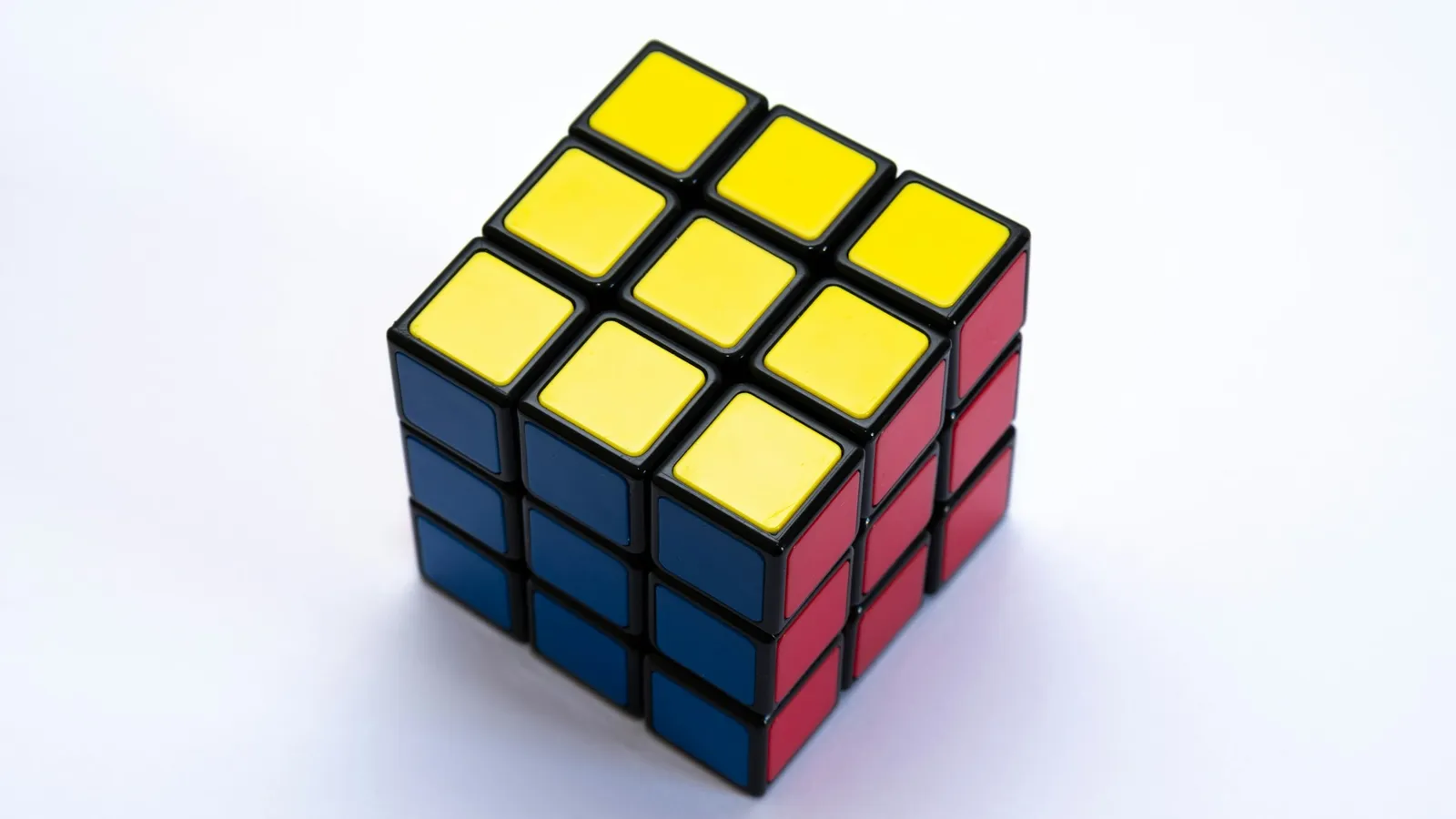
Ganita Prakash starts with blocks. A cube of side 2 units is built from 2 × 2 × 2 = 8 unit cubes; a cube of side 4 has four layers of 4 × 4 = 16, so 64 unit cubes in all. The numbers 1, 8, 27, 64, 125 and so on are perfect cubes, written n³. Numbers between them, such as 9 to 26, are not cubes.
You can cube fractions, decimals and negatives too. The book's examples: (−6)³ = −216 and (4/6)³ = 64/216. Note the sign: a negative number cubed stays negative, unlike a square.
What patterns do cubes follow?
Last digits. Squares can only end in 0, 1, 4, 5, 6 or 9. Cubes can end in any digit. Each last digit of a number fixes the last digit of its cube:
1 → 1, 4 → 4, 5 → 5, 6 → 6, 9 → 9, 0 → 0 (unchanged)
2 → 8 and 8 → 2
3 → 7 and 7 → 3
This table is what makes cube roots of perfect cubes quick to estimate.
Odd numbers. Ganita Prakash shows another pattern: 1 = 1³, 3 + 5 = 2³, 7 + 9 + 11 = 3³, 13 + 15 + 17 + 19 = 4³. The nth cube is the sum of n consecutive odd numbers.
Taxicab numbers. The chapter tells the story of G. H. Hardy visiting Srinivasa Ramanujan in hospital in a taxi numbered 1729, and Ramanujan's reply that it is the smallest number expressible as a sum of two cubes in two different ways:
1729 = 1³ + 12³ = 1 + 1728 1729 = 9³ + 10³ = 729 + 1000
The book asks you to find the two ways for the next one, 4104. Answer: 2³ + 16³ = 8 + 4096, and 9³ + 15³ = 729 + 3375.
How do you find a cube root? Worked examples
By prime factors. The book shows 3375 = 3 × 3 × 3 × 5 × 5 × 5 = (3 × 5)³, so ∛3375 = 15, and 500 = 2 × 2 × 5 × 5 × 5, which is not a cube because the 2s do not make a triplet.
Example 1: find ∛2744. 2744 = 2 × 2 × 2 × 7 × 7 × 7. Two triplets: (2 × 2 × 2) and (7 × 7 × 7). ∛2744 = 2 × 7 = 14. Check: 14 × 14 × 14 = 196 × 14 = 2744.
Example 2: what is the smallest number you must multiply 1323 by to get a perfect cube? 1323 = 3 × 3 × 3 × 7 × 7. The 3s make a triplet; the 7s need one more 7. 1323 × 7 = 9261 = (3 × 7)³ = 21³. And to divide instead: 1323 ÷ 49 = 27 = 3³, so the smallest divisor is 49.
By estimation (for perfect cubes). Find ∛17576.
Step 1: the last digit is 6, so the root ends in 6. Step 2: drop the last three digits, leaving 17. Since 2³ = 8 and 3³ = 27, 17 lies between them, so the tens digit is 2. So ∛17576 = 26. Check: 26 × 26 = 676, and 676 × 26 = 17576.
This only works when you already know the number is a perfect cube.
What mistakes should you avoid?
Grouping in pairs. Students write ∛2744 = 2 × 2 × 7 × 7 by habit from square roots.
Losing the sign. ∛(−27) = −3, because (−3)³ = −27. Cube roots of negative numbers exist; square roots of negatives do not, among real numbers.
Confusing 2³ with 2 × 3. 2³ = 8, not 6.
Misreading the last-digit table. Remember the swaps: 2 and 8, 3 and 7.
Mixing units in volume problems. A cube of side 3 cm has volume 27 cm³, not 27 cm.
How should you practise?
Trying a problem before you study the method can help, even if you fail. In Richland, Kornell and Kao (2009), people who were tested on questions before reading a passage did better on a later test than those who simply studied longer, even for questions they had answered wrongly at first. So attempt the estimation method on a new cube before rereading the steps.
Learn cubes 1 to 20. Write them out on the first day, then test yourself on a few each day.
One factor problem a day: alternate "find the cube root" with "smallest multiplier or divisor".
One estimate a day: take a number from your list of cubes up to 20³ and find its root from the last digit and the leading digits.
Link to powers: cubes are a special case of exponents; our post on exponents and powers in Class 8 takes the next step.
If you keep making errors in the factor tree, the Fermi Problem Library has a step-by-step solver that explains the reasoning rather than printing an answer.
Before bed, find ∛13824 by estimation, then confirm it by prime factors.


