

On this page
When you split a bill, mix ingredients for a recipe, or dissolve a chemical in a solvent, you are working with ratios. A ratio is a way of comparing two quantities of the same kind by division.
Often, you know the total amount and the ratio, but you need to find the individual shares. Whether you are splitting an inheritance or working with fractions in Class 7, the most reliable way to solve these problems is the unitary method: finding the value of a single part first.
How do you divide an amount in a given ratio?
The simplest way to divide an amount in a given ratio is the three-step "Add, Divide, Multiply" method. This relies on the unitary method, which NCERT textbooks introduce as finding the value of one unit before finding the value of many.
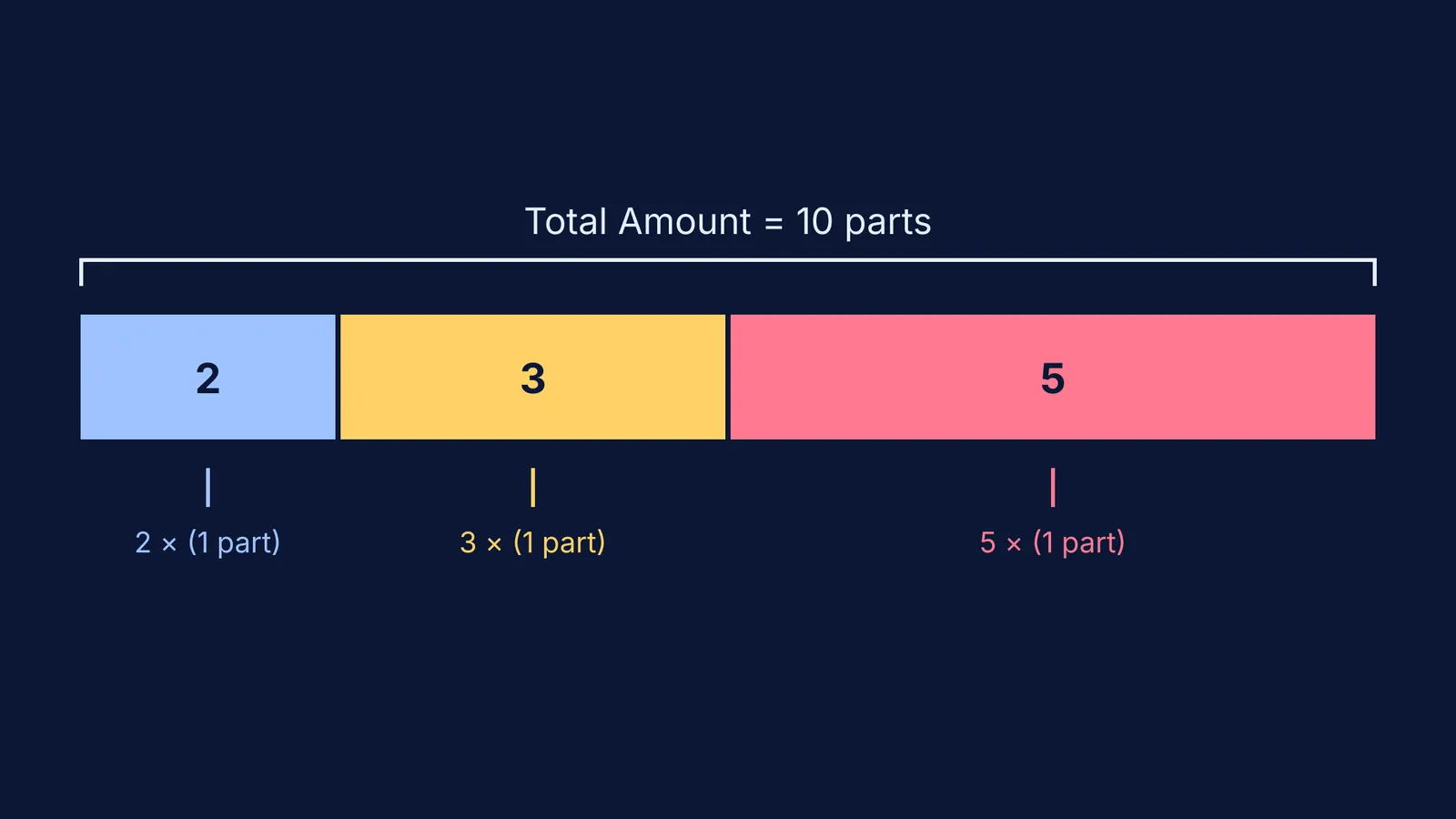
Add the numbers in the ratio together. This gives you the total number of parts the amount is being split into.
Divide the total amount by the total number of parts. This tells you exactly what one single part is worth.
Multiply this single part's value by each number in the original ratio to find the final shares.
How do you divide an amount in the ratio 2:3:5?
If a problem asks you to divide an amount in the ratio 2:3:5, it means the first share gets 2 parts, the second gets 3 parts, and the third gets 5 parts.
Let us say you need to divide ₹500 in the ratio 2:3:5.
Step 1: Add the parts. 2 + 3 + 5 = 10 parts in total.
Step 2: Find the value of one part. Divide the total amount (₹500) by the total parts (10). ₹500 ÷ 10 = ₹50. So, one part is worth ₹50.
Step 3: Multiply to find the shares. First share: 2 parts × ₹50 = ₹100. Second share: 3 parts × ₹50 = ₹150. Third share: 5 parts × ₹50 = ₹250.
To check your work, add them up: 100 + 150 + 250 = 500. The math is correct. This foundational logic helps build an introduction to trigonometry in Class 10, where trigonometric ratios define the shape of right-angled triangles.
What if the difference between shares is given?
Examiners often set a trap: instead of giving you the total amount, they give you the difference between two shares.
For example: *Alice and Bob share prize money in the ratio 3:7. Bob receives ₹280 more than Alice. How much do they each receive?*
Do not divide ₹280 by 10. The ₹280 is not the total; it is the difference. You must adjust the three steps to work with differences instead of totals.
Find the difference in parts. The ratio is 3:7. Bob has 7 parts and Alice has 3 parts. 7 - 3 = 4 parts. Bob has 4 parts more than Alice.
Find the value of one part. Since those 4 extra parts equal the ₹280 difference, divide the money difference by the part difference. ₹280 ÷ 4 = ₹70. One part is worth ₹70.
Multiply to find the shares. Alice gets 3 parts × ₹70 = ₹210, and Bob gets 7 parts × ₹70 = ₹490.
Check the answer: ₹490 - ₹210 = ₹280. Bob indeed has ₹280 more than Alice. Once you know the value of one part, you can also find the total prize money by multiplying the total parts (10) by the value of one part (₹70), which is ₹700.
Breaking down complex word problems
Word problems can hide ratio questions behind phrases like "fewer than", "larger than", or "ratio of girls to boys". Building an intuition for what "one part" represents is crucial, because mastering fractions and division by age 10 strongly predicts later mathematics achievement in high school. In a 2012 study, researchers found that this understanding uniquely predicted later success in algebra, as fractions and division predict later maths.
If you find yourself stuck translating a word problem into these steps, the Fermi Concept Library maps out how ratios connect to broader mathematical ideas. When you need to practise applying the steps, the Fermi Problem Library has worked problems with a step-by-step solver that explains the reasoning rather than printing an answer. By focusing on the value of a single part, you ensure that no matter how the problem is phrased, you can always work your way back to the solution.


